

Commentary
- +1
Paul Haenle, Xue Gong, Ngeow Chow Bing, …
{
  "authors": [
    "Paul Haenle"
  ],
  "type": "legacyinthemedia",
  "centerAffiliationAll": "",
  "centers": [
    "Carnegie Endowment for International Peace",
    "Carnegie China"
  ],
  "collections": [],
  "englishNewsletterAll": "",
  "nonEnglishNewsletterAll": "",
  "primaryCenter": "Carnegie China",
  "programAffiliation": "",
  "programs": [],
  "projects": [],
  "regions": [
    "North America",
    "United States",
    "East Asia",
    "North Korea",
    "South Korea",
    "China"
  ],
  "topics": [
    "Security",
    "Military",
    "Arms Control",
    "Foreign Policy",
    "Nuclear Policy"
  ]
}
Source: Getty
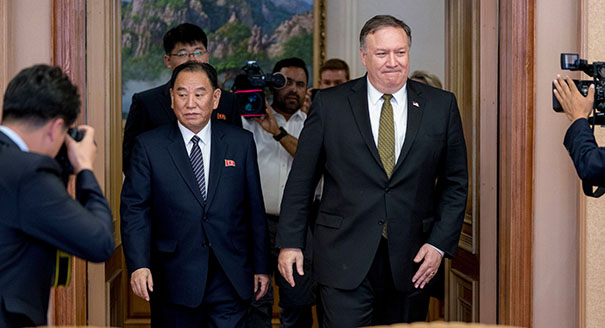
For the visit to be a success, Pompeo should leave Pyongyang with specific details on the North Korean nuclear inventory, concrete next steps and a timeline which shows Kim is earnest in denuclearizing, and an agreement on how verification of any of the aforementioned objectives will happen.
Source: China Review News Agency
During an interview on Face the Nation this past weekend, National Security Advisor John Bolton said: “With North Korean cooperation with full disclosure of all of their chemical and biological nuclear programs ballistic missile sites…we would be able to dismantle the overwhelming bulk of their programs within a year.” This seems very unrealistic and contradicts recent statements by Trump administration officials that major steps on denuclearization could be realized by the end of Trump’s first term in office. Secretary Pompeo’s statement last week that he is “not going to put a timeline on it,” is perhaps the most realistic, and reflects the lack of substantive conversation on the process for verifiable denuclearization during and since the Singapore summit.
It was no surprise to see the reports this past weekend by The Wall Street Journal and 38North that North Korea had advanced construction at a missile production facility for medium-range solid fuel missiles in May and June. A Diplomat article cited reports from the U.S. National Air and Space Intelligence Center that North Korea has continued production of launch vehicles and support equipment for its medium-range missiles. Furthermore, U.S. intelligence officials said they believe Kim is taking steps to conceal its nuclear facilities and capabilities and has more than one secret nuclear development site. These developments contradict North Korean commitments to denuclearize. They underscore concerns that President Trump declared victory in Singapore for domestic political purposes without securing significant concessions or verifiable commitments from the North. Securing a North Korean commitment to stop production, development, or research will require prolonged additional negotiations, and it is unclear what leverage the United States still holds with the Singapore summit in the past.
Beyond building his nuclear and missile inventory, Kim is also using momentum from Panmunjom and Singapore to lessen economic pressure. Some reports indicate that Beijing may be willing to relax economic pressure on the North outside of the UN framework in order to encourage Kim to adopt economic reforms similar to those China has undertaken. Indeed, during Kim’s latest meeting with Xi, Kim is reported to have asked China to help lift economic sanctions. China also continues to try to promote its model of reform and opening through site visits during Kim’s multiple recent trips to China. In addition, on July 1, Kim traveled to the Hwanggumpyong Exclusive Industrial Zone co-developed with China, another reminder of the economic potential between the two countries.
Secretary Pompeo will travel to North Korea this week, and the outcomes of his discussions will be the best indications yet of whether actual progress towards denuclearization is possible. There is much to be discussed, but for the visit to be a success, he should leave Pyongyang with specific details on the North Korean nuclear inventory, concrete next steps and a timeline which shows Kim is earnest in denuclearizing, and an agreement on how verification of the aforementioned objectives will happen. Reports that Pompeo has solicited a series of proposals on how denuclearization might occur are positive indications that he hopes to achieve the above and leave Pyongyang having made real progress. However, the same concerns voiced ahead of Trump’s meeting in Singapore remain, and it would be a major disappointment if he secures nothing further than the vague language to “work towards” denuclearization of the Korean Peninsula. If now is to really be any different from before, real specifics are needed.
This article was originally published in Chinese by China Review News Agency.

Former Maurice R. Greenberg Director’s Chair, Carnegie China
Paul Haenle held the Maurice R. Greenberg Director’s Chair at the Carnegie Endowment for International Peace and is a visiting senior research fellow at the East Asian Institute, National University of Singapore. He served as the White House China director on the National Security Council staffs of former presidents George W. Bush and Barack Obama.
Recent Work


Paul Haenle, Xue Gong, Ngeow Chow Bing, …

Paul Haenle, Chong Ja Ian
Carnegie does not take institutional positions on public policy issues; the views represented herein are those of the author(s) and do not necessarily reflect the views of Carnegie, its staff, or its trustees.

Germany's sometimes ambiguous nuclear policy advocates nuclear weapons for deterrence purposes but at the same time adheres to non-proliferation. This dichotomy can turn into a formidable dilemma and increase proliferation pressures in Berlin once no nuclear protector is around anymore, a scenario that has become more realistic in recent years.
Ulrich Kühn

In an interview, Hassan Mneimneh discusses the ongoing conflict and the myriad miscalculations characterizing it.

Michael Young
Domestic mobilization, personalized leadership, and nationalism have reshaped India’s global behavior.

Sandra Destradi
In an interview, Nicole Grajewski discusses the military dimension of the U.S. and Israeli attacks on Iran.
Michael Young
European reactions to the war in Iran have lost sight of wider political dynamics. The EU must position itself for the next phase of the crisis without giving up on its principles.

Richard Youngs