

Research
- +11
Frances Z. Brown, Nate Reynolds, Priyal Singh, …
{
  "authors": [
    "Frances Z. Brown"
  ],
  "type": "legacyinthemedia",
  "centerAffiliationAll": "dc",
  "centers": [
    "Carnegie Endowment for International Peace",
    "Malcolm H. Kerr Carnegie Middle East Center"
  ],
  "collections": [
    "Violence and Conflict"
  ],
  "englishNewsletterAll": "democracy",
  "nonEnglishNewsletterAll": "",
  "primaryCenter": "Carnegie Endowment for International Peace",
  "programAffiliation": "DCG",
  "programs": [
    "Democracy, Conflict, and Governance"
  ],
  "projects": [],
  "regions": [
    "Middle East",
    "Syria",
    "Levant"
  ],
  "topics": [
    "Political Reform",
    "Democracy",
    "Foreign Policy"
  ]
}
Source: Getty
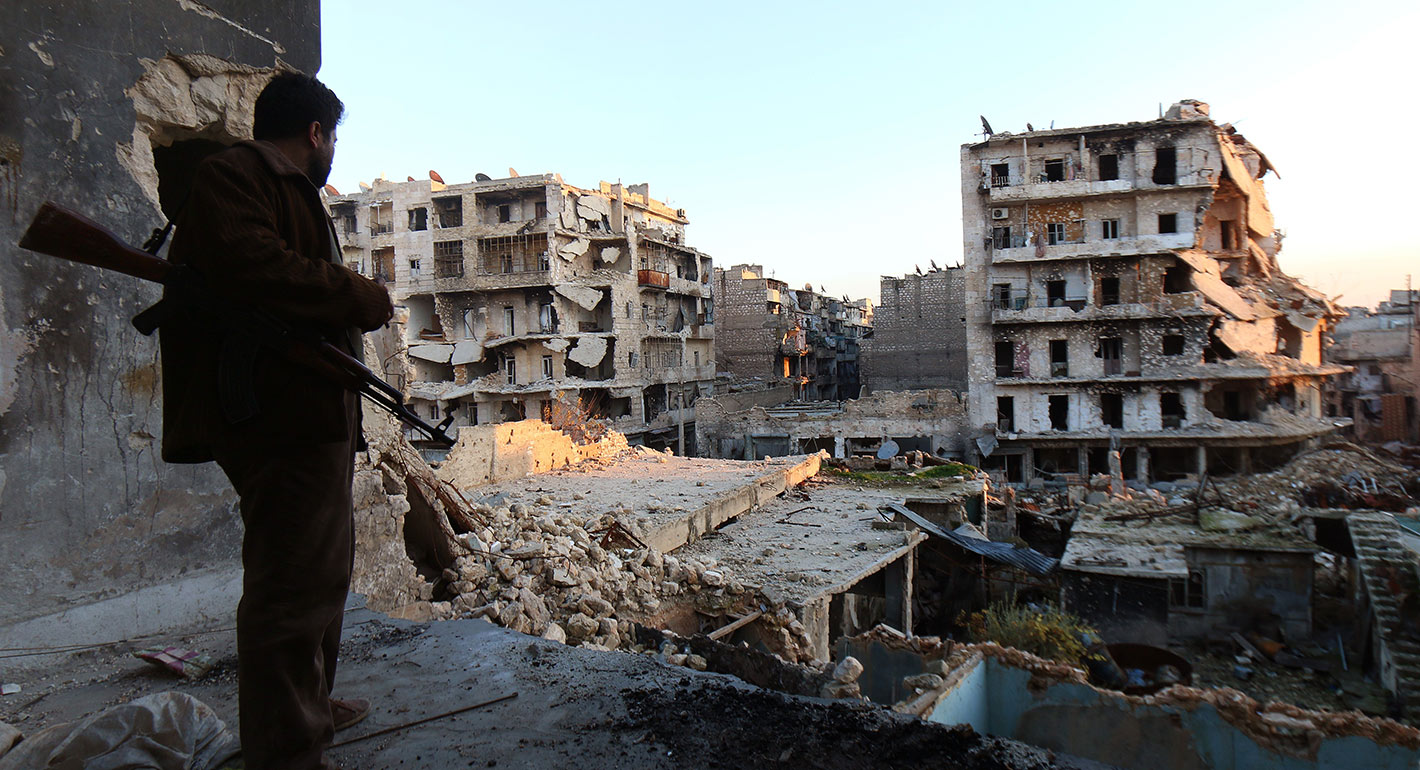
Stabilization programs in Syria long outlived their original political rationale, but bureaucratic factors, analytic biases, and an imperative to deliver services kept them going.
Source: Washington Post
For most of the Syrian war, the United States and Western partners have supported opposition local councils in their efforts to provide a viable alternative to President Bashar al-Assad’s regime. Yet Syria’s military realities have gradually overshadowed attempts to empower more democratic, inclusive local governance.
In Idlib, a fragile cease-fire is all that protects 3 million civilians from a Russian and Syrian government onslaught. Armed extremist groups rule much of the area, and last month a prominent moderate activist was assassinated there. Meanwhile, in southwest Syria, the Assad regime has brutally consolidated its rule — a marked deterioration from earlier this year, when the region was heralded for its promising opposition governance.
As the conflict has dragged on, it has become tragically clear that externally supported armed actors, not grass-roots civilian activists, shape strategic outcomes in Syria. Meanwhile, high-level U.S. policy choices — especially the 2014 decision to prioritize the fight against the Islamic State — cast doubt on the U.S. commitment to these stabilization programs’ counter-Assad governance objectives.
Why then did the United States continue to support opposition local council programs for most of the Syrian war — to the tune of more than $875 million in total — despite their increasingly marginal impact on strategic outcomes? And why did policymakers perpetuate these local programs when they were not aligned with high-level U.S. policy decisions? My recent research finds five key explanations.
First, Washington’s information environment led to an overemphasis on compelling — but not necessarily generalizable — local success stories rather than broader trends. Even as the regime and armed groups wiped out an increasing number of moderate local councils, biases in the way the U.S. government processed information led some policymakers to overly focus on the few success cases.
When reporting to the White House or to purse-string-holders in Congress, officials often felt pressure to provide impressive examples of progress. One field-based staffer recalled that he was asked to report on program effectiveness only when “some DAS [deputy assistant secretary of state] was headed into a meeting at the White House and needed some colorful good-news story from the field.” (Like other staffers and officials interviewed, the staffer spoke on the condition of anonymity given the sensitivity of the programs and concerns about safety.)
Reporting on an increasingly small number of success cases obfuscated that there were many more areas where programs could no longer operate. Given the heavily networked nature of the conflict, local activists were also a salient part of this equation: As scholar Marc Lynch has noted, Western journalists depended on social-media-savvy activists for information, “thus acting as megaphones for one side of a complex war.”
Invested activists and practitioners also repeatedly saw the potential for U.S.-Syria policy to turn a corner, finding reason to hope that the United States was on the verge of shifting toward stronger military intervention — for example, in 2013, when Assad crossed the “red line” against chemical weapons use.
Even after the Trump administration took office, its mixed messaging on Syria proved as open for interpretation as a Rorschach inkblot. Amid all the noise, contradictions and airstrikes, advocates could find some material to support their hopes for a more interventionist policy — and by extension, for their hopes for the future of opposition local councils.
On the ground, stabilization-program managers faced confusion as they juggled the often-competing policy objectives of fighting Assad and countering the Islamic State. But for policymakers in the Situation Room or for legislators on Capitol Hill, the tensions confronting practitioners were less pertinent. Senior officials managing the big picture — including the risk of military confrontation with Russia — unsurprisingly lacked the bandwidth to interrogate details of local programs.
The U.S. government’s own organization also undermined connections between high-level politics and local perspectives. The bureaucratic actors who led policy decision-making and diplomatic negotiation efforts were generally different from those overseeing local stabilization programs.
Furthermore, many senior U.S. officials felt the urge to “do something” on Syria — and continuing stabilization programs was a relatively easy choice in an otherwise deeply contested policy environment. Conversely, to stop local political assistance would have seemed defeatist and undermined the (still official) policy stance that “Assad must go.”
A fragmented aid apparatus also explains stabilization programs’ persistence. Rather than coordinating from a single geographic hub, donor and implementer offices were arrayed across multiple cities in neighboring countries, often interfacing directly with local councils. Thus it became difficult to assess whether these efforts were, in aggregate, achieving their overarching goals.
Competition among the multiple agencies also intensified the pressure to report success stories. As one former official recalled, “Every quarter, each of the U.S. government operating units was in an existential fight to demonstrate that their stuff was the most relevant on the ground.
Yet even as the goal of establishing a political alternative to Assad’s rule grew increasingly unrealistic, local councils continued to play a crucial role in providing much-needed services to besieged populations. Stabilization programs were often the best means to deliver aid in an inclusive, efficient fashion.
For many observers, this was plenty to justify continuing the programs — regardless of whether their initial political goals were viable. As one longtime official recounted, after the 2015 Russian intervention made Assad’s fall unlikely, “I wanted to be honest that we really had one country-level objective: Make life less sh—y for Syrians.”
Similarly, many Western donors maintained that supporting inclusive, democratic opposition councils in their stand against the brutal Assad regime was simply the right thing to do. Even when it appeared increasingly likely that the regime would ultimately prevail, some officials argued that they should “stick with local councils until the end.”
Most Syrian stabilization programs have ended as the regime has expanded its control; some have relocated to eastern Syria with the protection of Kurdish-led and American forces. These projects, aligned with the current security context, may offer a chance to salvage a marginally better outcome for U.S. interests and Syrian civilians.
But the broader track record of Syrian stabilization is bleak — and Syria will probably not be the last place where local civilian U.S. assistance programs are engulfed by a dramatically deteriorating strategic conflict environment. If policymakers are to accurately diagnose the prospects of such programs, they will need to grapple with the factors that have clouded their vision in the past.
This article was originally published in the Washington Post.

Vice President for Studies
Dr. Frances Z. Brown is a vice president for studies at the Carnegie Endowment for International Peace. Brown served on the White House National Security Council (NSC) staff over the past three presidential administrations. Her research focuses on U.S. foreign policy, Africa, the Middle East, and governance.
Recent Work
Frances Z. Brown, Nate Reynolds, Priyal Singh, …
Saskia Brechenmacher, Frances Z. Brown
Carnegie does not take institutional positions on public policy issues; the views represented herein are those of the author(s) and do not necessarily reflect the views of Carnegie, its staff, or its trustees.

Before the next wave of EU enlargement takes place, the union needs to grapple with thorny questions of how power is distributed among its members.


Emil Sondaj Hansen, Ditte Brasso Sørensen
The real test may come after the leaders leave the room.



Sheena Chestnut Greitens, Oriana Skylar Mastro, Yukon Huang, …

The Horn of Africa countries are among those facing a new security calculus.


Andrew Leber, Lesley Anne Warner

The European far right might fail to steer EU policy in the direction Russia wants, but they will create enough chaos inside Europe to benefit the Kremlin.

Dimitar Bechev

The new U.S.–Denmark–Greenland agreement will help Washington exert political, economic, and financial dominance under the guise of security. Yet, it acknowledged Copenhagen’s and Nuuk’s sovereignty on the island.

Marc Pierini