

Commentary
Jamie Kwong, Toby Dalton
{
  "authors": [
    "Toby Dalton"
  ],
  "type": "legacyinthemedia",
  "centerAffiliationAll": "dc",
  "centers": [
    "Carnegie Endowment for International Peace"
  ],
  "collections": [
    "U.S. Nuclear Policy",
    "Korean Peninsula"
  ],
  "englishNewsletterAll": "ctw",
  "nonEnglishNewsletterAll": "",
  "primaryCenter": "Carnegie Endowment for International Peace",
  "programAffiliation": "NPP",
  "programs": [
    "Nuclear Policy"
  ],
  "projects": [],
  "regions": [
    "North America",
    "United States",
    "East Asia",
    "North Korea"
  ],
  "topics": [
    "Security",
    "Foreign Policy",
    "Nuclear Policy",
    "Arms Control"
  ]
}
Source: Getty
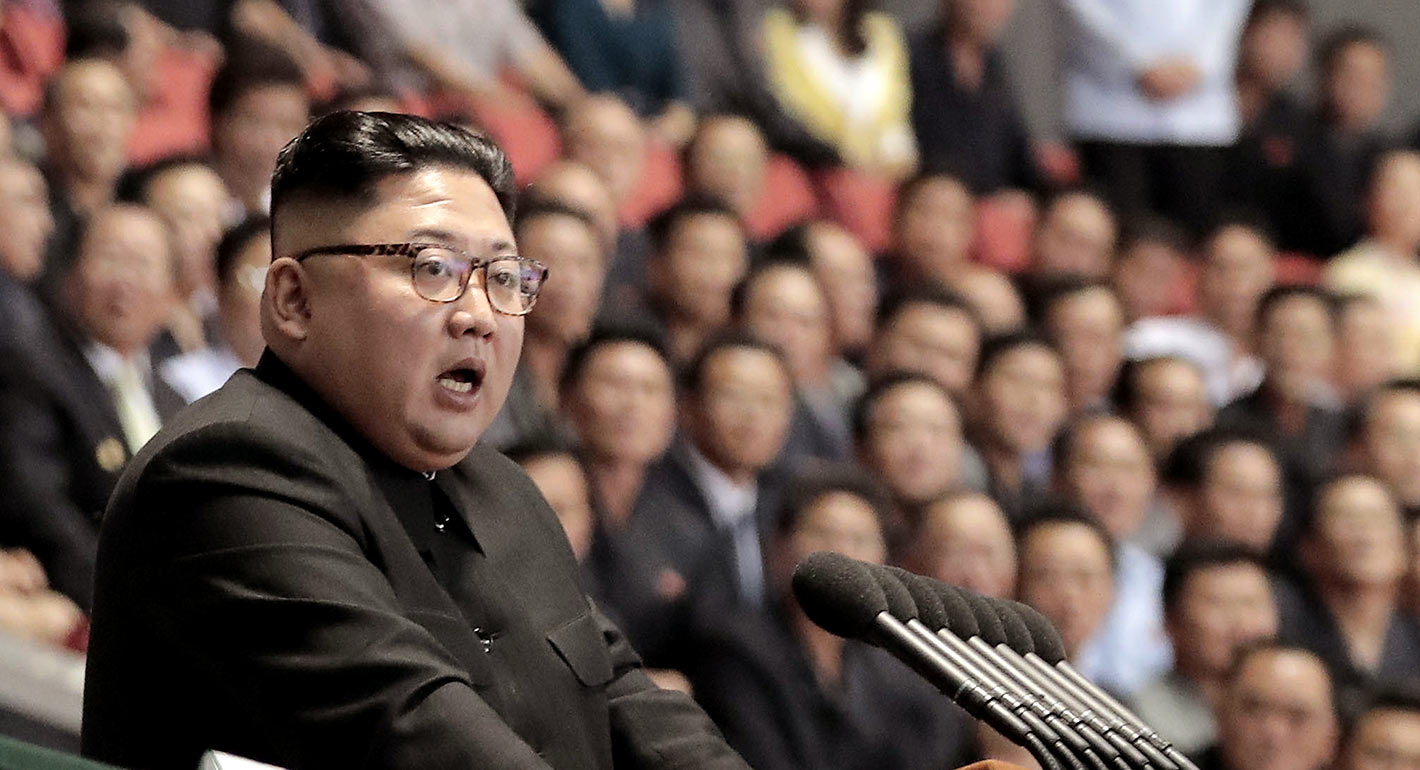
Kim Jong-un is prone to making bombastic threats and boasts. But it would be unwise to dismiss the North Korean leader’s words as mere hot air.
Is North Korean Supreme Leader Kim Jong-un a man of his word when it comes to nuclear weapons? The prevailing wisdom in Washington is that he will lie and cheat on any promises he makes. But lately Kim has been making good on his public commitments, both negative and positive. The big question heading into 2019 is whether the United States and North Korea can agree on a next step that will sustain diplomacy. The answer may well come from Kim himself when he gives his annual New Year’s address on January 1.
Kim’s words matter, both at home and abroad. Although he doesn’t have to worry about a future election, he clearly is sensitive to perceived domestic threats to his regime and the level of support for his rule among military and political elites. Accordingly, he has been very careful to make promises he thinks he can keep.
In this sense, Kim’s words send signals that may be more costly to him than physical actions, such as closing a missile test site. His words aren’t absolutely binding, of course. But unlike an easily reversed freeze on activities at a remote nuclear site hidden from public view, his words create public expectations among key constituencies that, if broken, could have repercussions.
Kim made major announcements about his country’s nuclear plans in each of his last two New Year’s addresses. In 2017, he declared that North Korea had “entered the final stage of preparation for the test launch of [an] intercontinental ballistic missile.” Lo and behold, three intercontinental-range missile tests followed before the year was out.
In January 2018, Kim affirmed “the accomplishment of the great, historic cause of perfecting the national nuclear forces,” as well as his desire to send North Korean athletes to compete in the Pyeongchang Winter Olympics in South Korea. Unified Korean teams competed in the Olympics, and Kim subsequently declared an end to the testing of nuclear weapons and missiles and shut down North Korea’s nuclear test site. These actions laid the foundation for a corresponding freeze in U.S.–South Korean military exercises and an unprecedented round of summitry between Kim and other regional leaders.
Kim is also sticking to a more worrying pledge from his 2018 New Year’s speech, in which he said, “The nuclear weapons research sector and the rocket industry should mass-produce nuclear warheads and ballistic missiles.” By all accounts, even as peaceful diplomacy proceeds, North Korea continues to produce more nuclear weapons and to build new military bases to house them, as several recent reports highlighted.
At the same time, Kim is making good on several important confidence-building measures that he and South Korean President Moon Jae-in agreed to at their September 2018 summit in Panmunjom. These commitments included removing mines from and destroying guard posts in the demilitarized zone that divides the two Koreas, steps that were carried out and accompanied by on-site inspections.
Kim’s public pronouncements on nuclear and security issues over the last few years are also noteworthy for what he did not say. He avoided making specific commitments to the denuclearization of North Korea, let alone clarifying what that might look like. Clearly he is exercising extreme caution, given the uncertainty of diplomacy and the importance given to nuclear weapons in North Korean rhetoric.
As U.S. President Donald Trump and his administration contemplate the prerequisites to a second summit with Kim, the latter’s 2019 New Year’s address could contain some clues about his intentions. The most meaningful announcement he could make would be the successful completion of the mass production of nuclear weapons and a voluntary halt to North Korea’s bomb production, including fissile material, warheads, missiles, and missile transport vehicles.
If Kim were to make a public vow to undertake a comprehensive nuclear freeze, that would signal for the first time a commitment to restraining and ultimately reversing the country’s nuclear program. Such a pledge would also show sincerity toward the inter-Korean peace process because, at a certain point, it is illogical for South Korea to continue to negotiate peace while North Korea makes more bombs.
The likelihood of Kim going this far in his New Year’s speech is admittedly low. But whatever he says should carry weight in Washington, given his recent record of carrying out his commitments. And if he signals further nuclear restraint, that signal should merit a reciprocal U.S. statement, such as an announcement of willingness to consider some limited sanctions exemptions or other meaningful steps.
Analysts are right to be wary of North Korea’s nuclear commitments, given the history of failed efforts to reverse Pyongyang’s weapons program. This makes identifying realistic and acceptable next steps even harder. Immediate disarmament by North Korea is the ideal goal, but there is zero chance that will happen. A more pragmatic path at this stage could start with a credible signal that Kim is willing to stem the unconstrained growth of North Korea’s arsenal. If an action-for-action approach proves difficult, then maybe Pyongyang and Washington should instead focus on a words-for-words mentality to push through this impasse and keep diplomacy alive in 2019.

Senior Fellow and Co-director, Nuclear Policy Program
Toby Dalton is a senior fellow and co-director of the Nuclear Policy Program at the Carnegie Endowment. An expert on nonproliferation and nuclear energy, his work addresses regional security challenges and the evolution of the global nuclear order.
Recent Work

Jamie Kwong, Toby Dalton
Ariel (Eli) Levite, Toby Dalton
Carnegie does not take institutional positions on public policy issues; the views represented herein are those of the author(s) and do not necessarily reflect the views of Carnegie, its staff, or its trustees.

Trump has promised Belarus a massive potash deal. But Minsk is seeking something greater: restored Western transit and greater room for maneuver from Russia.

Balázs Jarábik
The real test may come after the leaders leave the room.



Sheena Chestnut Greitens, Oriana Skylar Mastro, Yukon Huang, …
The Horn of Africa countries are among those facing a new security calculus.


Andrew Leber, Lesley Anne Warner

The European far right might fail to steer EU policy in the direction Russia wants, but they will create enough chaos inside Europe to benefit the Kremlin.

Dimitar Bechev

The new U.S.–Denmark–Greenland agreement will help Washington exert political, economic, and financial dominance under the guise of security. Yet, it acknowledged Copenhagen’s and Nuuk’s sovereignty on the island.

Marc Pierini