

Commentary
While the EU and European governments are embracing the much-lauded middle-power moment, this entails three difficult conundrums.
Richard Youngs
{
  "authors": [
    "Brett McGurk"
  ],
  "type": "legacyinthemedia",
  "centerAffiliationAll": "",
  "centers": [
    "Carnegie Endowment for International Peace"
  ],
  "collections": [],
  "englishNewsletterAll": "",
  "nonEnglishNewsletterAll": "",
  "primaryCenter": "Carnegie Endowment for International Peace",
  "programAffiliation": "",
  "programs": [],
  "projects": [],
  "regions": [
    "Middle East",
    "East Asia",
    "China"
  ],
  "topics": [
    "Political Reform",
    "Foreign Policy"
  ]
}
Source: Getty
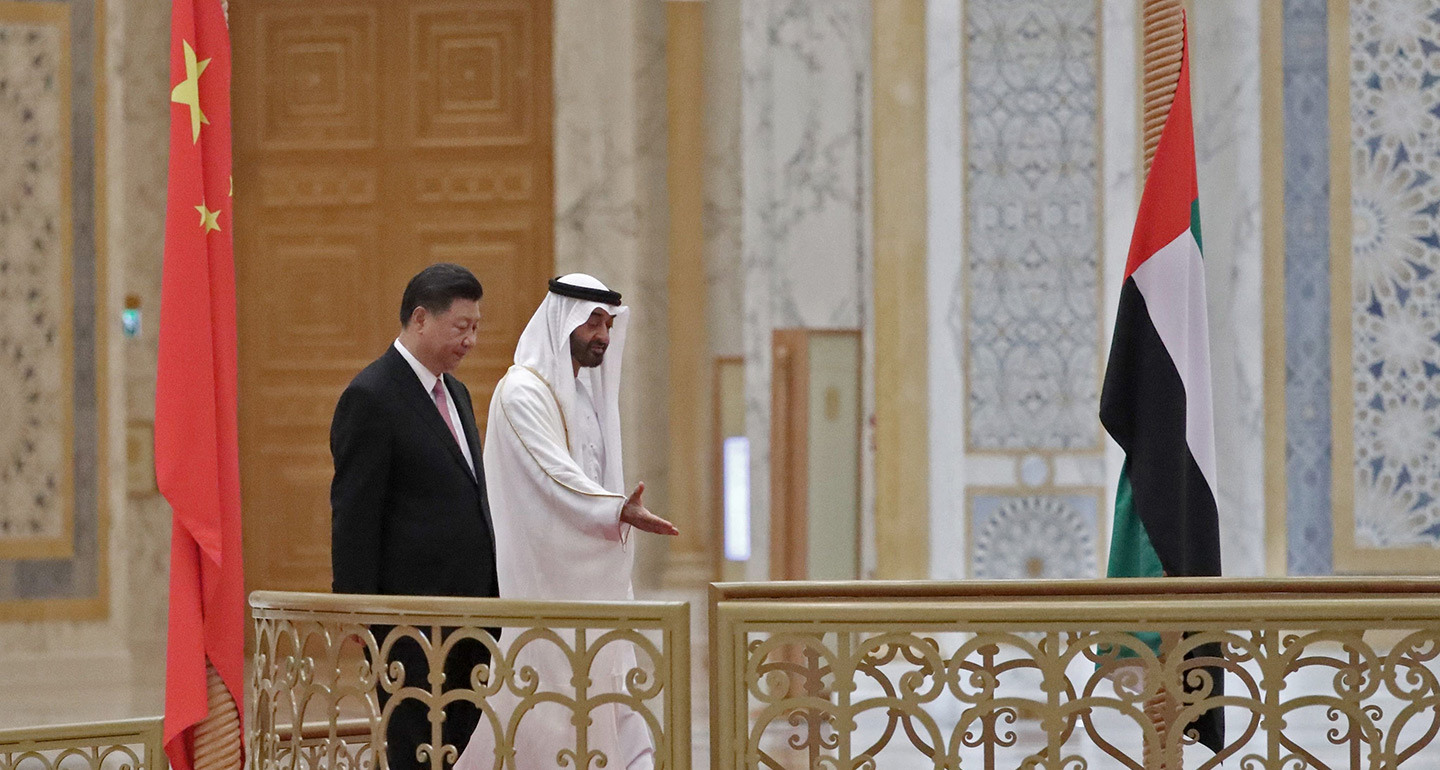
Beijing believes it can deepen relations with countries that are otherwise nearly at war with one another—all the while avoiding any significant role in the political affairs of the region.
Source: The Atlantic
China is making a risky bet in the Middle East. By focusing on economic development and adhering to the principle of noninterference in internal affairs, Beijing believes it can deepen relations with countries that are otherwise nearly at war with one another—all the while avoiding any significant role in the political affairs of the region. This is likely to prove naive, particularly if U.S. allies begin to stand up for their interests.
In meetings I attended earlier this month in Beijing on China’s position in the Middle East, sponsored by the Carnegie-Tsinghua Center, Chinese officials, academics, and business leaders expressed a common view that China can avoid political entanglement by promoting development from Tehran to Tel Aviv. China may soon find, however, that its purely transactional approach is unsustainable in this intractable region—placing its own investments at risk and opening new opportunities for the United States.
Over the past three years, China has charted an ambitious future in the Middle East by forging “comprehensive strategic partnerships” with Iran, the United Arab Emirates, Saudi Arabia, and Egypt. This is the highest level of diplomatic relations China can provide, and Beijing believes these four countries anchor a neutral position that will prove more stable over the long term than that of the United States. China has also made massive investments in infrastructure throughout the region, including in Israel, where China is now the second-largest trading partner behind the United States.
China’s interests in the Middle East are both structural and strategic. Structurally, China needs the natural resources of the region, whereas the United States—now the world’s largest oil producer—does not. China is also seeking new markets to absorb its excess industrial capacity, and sees the Middle East poised for growth after decades of wars, woeful infrastructure, and popular discontent. Strategically, together with Russia, China is taking advantage of the uncertainty produced by ever-shifting U.S. policies, including zero-sum prescriptions for Iran and Syria that are unlikely to produce desired outcomes anytime soon. Regional governments in turn have welcomed China’s embrace, and its offer of investment without pressure to politically reform or respect human rights.
China’s President Xi Jinping previewed this more assertive Middle East strategy in a landmark address in Cairo three years ago. There, he declared that China does not seek a “sphere of influence” in the region—even while sinking nearly $100 billion in investments there through ports, roads, and rail projects. He alleged China rejects “proxy” contests—even while concluding a strategic partnership with Iran, the main sponsor of proxies in the region. And he warned against “all forms of discrimination and prejudice against any specific ethnic group and religion”—even while reportedly forcing 1 million Muslims into reeducation camps in China’s Xinjiang province.
Such contradictions can be maintained only so long as traditional U.S. allies in the region now welcoming Chinese investment allow them to be maintained. These U.S. allies do not shy from asserting their broader interests with Washington or expressing disagreement where policies diverge, and it is time they do the same with Beijing.
As the United States questions Chinese investment and intentions, particularly in the areas of technology and ports such as Israel’s Haifa, it can also challenge traditional allies as to whether they are granting China a free ride on what remains a largely U.S.-led security architecture. Such an arrangement should be as unacceptable to American partners in the region as it is to Washington. At the very least, these partners, together with Washington, can demand that Beijing utilize its emerging influence—particularly with Tehran and Damascus—to pursue measures that promote longer-term stability.
This might include action in the following four areas.
First, China can pressure Tehran to pull back its proxies and formations from Syria that threaten Israel. Emerging voices in Beijing seem to recognize that some Iranian activities in Syria present risks to Israel—and that an Israeli-Iranian conflict would jeopardize China’s own position in the region. Recent commentary in the government-backed Global Times, for example, recommended that Iran pull back its proxies from Syria. Formalizing this policy would be in the mutual interests of Beijing, Washington, and even Moscow—which has implicitly recognized Israel’s right to defend itself against Iran’s import of offensive weapons systems into Syria.
Second, China can demand Syria’s President Bashar al-Assad cooperate in the UN-backed political process and withhold significant reconstruction assistance until he does so. To date, China has backed Assad to the hilt in the UN Security Council, issuing six vetoes of resolutions designed to assess accountability for war crimes. It appears to have demanded little from Assad in return, a situation that belies its claim of neutrality on regional matters. As one of the few countries likely to help bankroll Syria’s longer-term reconstruction, China can have significant influence in Damascus. In 2015, it voted for UN Security Council Resolution 2254—which calls for constitutional reform and UN-backed elections—and now it should help ensure its full implementation.
Third, China can unequivocally call for the release of Xiyue Wang, a Beijing-born American citizen who remains wrongfully detained in Iran. In recent years, China has stoked nationalist sentiment by claiming through popular movies that it’s prepared to protect its citizens whenever they find themselves in trouble overseas. It should not extend “comprehensive strategic partnership” status to Iran while at the same time looking the other way in this case. Wang’s wife and child are Chinese citizens. He is an innocent scholar. China should help secure his release.*
Finally, China can help support UN-led stabilization programs in areas such as Mosul that were once controlled by ISIS and are now seeking to rebuild. Chinese investment has largely avoided areas outside its controversial Belt and Road Initiative; but supporting recovery from ISIS—and mitigating the risks of its reemergence—is in the interests of the region and the rest of the world. China can also help resource the UN Security Council–mandated Investigated Tribunal on ISIS Accountability (UNITAD), which is doing historic work to document ISIS crimes and bring justice to its victims.
None of these initiatives would require a breach of China’s so-called noninterference policy. Each is also important for longer-term stability in the region, and thus a return on the investments China is now making from Cairo to Dubai. So, even by Beijing’s standards of transactional diplomacy, they fit the definition of “win-win” and may even present areas for practical cooperation between China and the United States.
The failure to support such uncontroversial aims, by contrast, would call into question China’s longer-term intentions as a benign power focused on development.
It is not possible to stop China’s emergence in the Middle East altogether. But the U.S. can still shape its position and role—and its friends in the region should help. Agreeing on a common agenda as outlined above would be a good first step.
Former Nonresident Senior Fellow, Middle East Program
Brett McGurk was a nonresident senior fellow in the Middle East Program at the Carnegie Endowment for International Peace.
Carnegie does not take institutional positions on public policy issues; the views represented herein are those of the author(s) and do not necessarily reflect the views of Carnegie, its staff, or its trustees.

While the EU and European governments are embracing the much-lauded middle-power moment, this entails three difficult conundrums.

Richard Youngs

The middle power moment will not be defined by sovereign states alone, and California stands out for its potential contributions to international cooperation.


Ian Klaus, Stewart Patrick

Ex-president Gurbanguly Berdimuhamedov remains interested in politics, but his son Serdar, Turkmenistan’s current president, is becoming increasingly independent and willing to break with his father’s legacy. If their covert rivalry goes too far, both risk losing power.

Galiya Ibragimova

Europe is facing rising populism internally as well as external pressures from Russia, China, Turkey, and the United States.

Dimitar Bechev

A notable degree of participative democracy has firmly arrived in Europe. But to have more far-reaching impact, democratic deliberation needs to move into a radically new phase.
Richard Youngs