

Paper
Christopher S. Chivvis, Rohan Mukherjee, Milan Vaishnav
{
  "authors": [
    "Milan Vaishnav"
  ],
  "type": "legacyinthemedia",
  "centerAffiliationAll": "dc",
  "centers": [
    "Carnegie Endowment for International Peace"
  ],
  "collections": [],
  "englishNewsletterAll": "ctw",
  "nonEnglishNewsletterAll": "",
  "primaryCenter": "Carnegie Endowment for International Peace",
  "programAffiliation": "SAP",
  "programs": [
    "South Asia"
  ],
  "projects": [
    "India Elects 2019"
  ],
  "regions": [
    "South Asia",
    "India"
  ],
  "topics": [
    "Political Reform",
    "Foreign Policy"
  ]
}
Source: Getty
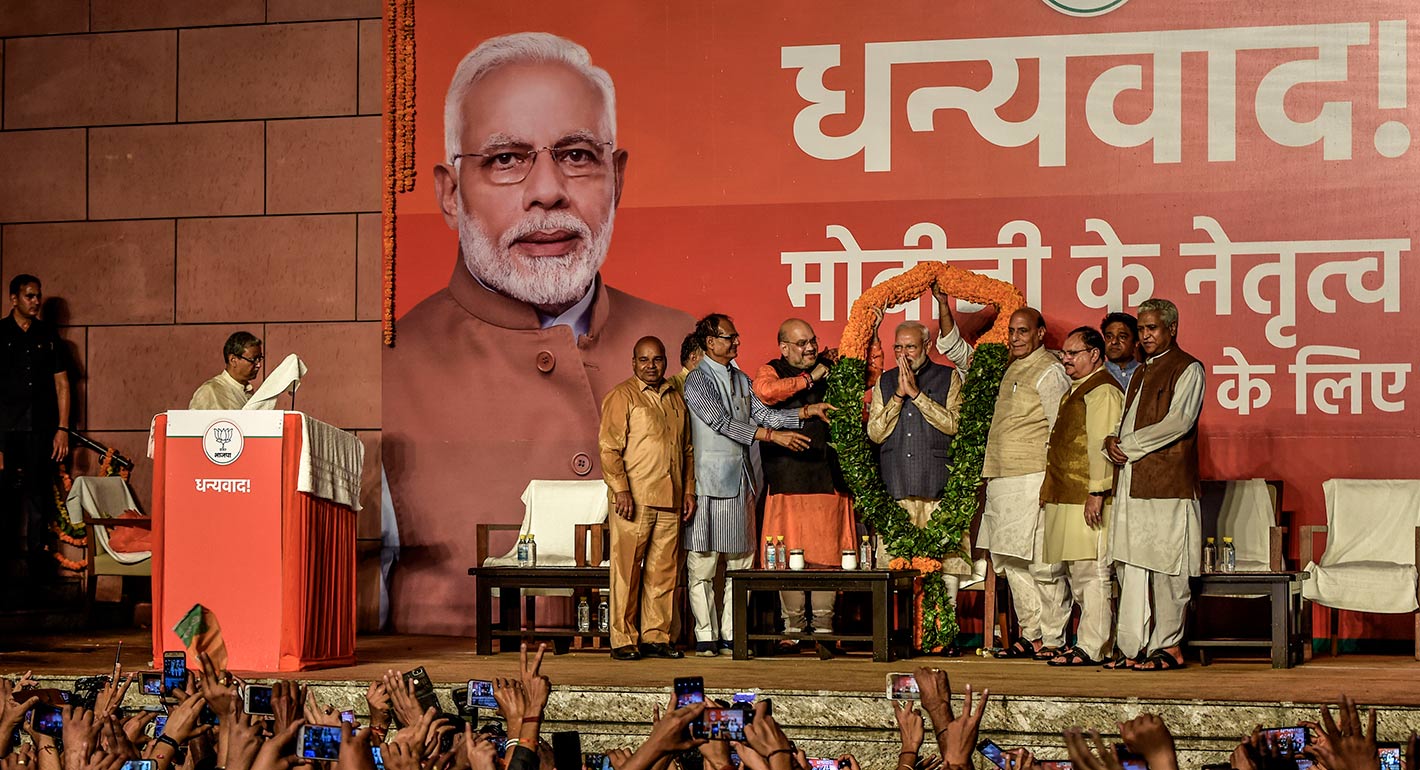
This election confirms what has been increasingly evident over the past five years: that the BJP, under Modi’s tutelage, has constructed a political hegemony that is impressively resilient.
Source: Hindustan Times
On Thursday, the Bharatiya Janata Party (BJP)-led National Democratic Alliance (NDA) stormed to power in a victory whose magnitude was presaged by exit polls, but whose final tally had to be seen to be fully believed. The NDA’s victory, propelled by Prime Minister Narendra Modi’s incomparable popularity, was matched only in scale by the Congress-led United Progressive Alliance (UPA)’s humbling defeat. The Congress recorded only a marginal improvement on its worst-ever performance in 2014.
Election analysts termed the 2014 general election a “black swan” election, a “perfect storm” of anti-incumbency and economic malaise, stoked by a larger-than-life Modi. Many warned that lightning was unlikely to strike twice, and yet it has. This election confirms what has been increasingly evident over the past five years: that the BJP, under Modi’s tutelage, has constructed a political hegemony that is impressively resilient. Electoral setbacks will come and go, as they did in the December 2018 assembly elections, but the BJP’s position as the central gravitational force of Indian politics is firmly entrenched. 2019 is not the result of another unlikely tempest but rather the sign of a climate that has been altered for good.
For starters, Indian voters — like their counterparts across the democratic world — are yearning for a strong, centralising leader. In 2014, Modi transformed a de jure parliamentary system into a de facto presidential one by portraying himself as the sole national leader who could fix India’s infirmities at home and abroad. Above all, Modi proclaimed, a vote for the BJP is a vote for me. In 2019, the prime minister hewed closely to this script, aided by the Opposition’s singular focus on targeting him to distract from its own yawning leadership deficit. For the BJP, this election was about Modi versus a fill-in-the-blanks answer. Even voters who had expressed reservations about the government’s performance concede that the PM remains a strong, incorruptible leader who has the country’s national interest at heart. Economic anxiety abounds, but there was no compelling political vehicle to translate it into political retribution. The Opposition gave voters neither a compelling enough vision for the future nor a leader that could rival Modi. Having stumbled on both counts, we should not be too surprised that Modi cruised to victory.
Second, the 2019 campaign took a nationalist turn whose dark rhetoric infuriated liberals and even made some within the BJP camp uncomfortable. The BJP party president delivered high-pitched rants about foreign “infiltrators” eating away at the body politic “like termites”. The prime minister directly waded into majoritarian waters by insinuating that minority-dominated constituencies were somehow inferior to Hindu majority ones. On social media, party loyalists gleefully endorsed praise uttered by a BJP candidate — one on trial on terror charges, no less — for Mahatma Gandhi’s assassin. Heading into this election, it was already evident that the Nehruvian construct of secularism was dead, discredited by its supposed backers on the left as much as its dogged opponents on the right. While many of the BJP’s voters may not endorse the crude majoritarianism on display, they believe that the alternative is so shorn of credibility that they are willing to, at best, ignore it and, at worst, condone it.
Third, Indian voters seem to have given Modi a temporary pass on the precarious state of the economy. There is anecdotal evidence to suggest that many Indians are willing to endure significant short-term economic pain for the promise of long-term gain. Demonetisation, however faulty its premises and implementation, provided strong evidence of this forbearance. Indian voters appear willing to absorb repeated blows in order to grant Modi more time to make good on his promises of creating jobs, boosting agrarian fortunes, and rejuvenating India’s flagging investment cycle. So far, the Modi government has only partially delivered on its pledges to lift economic fortunes, impressively building assets like roads and toilets but failing to raise incomes. The administration’s tepid incrementalism sits uneasily with Modi’s penchant of harnessing sky-high aspirations and ratcheting them up further.
It is a cliché to argue that this election marks a critical inflection point for India, but that does not make it untrue. The next five years will test the strength of India’s institutions to provide a check on a centralised political machine the likes of which India has not seen since the Congress of Indira Gandhi. With its substantial mandate, the BJP will also have a wide berth to redraw the precise boundaries between religion and politics — an opportunity its most vociferous backers will agitate to immediately exploit. Modi’s lofty promises to kickstart the economy have largely been deferred, but they cannot be delayed indefinitely. After five years, Modi has enjoyed the benefit of the doubt while blame for the economy has fallen on his party, the bureaucracy or the Opposition. Having remade the party in his image and centralised all authority within it, Modi owns this historic triumph. But now that the lines between party and supreme leader are indistinguishable, he will also own the aftermath.
This article was originally published in the Hindustan Times.

Director and Senior Fellow, South Asia Program
Milan Vaishnav is a senior fellow and director of the South Asia Program and the host of the Grand Tamasha podcast at the Carnegie Endowment for International Peace. His primary research focus is the political economy of India, and he examines issues such as corruption and governance, state capacity, federalism, and electoral behavior. He also conducts research on the Indian diaspora.
Recent Work


Christopher S. Chivvis, Rohan Mukherjee, Milan Vaishnav



Sophia Besch, Eric Ciaramella, Steve Feldstein, …
Carnegie does not take institutional positions on public policy issues; the views represented herein are those of the author(s) and do not necessarily reflect the views of Carnegie, its staff, or its trustees.

China’s political future will be shaped between now and next October. As the Communist Party enters its intense “campaign season” to prepare for a major political transition in 2027, reading Beijing's actions and responses may become more difficult as domestic politics weigh on its behavior more than usual.

Damien Ma

The EU can impose sanctions but struggles to enforce them without the United States. With Washington increasingly disinterested in backing European interests, the bloc must now fend for itself.


Nicu Popescu, Tiago Antunes
Global and rising powers will need to engage with Africa’s priorities and agency in order to secure the continent’s increasingly attractive partnerships.

Fonteh Akum

Rubio’s recent visit brought welcome attention, but more capital requires governance changes that may be a hard sell for regional governments.

Jennifer B. Murtazashvili

America’s foreign-policy objectives have grown more demanding while Americans have demanded greater focus on their own affairs.

Stephen Wertheim