

In The Media
Jessica Tuchman Mathews
{
  "authors": [
    "Jessica Tuchman Mathews"
  ],
  "type": "other",
  "centerAffiliationAll": "",
  "centers": [
    "Carnegie Endowment for International Peace"
  ],
  "collections": [],
  "englishNewsletterAll": "",
  "nonEnglishNewsletterAll": "",
  "primaryCenter": "Carnegie Endowment for International Peace",
  "programAffiliation": "",
  "programs": [],
  "projects": [],
  "regions": [
    "North America",
    "United States"
  ],
  "topics": [
    "Political Reform",
    "Security",
    "Military"
  ]
}
Source: Getty
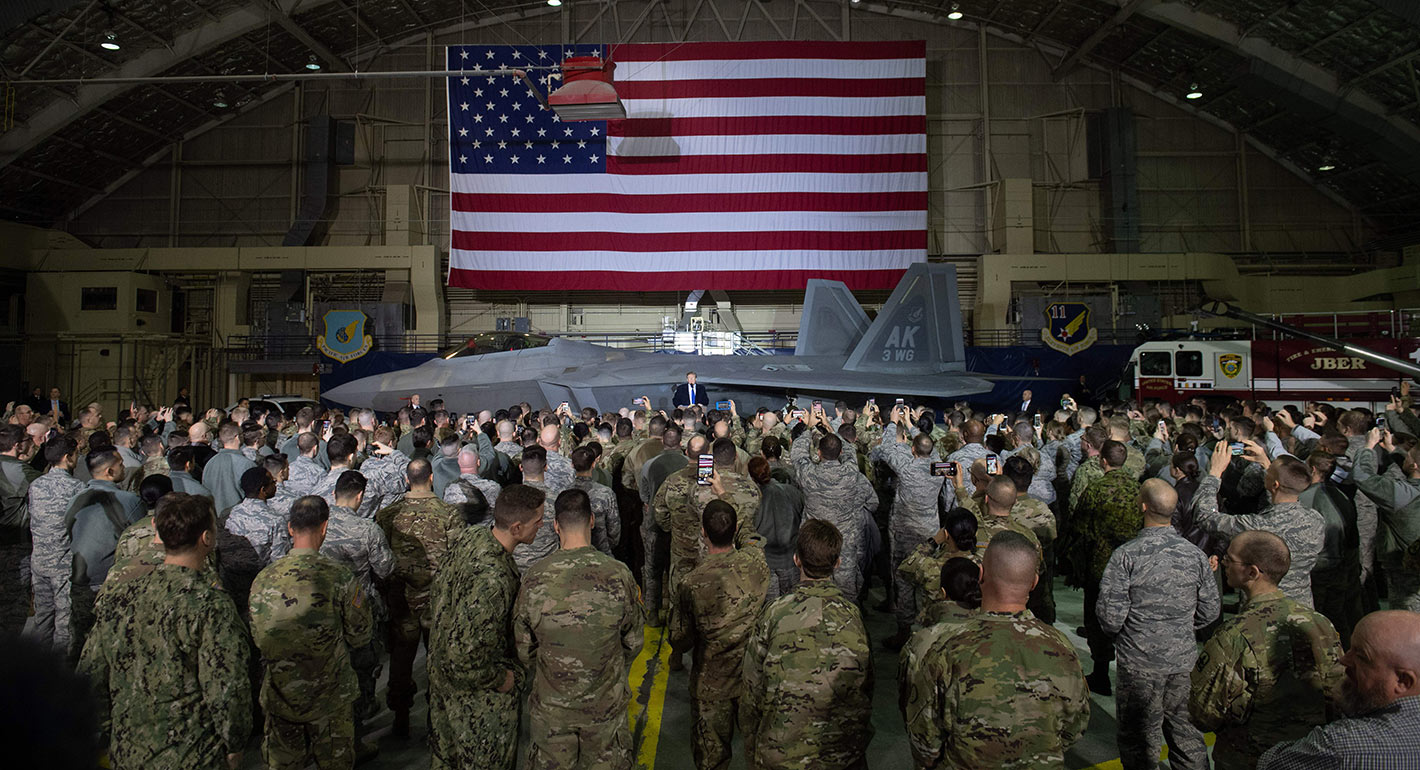
The sheer size of the military establishment and the habit of equating spending on it with patriotism make both sound management and serious oversight of defense expenditures rare.
Source: New York Review of Books
This piece will be in the July 18 edition of the New York Review of Books.
A parable, to begin: in 2016, the 136 military bands maintained by the Department of Defense, employing more than 6,500 full-time professional musicians at an annual cost of about $500 million, caught the attention of budget-cutters worried about surging federal deficits. Immediately memos flew and lobbyists descended. The Government Accountability Office, laying the groundwork for another study or three, opined, “The military services have not developed objectives and measures to assess how their bands are addressing the bands’ missions, such as inspiring patriotism.” Supporters of the 369th Infantry Regiment band noted that it had introduced jazz to Europe during World War I. How could such a history be left behind? A blues band connected effectively with Russian soldiers in Bosnia in 1996, another proponent argued, proving that bands are, “if anything, an incredibly cost-effective supplement” to the Pentagon’s then $4.5 billion public affairs budget.
When the dust cleared, funding for the bands was not cut, because the political cost entailed in reducing the number of them by, say, half would have been enormous. The resulting $250 million in annual savings, on the other hand, while a significant sum for most government agencies, would have produced the almost unnoticeable difference of three one-hundredths of one percent in the Pentagon budget.
The sheer size of the military establishment and the habit of equating spending on it with patriotism make both sound management and serious oversight of defense expenditures rare. As a democracy, we are on an unusual and risky path. For several decades, we have maintained an extraordinarily high level of defense spending with the support of both political parties and virtually all of the public. The annual debate about the next year’s military spending, underway now on Capitol Hill, no longer probes where real cuts might be made (as opposed to cuts in previously planned growth) but only asks how big the increase should be.
The political momentum that drives this annual increase, disconnected from hard thought about America’s responsibilities in a transformed world, threatens to become—or may have already become—unstoppable. The consequences are huge. At home, defense spending crowds out funds for everything else a prosperous economy and a healthy society need. Abroad, it has led us to become a country reflexively reliant on the military and one quite different from what we think ourselves to be or, I believe, wish to be....
This piece was originally published in the New York Review of Books.

Distinguished Fellow
Mathews is a distinguished fellow at the Carnegie Endowment for International Peace. She served as Carnegie’s president for 18 years.
Recent Work
Jessica Tuchman Mathews
Jessica Tuchman Mathews
Carnegie does not take institutional positions on public policy issues; the views represented herein are those of the author(s) and do not necessarily reflect the views of Carnegie, its staff, or its trustees.

Over the past ten years, NATO has held almost as many summits as it did during the entirety of the Cold War. Are they still useful, or is it time to stop holding annual meetings?

Rym Momtaz, ed.

The move is an escalation of its war on multilateralism.

Stewart Patrick

As the EU confronts profound challenges, several leaders have called for fundamental reform to the union’s model—but only modest, superficial changes have resulted. What if Europe really could be reimagined from zero today: What should such a redesigned European order look like?

Richard Youngs, ed.
Andrey Melnichenko’s essay offers no answer to the fundamental question of how, under any kind of negotiated settlement, Europe can protect itself from the Russian ressentiment that is inevitable in all scenarios except for an outright victory for Putin.

Leonid Bershidsky

How is AI reshaping space security, creating governance challenges, and where does international diplomacy stand today?


Tejas Bharadwaj, Almudena Azcárate Ortega