

Commentary
It should address the shortcomings of previous crisis communication efforts and adapt to the demands of frontier AI.
Lucy Luo
{
  "authors": [
    "Ariel (Eli) Levite",
    "George Perkovich"
  ],
  "type": "commentary",
  "centerAffiliationAll": "dc",
  "centers": [
    "Carnegie Endowment for International Peace"
  ],
  "collections": [
    "U.S. Nuclear Policy",
    "Korean Peninsula"
  ],
  "englishNewsletterAll": "ctw",
  "nonEnglishNewsletterAll": "",
  "primaryCenter": "Carnegie Endowment for International Peace",
  "programAffiliation": "NPP",
  "programs": [
    "Nuclear Policy"
  ],
  "projects": [],
  "regions": [
    "North America",
    "United States",
    "East Asia",
    "North Korea"
  ],
  "topics": [
    "Foreign Policy",
    "Nuclear Policy",
    "Arms Control"
  ]
}
Source: Getty
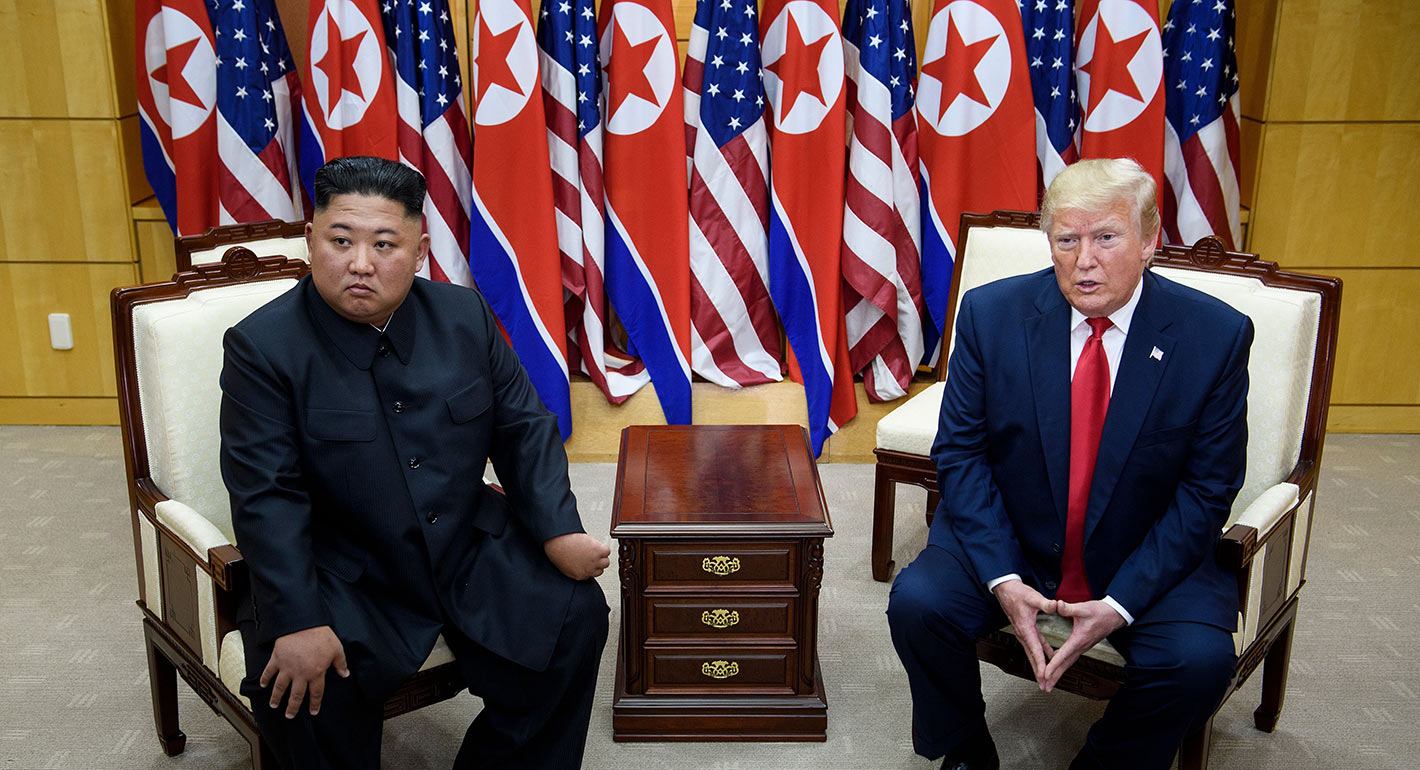
Nuclear negotiations with North Korea are at an impasse, but there are pragmatic ways the United States can seek to regain diplomatic momentum.
Five U.S. presidents have tried to persuade three generations of North Korean leaders to abandon their nuclear weapons program. None have succeeded. The top brass in Pyongyang cannot imagine how it would survive and keep its leverage over others without a nuclear arsenal. Despite this deadlock, there still are ways to meaningfully constrain and eventually roll back North Korea’s nuclear pursuits, ways that Supreme Leader Kim Jong Un might reluctantly accept and that the United States and others should be willing to reward, including with some sanctions relief.
Give U.S. President Donald Trump credit. His fire-and-fury tweets and theatrical charm offensives have produced a halt in some of the most egregious forms of North Korea’s nuclear progress: long-range missile and nuclear tests. But, predictably, that halt has come only after North Korea has accomplished a breakthrough in its program, and Pyongyang steadfastly refuses to hand over its nuclear weapons outright or even lay out a timetable and sequence for doing so. The current halt on testing is also precarious, given Pyongyang’s track record and threats to escalate without diplomatic progress. Washington needs to clarify realistic interim objectives in the upcoming negotiations.
Three options are worthy of consideration. The aim would be to improve U.S. and international security, prepare the groundwork for eventual denuclearization, and offer enough verification to warrant some easing of sanctions. Each option has advantages and drawbacks. All would represent substantial progress over the status quo. They could also reinforce North Korea’s current restraint from conducting further tests that would significantly advance its capacity to launch thermonuclear weapons at the United States.
The first option is comprehensive benchmarking of the North Korean nuclear weapons program. This would essentially entail that Pyongyang provide information about its nuclear facilities and capabilities that could be verified by a thorough inspections regime. This option offers only modest immediate benefits. But it would be indispensable for the two most likely alternative long-term scenarios—either progress toward the voluntary, verifiable elimination of North Korea’s arsenal and related infrastructure, or conversely U.S. military action to take out as much of this arsenal as possible. Either way, denuclearization would require detailed information on what relevant nuclear and missile capabilities Pyongyang possesses and where they are located. For such information to be reliable, a rigorous, on-site verification scheme would be necessary. But the Kim regime is unlikely to agree to provide information and grant access that would make it easier for the United States to attack its capabilities. That means this goal is probably unattainable, even if the United States were willing to offer massive sanctions relief in return, which Washington appears unwilling to do.
The second option is a freeze of North Korea’s activities involving the fissile materials that are vital for building nuclear weapons. This would heavily constrain Pyongyang’s ability to keep scaling up its arsenal. Yet it would do little to diminish its existing capabilities, which are already quite formidable. What’s more, it would require North Korea to allow very intrusive access to its facilities for producing, processing, and stocking fissile materials, including secret ones that it so far has not even admitted possessing. At the Hanoi summit, Pyongyang offered access to only part of its infamous Yongbyon complex, an offer that Washington justifiably rejected as insufficient.
The third option is a cap on the North Korean arsenal itself, instead of only on the fissile material activities and facilities. This option would involve temporarily tolerating additional fissile material activity. But, in return, such a cap would shift the diplomatic focus to what the United States and its regional allies care about most: stopping the qualitative and quantitative upgrades of the North Korean nuclear arsenal, while significantly reducing the country’s readiness to use nuclear weapons. This could be done by requiring Pyongyang to disassemble its nuclear weapons; separately store the missile launchers, missiles, and warheads; and lock them in place. Much of this separation could be verified by satellite and air reconnaissance as well as communications intercepts, making physical access to the arsenal unnecessary. This could ease North Korean concerns about spying. Such steps could be reversible, but this would take time and the cheating could be detected, making violations of such an agreement riskier for Pyongyang.
Even if the United States pursues and North Korea accepts any of these options, the sobering reality is that North Korea will retain a nuclear arsenal for the foreseeable future. It will not make concessions otherwise. Still, each of these options would leave the United States and its allies significantly better off than they are today. There would be no crisis to manage, no escalation to curb, and no arsenal-improvement time bombs to defuse. And each option would set North Korea on a course to diminish the strategic salience of its nuclear program, an important precursor to eventual denuclearization.
The United States and others should stand ready to reward North Korean willingness to embark on any of these three paths. Importantly, Washington and its allies need to recognize that in return Kim expects more than has been offered to date. Pyongyang resents that it has not been rewarded for its previous nuclear concessions, and the Kim regime emphasizes that countries like Libya and Iran did not receive the benefits they were promised in previous nuclear deals with the United States (and others) in 2004 and 2015. Offering more benefits would address these concerns, while lending extra credibility to U.S. threats to withdraw those benefits should North Korea later cheat or renege on the programmatic constraints it has accepted.

Senior Fellow, Nuclear Policy Program, Technology and International Affairs Program
Levite was the principal deputy director general for policy at the Israeli Atomic Energy Commission from 2002 to 2007.

Japan Chair for a World Without Nuclear Weapons, Senior Fellow
George Perkovich is the Japan Chair for a World Without Nuclear Weapons and a senior fellow in the Carnegie Endowment for International Peace’s Nuclear Policy Program. He works primarily on nuclear deterrence, nonproliferation, and disarmament issues.
Carnegie does not take institutional positions on public policy issues; the views represented herein are those of the author(s) and do not necessarily reflect the views of Carnegie, its staff, or its trustees.

It should address the shortcomings of previous crisis communication efforts and adapt to the demands of frontier AI.

Lucy Luo

Washington’s decision to support some UN functions while letting others wither is pulling the organization apart at the seams.

Stewart Patrick, Theodore Zaritsky

While there are notable demographic, economic, and geographic divides over AI, there is also substantial alignment between Republicans and Democrats.



Ian Klaus, Mark Baldassare, Rachel George, …

Are Germany’s economic, industrial, and political struggles becoming a liability for the EU’s ability to rise to the geopolitical moment?

Rym Momtaz, ed.

China’s police training infrastructure construction projects provide benefits to recipient countries, promote China’s image as a major global security provider, and are likely to reinforce alignment between Beijing’s security priorities and those of countries in the Global South.


Cameron Waltz, Sheena Chestnut Greitens, Kim Nguyen, …