

Research
- +4
Milan Vaishnav, Rahul Verma, Rukmini S., …
{
  "authors": [
    "Christophe Jaffrelot"
  ],
  "type": "legacyinthemedia",
  "centerAffiliationAll": "dc",
  "centers": [
    "Carnegie Endowment for International Peace"
  ],
  "collections": [],
  "englishNewsletterAll": "ctw",
  "nonEnglishNewsletterAll": "",
  "primaryCenter": "Carnegie Endowment for International Peace",
  "programAffiliation": "SAP",
  "programs": [
    "South Asia"
  ],
  "projects": [],
  "regions": [
    "North America",
    "United States",
    "South Asia",
    "India"
  ],
  "topics": [
    "Political Reform",
    "Democracy",
    "Foreign Policy"
  ]
}
Source: Getty
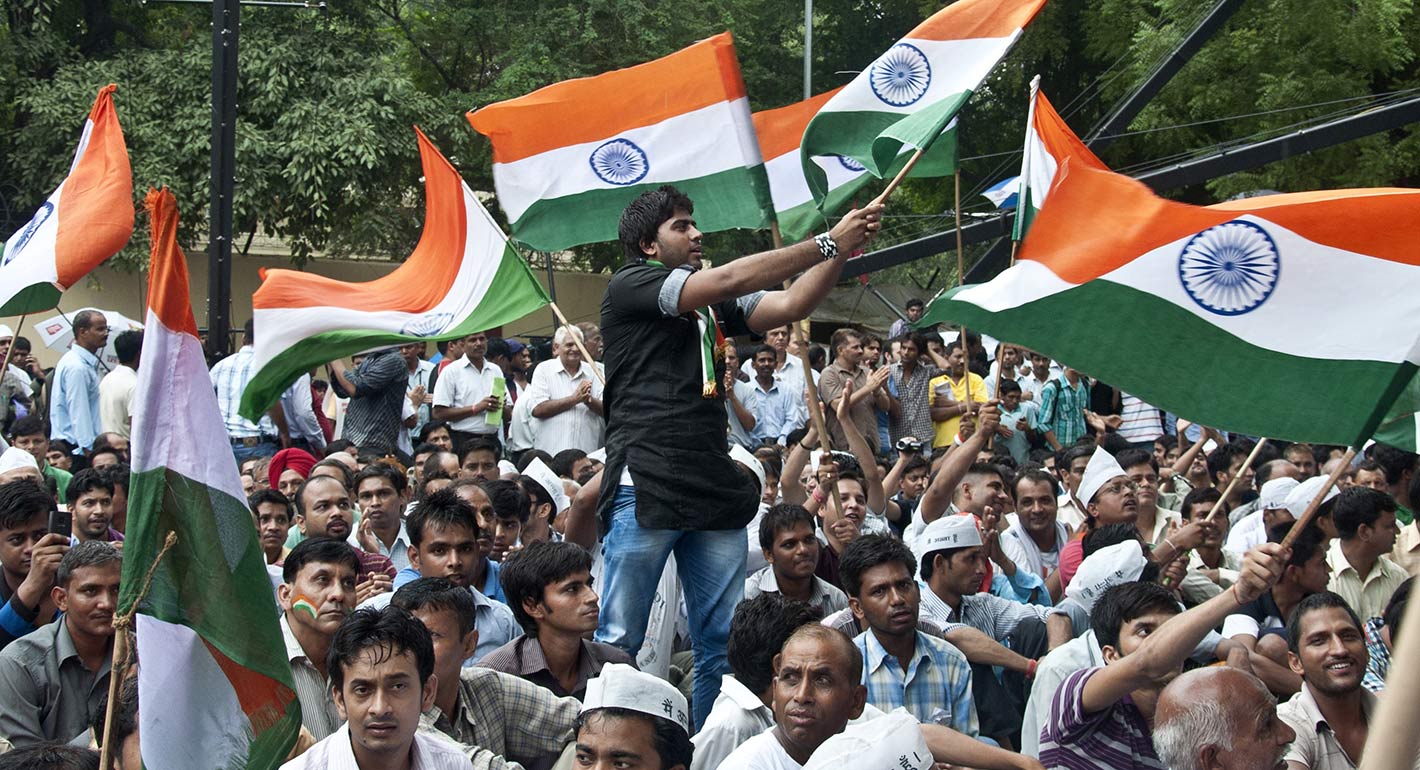
Today, the Indian subcontinent is returning to this peaceful mode of popular protest.
Source: Indian Express
If India did not invent non-violent civil disobedience (also mistakenly called passive resistance), it is surely the first country to practise it on a large scale, under the leadership of Mahatma Gandhi – who referred it to the Hindu/Jain notion of ahimsa. Exactly hundred years ago, the Non-Cooperation Movement that followed the Jallianwala Bagh massacre set the tone for the satyagrahas that were to mark the freedom movement. Subsequently, this modus of protest was used to mobilise Indian masses when they had to fight oppression. The JP Movement, which precipitated the declaration of Emergency in 1975, is a case in point.
Today, the Indian subcontinent is returning to this peaceful mode of popular protest. In Pakistan, the Pashtuns have reactivated the legacy of Abdul Ghaffar Khan, also known as Bacha Khan and “Frontier Gandhi”– because his stronghold was located in the North West Frontier Province. Drawing its inspiration from this repertoire of popular mobilisation, the Pashtun Tahafuz Movement (Pashtun Protection Movement) was formed after the extra-judicial murder of Naqeebullah Mehsud, originally from Waziristan, allegedly in a police encounter in Karachi on 13 January 2018. This crime has prompted rallies in support of the human rights of the Pashtuns. But these spontaneous protest marches have also been precipitated by other problems faced by Pashtuns in the former-Federally Administered Tribal Areas (FATA) which have merged with the province of Khyber-Pakhtunkhwa but are still badly affected by pressing issues, including the land mines that the Taliban have left behind, and that the Pakistani state is not removing quickly enough. The peaceful protest of the followers of PTM has been met by repression, army or paramilitary personnel have allegedly caused the disappearance of dissenting voices (hence the “missing persons” syndrome) and killed dozens of peaceful demonstrators. Still, PTM remains faithful to the non-violent protest mode.
This is also the attitude of most of the Indian demonstrators marching peacefully against the Citizenship Amendment Act and the National Register of Citizens that they consider as non constitutional. This non-violent movement has been subjected to intense forms of repression – at least 24 people have been killed so far, mostly in BJP-ruled UP and Karnataka. (Delhi is a very special case because its police reports to the Centre). In these states, mobile phones could take videos showing the deliberate violence of the police against students on university campuses or against peaceful demonstrators – and the destruction of private properties, including cars, allegedly by the custodians of the rule of law. This is the era of Ahmisa 2.0, where social media makes it impossible for the state to escape testimonies of committed eyes witnesses, even in the context of internet shutdown. The same thing is happening in case of the Pashtun as well: Un spite of the quasi indifference of the mainstream media, those who want to know what is going on can remain informed via social media.
But beyond indifference, mainstream media can indulge in disinformation. In Pakistan, PTM leaders have been presented as traitors working for some foreign country and in India non violent demonstrators have been characterised as hooligans by several TV channels which have repeatedly screened a select number of incidents.
The first challenge that a non-violent protest faces, always, is to remain non-violent in spite of repression and the activities of agents provocateurs. Mahatma Gandhi suspended the Non Cooperation Movement in 1922 after Chauri Chaura for that reason. The second challenge pertains to the sustainability of such a movement. As Gandhi himself used to say, non-violence is not for the cowards. It demands a lot of physical courage, something may erode gradually in the face of repression, especially when repression is intense. If ahimsa took India to the liberation path and helped Nelson Mandela to defeat apartheid, it failed in China where Dalai Lama could not prevent Beijng from fighting Tibetans and their culture. Non-violence can only work vis-à-vis states and societies which are accessible to moral pressure and likely to develop feelings of guilt; it is bound to fail otherwise, especially when the rulers and/or the majorities supported them have dehumanised their targets, be they ethnic groups, religious communities or political movements.
If moral pressures are a key factor, external pressures can also play a role. South Africa turned its back to apartheid also because of sustained international sanctions. Peaceful demonstrators cannot expect much from the West today. State sovereignty has staged a comeback after the fiasco of foreign interventions. More importantly, western governments do not dare to interfere with domestic politics in the name of human rights, especially when the victims are Muslims, when they are doing business with a big country or when they look at it as a potential partner to balance China – and India, here, is a case in point.
For a peaceful protest to bear fruit before they are exhausted, the hope can probably come only from the judiciary – provided it is independent enough. If the rule of law prevails, the Supreme Court is the last resort for a divided society to find the way out of the crisis by implementing the Constitution of the country. On February 11, 2019, the leader of PTM, Manzoor Ahmad Pashteen wrote in a New York Times oped titled “The Military Says Pashtuns Are Traitors. We Just Want Our Rights”: “We are not seeking a violent revolution, but we are determined to push Pakistan back toward a constitutional order”.
The Indian peaceful demonstrators are also asking for the respect of the Constitution, whose preamble they cite publicly. The ball is in the court of the judiciary, in the case of the CAA, NRC as well as Article 370 and the transformation of the state of Jammu and Kashmir into a Union Territory, two decisions made more than six months ago. In Pakistan, the judiciary is back to the judicial activism of the years 2007-08, as evident from the recent verdict condemning General Musharraf to the death penalty and the Supreme Court’s judgement asking the parliament to pass a law codifying the procedure through which the Chief of Army Staff can benefit from an extension. In the past also the Supreme Court of India was the harbinger of a strong form of judicial activism, so much so that it appeared as the symbol of the checks and balances that are crucial to any democratic order.
This article was originally published by the Indian Express.

Former Nonresident Scholar, South Asia Program
Jaffrelot’s core research focuses on theories of nationalism and democracy, mobilization of the lower castes and Dalits (ex-untouchables) in India, the Hindu nationalist movement, and ethnic conflicts in Pakistan.
Recent Work

Milan Vaishnav, Rahul Verma, Rukmini S., …
Christophe Jaffrelot
Carnegie does not take institutional positions on public policy issues; the views represented herein are those of the author(s) and do not necessarily reflect the views of Carnegie, its staff, or its trustees.

The books, podcasts, and films that explain the world it made.

Andrew Leber
U.S. trading partners in Asia are closely watching the dispute for signs of how it may affect their own interests.

Barbara Weisel

The aftermath of the Ceuta crisis shows Europe has drawn the wrong lessons. Rather than doubling down on failed migration policies, the EU needs to address the underlying roots of such episodes.

Richard Youngs
By abandoning past U.S. pro-democracy policies and adopting several lines of pro-autocratic action, the Trump administration has fundamentally repositioned the United States vis-à-vis democracy in the world.

Thomas Carothers
Chinese strategists are once again debating whether American power is declining and whether U.S. hegemony is experiencing irreversible decay.
Wu Xinbo