

Article
Erik Brattberg, David Whineray
{
  "authors": [
    "David Whineray"
  ],
  "type": "legacyinthemedia",
  "centerAffiliationAll": "dc",
  "centers": [
    "Carnegie Endowment for International Peace"
  ],
  "collections": [],
  "englishNewsletterAll": "ctw",
  "nonEnglishNewsletterAll": "",
  "primaryCenter": "Carnegie Endowment for International Peace",
  "programAffiliation": "EP",
  "programs": [
    "Europe"
  ],
  "projects": [],
  "regions": [
    "North America",
    "United States",
    "Eastern Europe",
    "Western Europe",
    "Iran"
  ],
  "topics": [
    "Political Reform",
    "Democracy",
    "Foreign Policy"
  ]
}
Source: Getty
The view of senior European diplomats in Washington is that the Trump administration’s focus on isolationism, protectionism and burden sharing was a reflection of wider changes in Americans’ view about United States’ role in world
Source: Hill
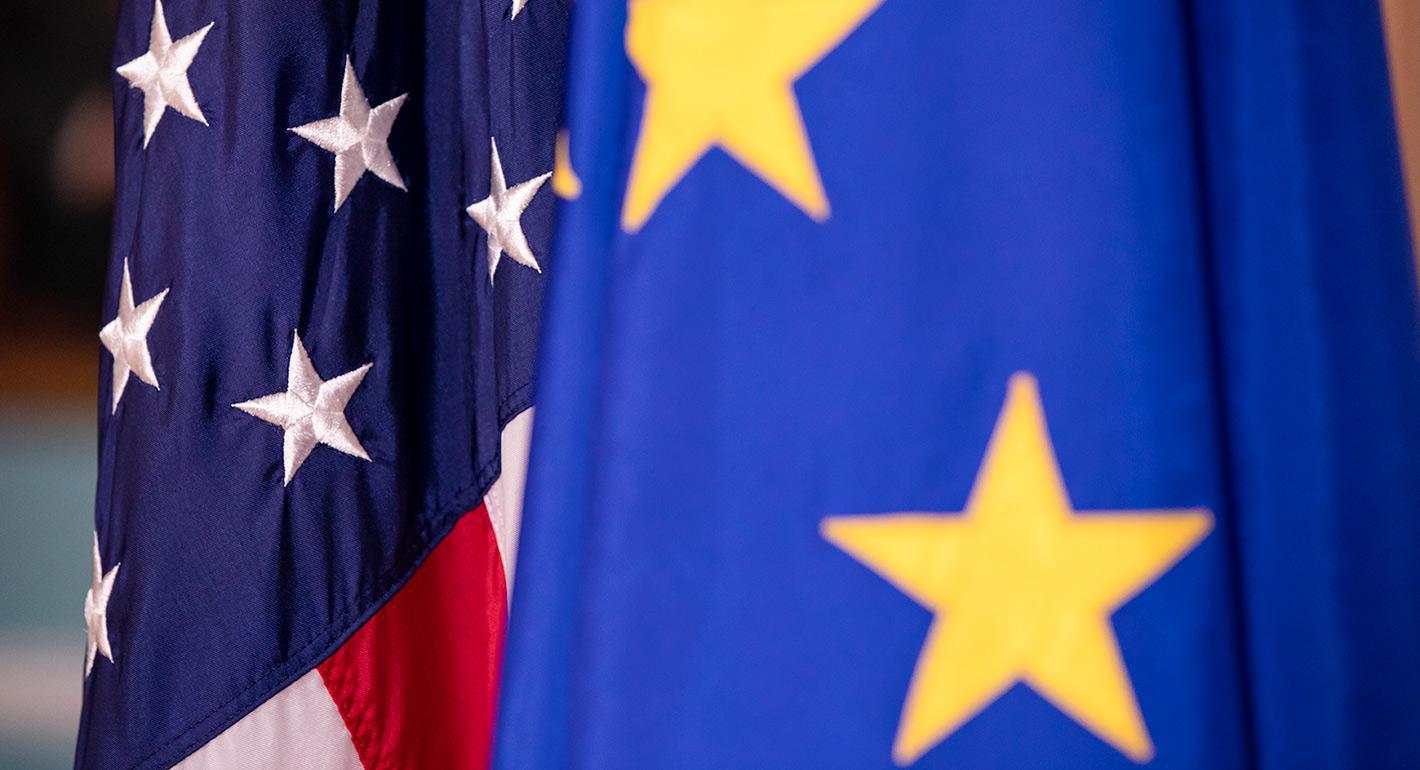
Coronavirus has added more tension into the United States’ relationship with the European Union. President Donald Trump’s decision to ban European citizens from the U.S. and his description of the virus as “Chinese” has strained U.S. relations with the European Union. Europeans and the U.S. were even unable to agree to a joint G7 Foreign Ministers’ text on attacking the virus.
These tensions come on top of a range of wider transatlantic splits. Whether the agenda is coronavirus, climate change or China, the world’s two biggest economies — the United States and the European Union — are now often divided. The West has split.
Against this background I recently interviewed European ambassadors and senior diplomats in Washington off-the-record on what they expect, hope and fear for U.S.-EU relations under a Biden, Sanders or second Trump administration for a new Carnegie Endowment study. They were downbeat on the future of U.S. relations with Europe under any future administration. Here’s what they privately think.
First, almost all said the United States’ relationship with Europe was in a worse state today than under any other modern U.S. administration, including during the 2003 Iraq war. In addition to EU-U.S. disagreements over policy — such as on trade, defense, climate change and Iran — ambassadors berated the Trump administration’s “ideological hostility” to the EU and NATO. One described the administration as showing a “blatant disregard for shared values that have underpinned transatlantic alliance for decades” and the president’s “lack of decorum” when engaging European allies. The president’s calling the EU a “foe” and European countries “crime-ridden” was described as “offensive.”
More widely, ambassadors described President Trump as “impulsive” and “unpredictable.” Some felt the best way to work with the U.S. was to “stay under the radar” with the White House and work with Congress and the states instead. One bluntly described this strategy as: “stay away from the person in the White House and invest in the country.” Another even commented that “90 percent of countries are worse off after a meeting with Trump than they were beforehand.”
This said, not all European countries held such a negative assessment. Some — especially from Central Europe — welcomed the strength of U.S.-European security relations and the increase in U.S. military spending/deployment in Europe since 2017.
Second, most European diplomats expected transatlantic tensions to get even worse under a second Trump administration. As one commented on the relationship, the “fear is that we have not hit rock bottom yet.” Their three biggest worries were: the U.S. withdrawing from NATO or placing conditions on Article 5; more trade tariffs; and growing U.S. international isolationism with the consequent risk that China and Russia “fill the void.” Some gave a clear warning that the election of a second Trump administration could see Europe conclude that “it could no longer rely on the U.S.” and begin to work more with other powers and to even begin to draw a “moral equivalence” between Washington, Beijing and Moscow.
Third, conversely, European ambassadors felt the United States’ relationship with the European Union would improve under a Democratic administration. A Democratic win in November would be met on the other side of the Atlantic with “huge relief.” But many also feared European leaders would end up disappointed by a Biden or Sanders administration, as many current transatlantic tensions would remain. The U.S. would co-operate more with the E.U. on climate change and multilateralism, but transatlantic tensions on defense, trade and China would remain. These reflected a bigger, more structural and longer-term divergence of the EU and U.S. interests.
Indeed, some ambassadors worried that a Sanders administration could be as — or possibly even more — difficult for Europe as the Trump administration on some issues, such as trade. Some Central Europeans also feared it would cut U.S. defense spending or military deployments in Europe.
Overall, regardless of the outcome in November, many European ambassadors in Washington see a negative outlook on prospects for transatlantic relations over long-term.
The view of senior European diplomats in Washington is that the Trump administration’s focus on isolationism, protectionism and burden sharing was a reflection of wider changes in Americans’ view about United States’ role in world. This view — combined with U.S. domestic political polarization — will likely continue, they say, and constrain whoever occupies the Oval Office next year. Whatever the outcome in November, transatlantic relations will likely not return to the pre-2017 period: European trust in U.S. global leadership has been permanently damaged.
Former Nonresident Fellow, Europe Program
David Whineray was a nonresident fellow in the Europe Program at the Carnegie Endowment for International Peace in Washington, DC.
Recent Work

Erik Brattberg, David Whineray
David Whineray
Carnegie does not take institutional positions on public policy issues; the views represented herein are those of the author(s) and do not necessarily reflect the views of Carnegie, its staff, or its trustees.

In an interview, Hassan Mneimneh discusses the ongoing conflict and the myriad miscalculations characterizing it.

Michael Young
Domestic mobilization, personalized leadership, and nationalism have reshaped India’s global behavior.

Sandra Destradi
The recent record of citizen uprisings in autocracies spells caution for the hope that a new wave of Iranian protests may break the regime’s hold on power.


Thomas Carothers, McKenzie Carrier

In an interview, Nicole Grajewski discusses the military dimension of the U.S. and Israeli attacks on Iran.
Michael Young
European reactions to the war in Iran have lost sight of wider political dynamics. The EU must position itself for the next phase of the crisis without giving up on its principles.

Richard Youngs