

• Research
  • Emissary
  • About
  • Experts
Carnegie Global logoCarnegie lettermark logo
Democracy
  • Donate
{
  "authors": [
    "Thomas Carothers",
    "Benjamin Press"
  ],
  "type": "legacyinthemedia",
  "centerAffiliationAll": "dc",
  "centers": [
    "Carnegie Endowment for International Peace"
  ],
  "collections": [],
  "englishNewsletterAll": "",
  "nonEnglishNewsletterAll": "",
  "primaryCenter": "Carnegie Endowment for International Peace",
  "programAffiliation": "DCG",
  "programs": [
    "Democracy, Conflict, and Governance"
  ],
  "projects": [],
  "regions": [
    "North America",
    "United States",
    "Eastern Europe",
    "Western Europe"
  ],
  "topics": [
    "Political Reform",
    "Security",
    "Civil Society",
    "Foreign Policy"
  ]
}

Source: Getty

In The Media

The Global Rise of Anti-Lockdown Protests—and What to Do About It

Lockdown measures, especially stay-at-home orders and restrictions on mass gatherings, halted protests almost everywhere. Yet as the pandemic has dragged on, the increasingly strained relationship between governments and citizens in many countries has brought demonstrators back into the streets.

Link Copied
By Thomas Carothers and Benjamin Press
Published on Oct 15, 2020
Program mobile hero image

Program

Democracy, Conflict, and Governance

The Democracy, Conflict, and Governance Program is a leading source of independent policy research, writing, and outreach on global democracy, conflict, and governance. It analyzes and seeks to improve international efforts to reduce democratic backsliding, mitigate conflict and violence, overcome political polarization, promote gender equality, and advance pro-democratic uses of new technologies.

Learn More

Source: World Politics Review

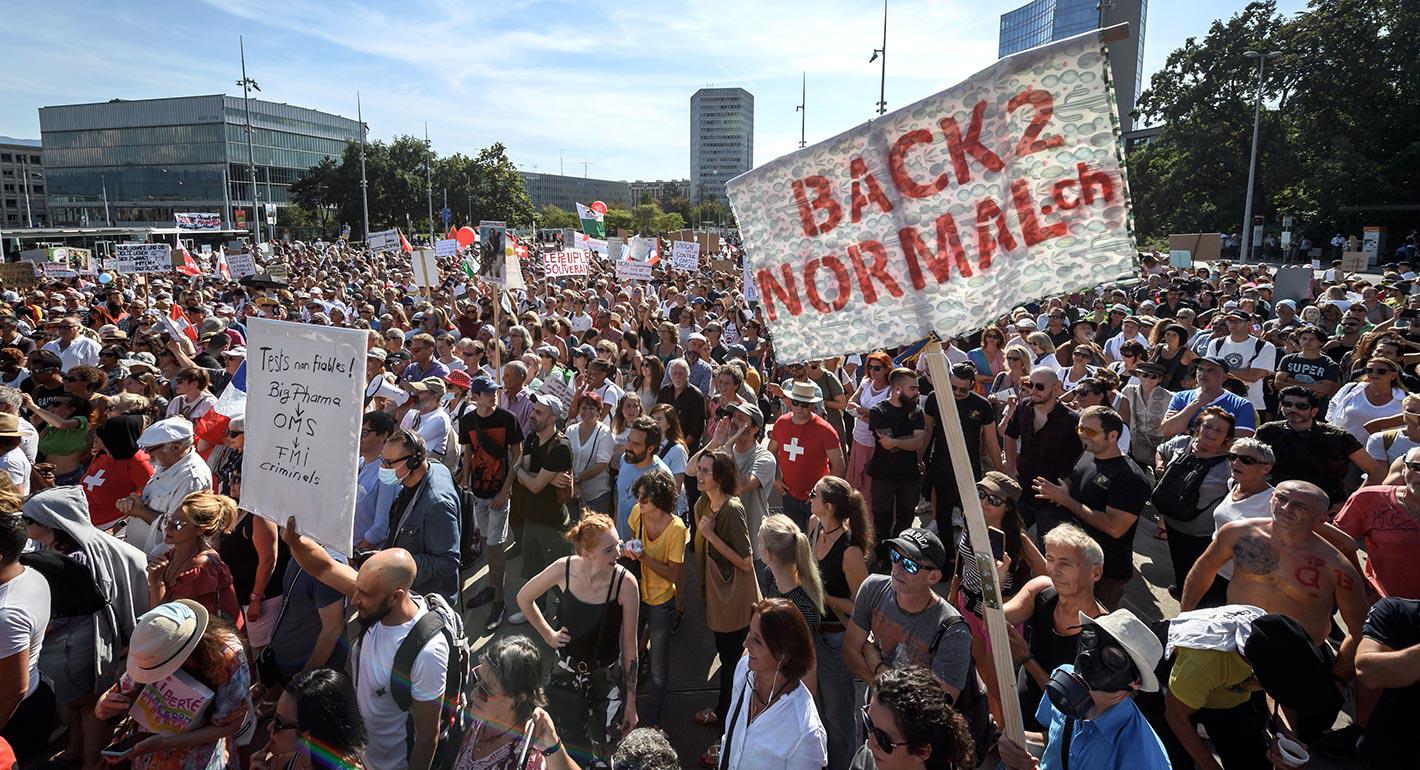
The wave of anti-government protests that roiled global politics over the past decade initially seemed to be an early casualty of COVID-19. Lockdown measures, especially stay-at-home orders and restrictions on mass gatherings, halted protests almost everywhere. Yet as the pandemic has dragged on, the increasingly strained relationship between governments and citizens in many countries has brought demonstrators back into the streets. While many renewed protests reflect anger over familiar issues like corruption, political repression and economic hardship, a striking new trend is afoot: citizens openly challenging the public health measures governments have taken to slow the spread of the coronavirus.

Since March, more than 30 major protests in 26 countries have targeted coronavirus restrictions. Such demonstrations have emerged in every region of the globe, not only in wealthy countries like Australia, Germany and the United States, but also in poorer ones like Brazil, Mexico and Nigeria. Moreover, anti-lockdown uprisings are occurring in states with very different governance systems—consolidated autocracies and liberal democracies alike. These popular eruptions have generally occurred in two waves: An early one in April and May emerged soon after the virus spread around the world, and an ongoing second one started in early August in reaction to the extension of public health measures. As large demonstrations in the past month across multiple regions have made clear, their tempo is accelerating.

Read the Full Text

This article was originally published by World Politics Review.

About the Authors

Thomas Carothers

Harvey V. Fineberg Chair for Democracy Studies; Director, Democracy, Conflict, and Governance Program

Thomas Carothers, director of the Carnegie Endowment for International Peace’s Democracy, Conflict, and Governance Program, is a leading expert on comparative democratization and international support for democracy.

Benjamin Press

Former Nonresident Research Analyst, Democracy, Conflict, and Governance Program

Benjamin Press was a nonresident research analyst in the Democracy, Conflict, and Governance Program.

Authors

Thomas Carothers
Harvey V. Fineberg Chair for Democracy Studies; Director, Democracy, Conflict, and Governance Program
Thomas Carothers
Benjamin Press
Former Nonresident Research Analyst, Democracy, Conflict, and Governance Program
Political ReformSecurityCivil SocietyForeign PolicyNorth AmericaUnited StatesEastern EuropeWestern Europe

Carnegie does not take institutional positions on public policy issues; the views represented herein are those of the author(s) and do not necessarily reflect the views of Carnegie, its staff, or its trustees.

More Work from Carnegie Endowment for International Peace

  • Commentary
    Carnegie Politika
    How Far Can Russian Arms Help Iran?

    Arms supplies from Russia to Iran will not only continue, but could grow significantly if Russia gets the opportunity.

      Nikita Smagin

  • Front of a damaged apartment building
    Commentary
    Emissary
    Is a Conflict-Ending Solution Even Possible in Ukraine?

    On the fourth anniversary of Russia’s full-scale invasion, Carnegie experts discuss the war’s impacts and what might come next.

      • +1

      Eric Ciaramella, Aaron David Miller, Alexandra Prokopenko, …

  • Commentary
    Carnegie Politika
    The Kremlin Is Destroying Its Own System of Coerced Voting

    The use of technology to mobilize Russians to vote—a system tied to the relative material well-being of the electorate, its high dependence on the state, and a far-reaching system of digital control—is breaking down.

      Andrey Pertsev

  • People in voting booths
    Commentary
    Emissary
    Indian Americans Still Lean Left. Just Not as Reliably.

    New data from the 2026 Indian American Attitudes Survey show that Democratic support has not fully rebounded from 2020.

      • +1

      Sumitra Badrinathan, Devesh Kapur, Andy Robaina, …

  • Teenagers hold a large banner reading "stop pollution in Gabes, stop pollution everywhere, save Gabes'' in English and Arabic
    Article
    Civil Society Restrictions in North Africa: The Impact on Climate-Focused Civil Society Organizations

    For climate-focused civil society in countries like Morocco, Algeria, and Tunisia to be most effective, organizations should work together to develop networks that extend their reach beyond their local area and connect across borders to share best practices and amplify each other’s work.

      • Sarah Yerkes

      Sarah Yerkes

Get more news and analysis from
Carnegie Endowment for International Peace
Carnegie global logo, stacked
1779 Massachusetts Avenue NWWashington, DC, 20036-2103Phone: 202 483 7600Fax: 202 483 1840
  • Research
  • Emissary
  • About
  • Experts
  • Donate
  • Programs
  • Events
  • Blogs
  • Podcasts
  • Contact
  • Annual Reports
  • Careers
  • Privacy
  • For Media
  • Government Resources
Get more news and analysis from
Carnegie Endowment for International Peace
© 2026 Carnegie Endowment for International Peace. All rights reserved.