

Article
Paul Stronski
{
  "authors": [
    "Paul Stronski"
  ],
  "type": "commentary",
  "centerAffiliationAll": "dc",
  "centers": [
    "Carnegie Endowment for International Peace"
  ],
  "collections": [],
  "englishNewsletterAll": "ctw",
  "nonEnglishNewsletterAll": "",
  "primaryCenter": "Carnegie Endowment for International Peace",
  "programAffiliation": "russia",
  "programs": [
    "Russia and Eurasia"
  ],
  "projects": [],
  "regions": [
    "Caucasus",
    "Azerbaijan",
    "Armenia"
  ],
  "topics": [
    "Security"
  ]
}
Source: Getty
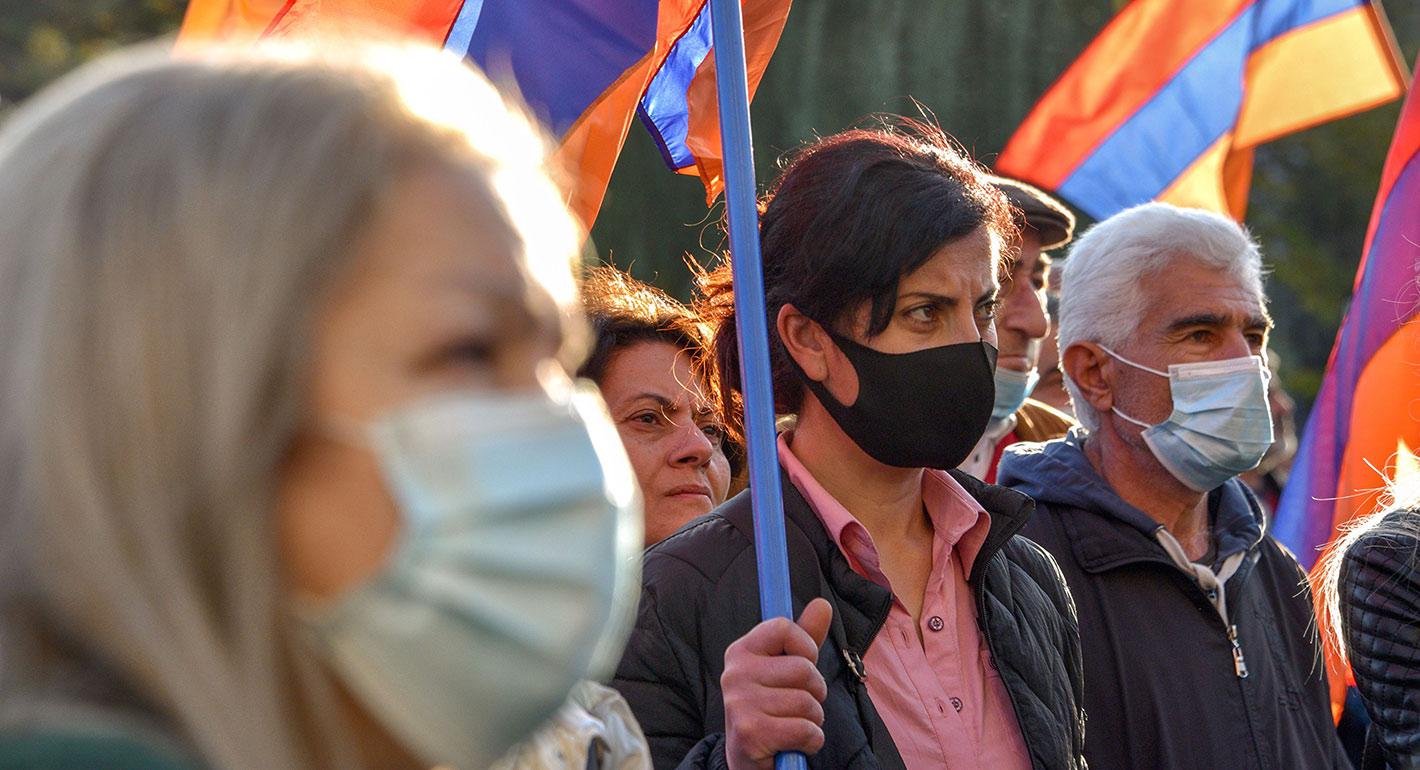
The six-week war between Armenia and Azerbaijan over Nagorno-Karabakh has ended, shifting the regional landscape in the Caucasus. Yet the fragile peace has come at great cost to Armenia, which feels betrayed by Russia and abandoned the West.
After three decades of on-again-off-again fighting between Armenians and Azerbaijanis over the enclave of Nagorno-Karabakh, the oldest frozen conflict in the former Soviet space appears to be over, at least for now. This should be a joyful moment, but there is little to celebrate. The agreement to end the fighting hammered out by Russia promises to be neither the end nor a new beginning. Instead, it is merely a pause in the long-standing imperial rivalries and religious and ethnic conflicts that have tormented the Caucasus for years.
First, peace—if it really is peace—comes not as a result of a negotiation, but after six weeks of bloody war that cost thousands of lives on both sides, including both combatants and civilians, and left many more displaced. Armenia suffered devastating losses on the battlefield. Its Soviet-era arms and strategy were no match for the fast-moving, high-tech, twenty-first-century war that Azerbaijan, with Turkish support, waged. Yerevan had no choice but to accept the humiliating terms that the majority of Armenians in Armenia and in the diaspora view as another chapter in its national tragedy, a defeat at the hands of its historic enemy Turkey. There is no room for reconciliation here; instead, the Armenian struggle will continue.
Second, Armenia’s democratically elected government has been dealt a devastating blow. The lesson many will take from this loss is that democracy and national security are incompatible. The angry mob that roamed Yerevan and brutally beat the country’s parliamentary speaker was not a sign of the country’s democratic health, but ominously reminiscent of the country’s tragic legacy of political violence. With the opposition—including hardline, corrupt, and non-democratic elements—gunning to oust Armenia’s prime minister, the promise of the country’s Velvet Revolution is more uncertain than ever.
Third, Armenia’s defeat comes at the hands of the authoritarian hereditary Azerbaijani regime, which is backed diplomatically and militarily by the increasingly authoritarian Turkish leader in the form of a treaty dictated to Armenia from Moscow. Azerbaijan’s previously unpopular leader, who was facing splits in his own government, is now a national hero. Some have concluded that war is good and might is right. To them, authoritarianism is the winner while democracy is the loser.
Fourth, the so-called treaty or agreement forged in Moscow is more notable for what is not in it than for what is. The status of the disputed territory is uncertain, while the fate of refugees and internally displaced persons is left vague. There is no real plan for reconstruction, stabilization, or reconciliation. The role of Turkey, which is not a signatory, is not formally mentioned, making it unclear what role it and Baku claims it will have. This new so-called peace appears more brittle than the frozen conflict that preceded it. The only thing that is clear is that Russia is expanding its military presence in the region, and possibly Turkey too, at Azerbaijan’s behest. With Moscow and Ankara butting heads elsewhere in the world, this is a recipe for more tension, not less.
Fifth, memories of three occasionally hopeful post-Soviet decades of independence are rapidly fading. The Caucasus is once again being trampled by its neighboring heavyweights clinging to their imperial aspirations. Putin is enforcing what former Russian president Dmitri Medvedev once called Russia’s “sphere of privileged interests.” Turkish President Recep Tayyip Erdogan, apparently fueled by neo-Ottoman visions, is trying to reestablish Turkey’s sphere of influence in the Caucasus and Caspian Sea region. This is unlikely to result in a happy condominium between the two and promises more trouble for the region. Meanwhile, Iran, Israel, and the Gulf States—all of which have increased their engagement with the region in recent years—watch nervously as the geopolitical landscape shifts.
Finally, the world doesn’t seem to care. Europe and the United States are distracted by their own problems, and the fate of Armenians matters little to them. For nearly three decades, Washington and Paris pledged their support to a negotiated solution to the conflict, but in the end neither proved capable of helping. Russia, another party to the talks, stood by and watched its ally Armenia get crushed on the battlefield and then cynically used its defeat to assert its claim to regional leadership. Moving forward, Washington and Paris could try to re-insert themselves and play a useful role in the region’s reconstruction and reconciliation—something with which the West has far greater experience than Moscow or Ankara. However, the outgoing administration of U.S. President Donald Trump shows little desire to do so, and the future administration of President-elect Joe Biden will be left with limited leverage by January.
What next? The outlook is bleak. Jubilation in Azerbaijan over the victory can do little to fix its economy, which has been battered by low oil prices, widespread corruption, and the consequences of the coronavirus pandemic. Armenia, badly wounded on the battlefield, has to reckon with trauma, the betrayal by Russia, an uncertain domestic political future, and a similarly fast-growing coronavirus crisis, particularly among the displaced.
Neither of the two countries aspiring to regional hegemony in the Caucasus—Russia and Turkey—will do much to address the region’s long-standing underlying problems. Their jockeying for advantage, which extends to Syria and Libya, is hardly a precondition for peace and stability in the Caucasus, which they have turned into another part of their geopolitical chessboard. They may hammer out something resembling a more durable arrangement for ending the Armenian-Azeri conflict, but any peace resulting from it will remain fragile. Neither big power seems interested in a real economic or political stabilization effort. The frozen conflict over Nagorno-Karabakh is being replaced by a frozen and stunted peace.

Former Senior Fellow, Russia and Eurasia Program
Paul Stronski was a senior fellow in Carnegie’s Russia and Eurasia Program, where his research focuses on the relationship between Russia and neighboring countries in Central Asia and the South Caucasus.
Recent Work
Paul Stronski
Paul Stronski
Carnegie does not take institutional positions on public policy issues; the views represented herein are those of the author(s) and do not necessarily reflect the views of Carnegie, its staff, or its trustees.

The Horn of Africa countries are among those facing a new security calculus.


Andrew Leber, Lesley Anne Warner

The European far right might fail to steer EU policy in the direction Russia wants, but they will create enough chaos inside Europe to benefit the Kremlin.

Dimitar Bechev

The new U.S.–Denmark–Greenland agreement will help Washington exert political, economic, and financial dominance under the guise of security. Yet, it acknowledged Copenhagen’s and Nuuk’s sovereignty on the island.

Marc Pierini

A summer of escalation in the Black Sea has hurt Ukraine economically and is exacerbating world food security. A truce is needed—as is a broader reframing of Europe’s Ukraine strategy.

Thomas de Waal

Are Germany’s economic, industrial, and political struggles becoming a liability for the EU’s ability to rise to the geopolitical moment?

Rym Momtaz, ed.