

Article
Micah Weinberg
{
  "authors": [
    "Micah Weinberg"
  ],
  "type": "other",
  "centerAffiliationAll": "dc",
  "centers": [
    "Carnegie Endowment for International Peace"
  ],
  "collections": [
    "Democratic Innovation"
  ],
  "englishNewsletterAll": "ctw",
  "nonEnglishNewsletterAll": "",
  "primaryCenter": "Carnegie Endowment for International Peace",
  "programAffiliation": "CC",
  "programs": [
    "Carnegie California"
  ],
  "projects": [],
  "regions": [
    "United States"
  ],
  "topics": [
    "Democracy",
    "Domestic Politics"
  ]
}
Source: Getty
A new series of articles will offer a deep evaluation of the state of democracy in California and contrast it with countries around the world.
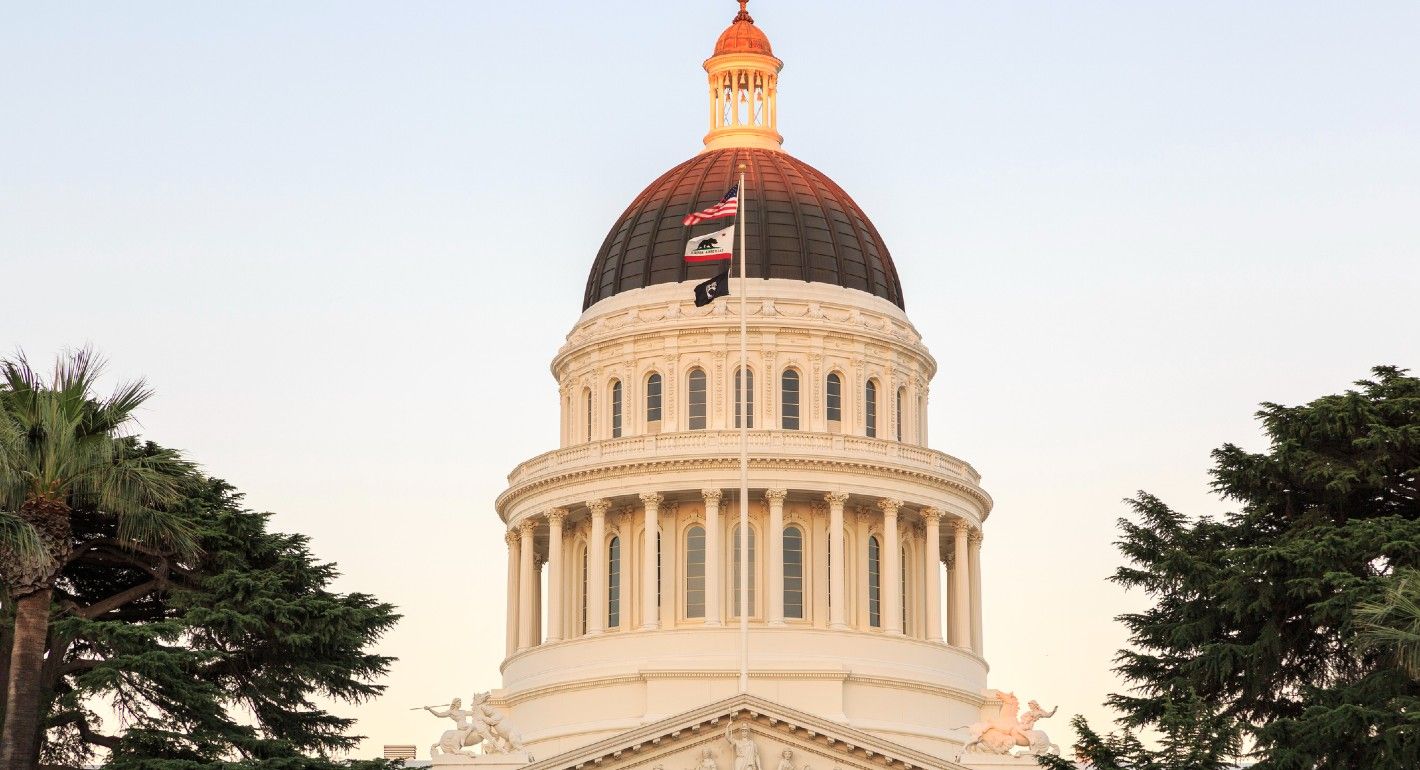
The state of California looms large in the global imagination, perhaps more than any other subnational unit in the world. It is a polity of nearly 40 million people with one of the world’s top-five economies.1 It is the birthplace of technologies that have transformed public life, from the first personal computers to the current explosion of generative artificial intelligence (AI). And it has been a leader in policy and cross-national partnerships in areas from climate change to LGBTQ rights. The state, though, is much more than Silicon Valley and Hollywood. A deeper understanding both of its political demographics and its governing systems calls into question its superficial image as a politically progressive—or “blue”—state and, especially, as a place primarily of power and privilege.
So, let’s reconsider: When adjusted for the cost of living, California has the highest rate of poverty in the United States.2 It is home to nearly half of the country’s homeless population. Politically, it has more registered Republicans than all but four other states. It is also a structurally “conservative” state in terms of having more control at the local level than many of its peers on issues from land use to the provision of social services to the utilization of the local initiative.3 There are large swaths of California that—both geographically and demographically—better resemble the Great Plains or the sprawling exurban southwest than the conventional pictures that the state’s name draws to mind, like the Golden Gate Bridge or the Hollywood sign. Much of what people assume about California may, in fact, be wrong in ways that are both interesting and important.
This is true of the state of democracy in California as well. Many residents of the state think of themselves as “defenders of democracy,” especially in the United States’ current political context.4 But California’s form of democracy is unconventional. It has not hosted meaningful partisan competition in decades, and its systems of statewide and local representative and direct democracy are often in conflict with and undermine each other.5
Recognizing both California’s strength as a symbol and the complexity of its democracy and politics in practice, this series will offer a deep evaluation of the state of democracy in California and contrast it with countries around the world. It will also look at instances in which the state can learn from other jurisdictions and practices in the United States and from the international community, including subnational peers and other nations with which it shares enormous economic power and cultural influence.
The series will include four pieces focused, in turn, upon:
People tend to have very passionate but sometimes narrow-minded opinions about California both within the United States and throughout the world. Framing it just as a beacon of hope or as a cautionary tale, however, does violence to its fascinating complexity. The world has much to learn from California, both good and bad. And California has a great deal to learn from others countries around the globe.
1Aidin Vaziri, “California Retains Standing as the World’s 5th Largest Economy,” San Francisco Chronicle, April 16, 2024.
2 Sarah Bohn et al., “Poverty in California,” Public Policy Institute of California, 2023.
3 Nestor M. Davidson and Richard C. Schragger, “Do Local Governments Really Have Too Much Power?,” 100 N.C. L. Rev. 1385 (2022); Deborah Kelch, “Locally Sourced: The Crucial Role Counties Play in the Health of Californians,” California HealthCare Foundation, 2017; Tracy Gordon, “The Local Initiative in California,” Public Policy Institute of California, 2004.
4 Edward Lempinen, “California Voters Are Deeply Worried About Political Disinformation, IGS Poll Finds,” Berkeley News, November 16, 2023, https://news.berkeley.edu/2023/11/16/california-voters-are-deeply-worried-about-political-disinformation-igs-poll-finds/.
5 Joe Mathews and Mark Paul, California Crackup: How Reform Broke the Golden State and How We Can Fix It (Berkeley, CA: University of California Press, 2010).
6See, for example, V. O. Key, Southern Politics in State and Nation (New York: Vintage Books, 1962).
7 Thomas Carothers and Andrew O’Donohue, eds., Democracies Divided: The Global Challenge of Political Polarization (Washington, DC: Brookings Institution, 2019).
8 “Governor Newsom Signs Historic Broadband Legislation to Help Bridge Digital Divide,” Governor Gavin Newsom’s website, July 20, 2021, https://www.gov.ca.gov/2021/07/20/governor-newsom-signs-historic-broadband-legislation-to-help-bridge-digital-divide/.
9 Darriya Starr, Joseph Hayes, and Niu Gao, “The Digital Divide in Education,” Public Policy Institute of California, June 2022, https://www.ppic.org/publication/the-digital-divide-in-education/.
10 Mark Baldassare and Lynette Ubois, “Californians Are Worried about Wildfires,” Public Policy Institute of California, August 2023, https://www.ppic.org/blog/californians-are-worried-about-wildfires/.
11 Associated Press, “California’s Homeless Population Rose 5.8% in 2023, While U.S. Rate Surged 12%,” San Francisco Standard, December 17, 2023, https://sfstandard.com/2023/12/17/californias-homeless-population-rose-5-8-in-2023-while-u-s-rate-surged-12/.
12 Sean Illing and Yascha Mounk, “Why So Many Westerners Feel Like Democracy Has Failed Them,” Vox, March 5, 2018, https://www.vox.com/2018/3/5/17035848/democracy-populism-trump-europe.
13 David Freeman Engstrom and Jeremy M. Weinstein, “What If California Had a Foreign Policy? The New Frontier of States’ Rights,” Washington Monthly, Spring 2018.

Nonresident Scholar, Carnegie California
Dr. Micah Weinberg is a nonresident scholar at Carnegie California. His scholarship centers on the global relevance of the quality of democracy and public policy in this important subnational polity.
Recent Work
Micah Weinberg
Micah Weinberg
Carnegie does not take institutional positions on public policy issues; the views represented herein are those of the author(s) and do not necessarily reflect the views of Carnegie, its staff, or its trustees.
It should address the shortcomings of previous crisis communication efforts and adapt to the demands of frontier AI.
Lucy Luo

If the Russian-speaking community in Latvia cannot articulate their interests without being seen as disloyal, they could end up embracing a pro-Kremlin agenda.

Sergejs Potapkins
Washington’s decision to support some UN functions while letting others wither is pulling the organization apart at the seams.

Stewart Patrick, Theodore Zaritsky

While there are notable demographic, economic, and geographic divides over AI, there is also substantial alignment between Republicans and Democrats.
Ian Klaus, Mark Baldassare, Rachel George, …

Russia’s ruling party would have benefited from Putin appearing as its distant patron, but as an active frontman imposing his views on the public, he has done nothing but harm both the party’s election campaign and the ruling system overall.

Andrey Pertsev