• Research
  • Emissary
  • About
  • Experts
Carnegie Global logoCarnegie lettermark logo
Democracy
  • Donate
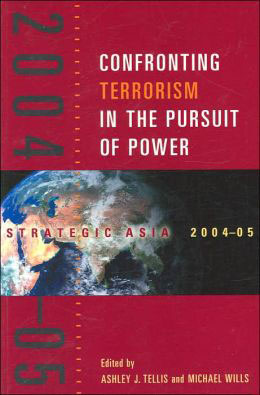
Strategic Asia 2004-05: Confronting Terrorism in the Pursuit of Power
Book

Strategic Asia 2004-05: Confronting Terrorism in the Pursuit of Power

A new book provides broad trend analyses of the major Asian sub-regions, as well as an array of transnational topical studies. It also evaluates current threats to regional peace and stability, considering how the strategic environment in Asia could change.

Link Copied
By Ashley J. Tellis and Michael Wills
Published on Oct 1, 2004

Additional Links

Introduction by Ashley Tellis
Program mobile hero image

Program

Asia

The Asia Program in Washington studies disruptive security, governance, and technological risks that threaten peace, growth, and opportunity in the Asia-Pacific region, including a focus on China, Japan, and the Korean peninsula.

Learn More
Program mobile hero image

Program

South Asia

The South Asia Program informs policy debates relating to the region’s security, economy, and political development. From strategic competition in the Indo-Pacific to India’s internal dynamics and U.S. engagement with the region, the program offers in-depth, rigorous research and analysis on South Asia’s most critical challenges.

Learn More

Source: The National Bureau of Asian Research

"The Strategic Asia Program is ambitious by drawing upon the best people in the nation, by analyzing key dynamics, and by tracking changes in the region."

—Robert A. Scalapino, University of California at Berkeley

Edited by Ashley J. Tellis and Michael Wills, and written by some of America’s leading specialists including Michael Swaine, senior associate at the Carnegie Endowment for International Peace, this new study provides an authoritative, independent assessment of the implications of the U.S.-led war on terrorism in Asia and analyzes its effects on the grand strategies of the region’s major powers.

Strategic Asia 2004–05: Confronting Terrorism in the Pursuit of Power includes broad trend analyses of the major Asian sub-regions, as well as an array of transnational topical studies. The reportcontains studies of five major powers in the region—the United States, China, Japan, Korea, and Russia—and regional studies on Central, South, and Southeast Asia, and the Middle East. It includes special studies on trends in energy security, proliferation of weapons of mass destruction, and science and technology in Asia, as well as alternative outcomes to the North Korean nuclear crisis.The book also evaluates current threats to regional peace and stability, and, through innovative forecasts, considers how the strategic environment in Asia could change surprisingly and underscores the reasons for, and implications of, such strategic discontinuities.

Order this book, or read the introduction by Ashley J. Tellis for free.

About the Authors

Ashley J. Tellis, senior associate at the Carnegie Endowment for International Peace, served in the U.S. Department of State as senior advisor to the Ambassador at the U.S. embassy in India and on the National Security Council staff as special assistant to the president and senior director, strategic planning and Southwest Asia. He is the author of India’s Emerging Nuclear Posture and co-author of Interpreting China’s Grand Strategy. He has co-edited Strategic Asia 2005-06: Military Modernization in an Era of Uncertainty.

Michael Wills is director of Southeast Asia Studies at The National Bureau of Asian Research.

Authors

Ashley J. Tellis
Former Senior Fellow
Michael Wills
National Bureau of Asian Research
North AmericaUnited StatesMiddle EastSouth AsiaIndiaEast AsiaSouth KoreaChinaJapanCentral AsiaCaucasusRussiaPolitical ReformEconomySecurityMilitaryForeign PolicyNuclear PolicyNuclear Energy

Carnegie does not take institutional positions on public policy issues; the views represented herein are those of the author(s) and do not necessarily reflect the views of Carnegie, its staff, or its trustees.

More Work from Carnegie Endowment for International Peace

  • People on a stage
    Commentary
    Emissary
    The Dangerous Consequences of Treating Colombia Like Venezuela

    When democracies and autocracies are seen as interchangeable targets, the language of democracy becomes hollow, and the incentives for democratic governance erode.

      • Sarah Yerkes

      Sarah Yerkes, Amr Hamzawy

  • Workers of automotive manufacturer VW assemble pieces of a model in the Uitenhage plant.
    Paper
    Win-Win: The Potential and Prospects of German FDI in Supporting the Structural Transformation of African Economies

    German manufacturing firms in Africa add value, jobs, and skills, while benefiting from demand and a diversification of trade and investment partners. It is in the interest of both African economies and Germany to deepen economic relations. 

      Hannah Grupp, Paul M. Lubeck

  • Commentary
    Carnegie Politika
    Has Trump the Destroyer Eclipsed Putin the Destroyer?

    Unexpectedly, Trump’s America appears to have replaced Putin’s Russia’s as the world’s biggest disruptor.

      Alexander Baunov

  • Soldier looking at a drone on the ground
    Commentary
    Emissary
    Are All Wars Now Drone Wars?

    From Sudan to Ukraine, UAVs have upended warfighting tactics and become one of the most destructive weapons of conflict.

      • Jon Bateman

      Jon Bateman, Steve Feldstein

  • Carney speaking on stage
    Commentary
    Emissary
    Carney’s Remarkable Message to Middle Powers

    And how they can respond.

      • +1

      Sophia Besch, Steve Feldstein, Stewart Patrick, …

Get more news and analysis from
Carnegie Endowment for International Peace
Carnegie global logo, stacked
1779 Massachusetts Avenue NWWashington, DC, 20036-2103Phone: 202 483 7600Fax: 202 483 1840
  • Research
  • Emissary
  • About
  • Experts
  • Donate
  • Programs
  • Events
  • Blogs
  • Podcasts
  • Contact
  • Annual Reports
  • Careers
  • Privacy
  • For Media
  • Government Resources
Get more news and analysis from
Carnegie Endowment for International Peace
© 2026 Carnegie Endowment for International Peace. All rights reserved.