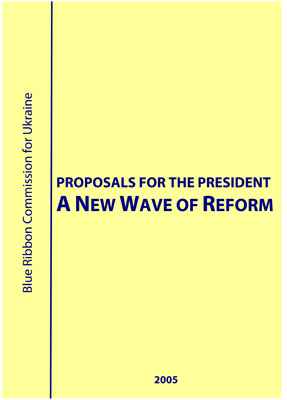
The outcome of Ukraine’s presidential elections has created an opportunity for dramatic change in the way the country is governed. Anticipating this possibility, a Blue Ribbon Commission composed of leading international and Ukrainian experts has drafted a report providing over a hundred specific policy recommendations to the new President. The authors of the report urge the new administration to undertake a sweeping "new wave" of reform, with the aim of recasting relations between state and society, sustaining current high rates of growth, and broadening the reach of prosperity. The report will be presented to Viktor Yushchenko on the eve of his inauguration, and publicized widely among policy makers, business leaders, and journalists, both in Ukraine and abroad.
The report identifies five key areas for reform. First, and most urgent, is political reform. The fundamental problem in Ukraine, as in other postcommunist countries, is that the state rules its citizens, rather than serving them. The relationship between state and citizens must change, the report concludes. To win the confidence of its citizens, the state machinery must become efficient through real control by society and law. Second, social spending in areas such as health care and education needs to be made more effective so that it benefits the truly needy, rather than mainly the well-off, as is now the case. Third, the tax system and the legal foundations of the financial system need to be overhauled so that they work to stimulate economic growth. Fourth, a clear line must be drawn between the state and private enterprise, so that property rights are fully guaranteed. Fifth, integration into the world economy must be facilitated through early accession to the World Trade Organization (WTO) and closer integration with the European Union (EU).
The report is designed to be a hands-on document of genuine practical use to the new administration in Ukraine, with most measures designed for enactment within the new President’s first year in office. Of the report’s many specific policy recommendations, the Blue Ribbon Commission has identified the following 12 as the most urgent:
- Enact an administrative reform based on the principles of accountability, transparency, and professionalism, and enshrining the rights of ordinary citizens;
- Reform the judicial system to make judges independent and impartial, and to make the court administration more efficient;
- Enact a territorial-administrative reform, improving the delivery of public services by devolving power and resources to regional and local bodies;
- Introduce mandatory public medical insurance, using a multi-level insurance-based approach for financing that provides for competition among care providers;
- Enact a liberal tax code that reduces the number of taxes, lowers tax rates, eliminates exemptions, and eliminates competing revenue services;
- Reduce public expenditures substantially by eliminating non-essential and harmful spending (such as enterprise subsidies) and target social benefits to the truly needy;
- Improve corporate legislation (and pass a modern law on joint-stock companies), by enacting rules to introduce ownership transparency and protect minority shareholders;
- To eliminate conflict between two contradictory legislative frameworks, abolish the anachronistic Economic Code and develop the market-oriented Civil Code;
- Create functioning property markets by ending the moratorium on the sale of agricultural land and developing a unified property register;
- Create a level playing field for economic activity by abolishing regulatory discrimination and subsidies and halting state intervention in pricing and trade;
- Join the WTO in 2005; and
- Make Ukraine’s "European Choice" a reality by adopting European legal standards and forging an initial action plan with the EU that paves the way to a free trade agreement and makes future membership of the EU a real opportunity.
"We recommend this report as a practical checklist of ‘second wave’ political and economic reforms—not just for Ukraine, but also for many other former Soviet countries where recent spurts of economic growth have not been matched by the far-reaching structural reforms needed to secure democratic governance and combat poverty," said Kalman Mizsei, the UN Assistant Secretary General and UNDP Assistant Administrator who helped create the Blue Ribbon Commission and served as a member.
The Blue Ribbon Commission, formed in July 2004, was co-chaired by Anders Åslund, Director of the Russian & Eurasian Program at the Carnegie Endowment for International Peace in Washington, D.C., and Oleksandr Paskhaver, President of the Kyiv-based Center of Economic Development. Other commission members included Iryna Akimova, Dan Bilak, Ihor Burakovsky, Oleksandr Chalyi, Keith Crane, Marek Dabrowski, Adrian Karatnytcky, Ihor Koliushko, Oleksandra Kuzhel, Dmytro Leonov, Georges de Menil, Vira Nanivska, Jerzy Osiatynski, Oleksandr Rohozynsky, Oleksandr Shevtsov, and Ben Slay. UNDP’s office in Ukraine provided the funding for the project, but the Blue Ribbon Commission enjoyed full freedom in defining recommendations and drafting the report.
Click on the link above for full text of the Report in English and Ukrainian.
About UNDP
UNDP is the UN’s global development network, focused on helping countries build and share solutions to the challenges of democratic governance, poverty reduction, HIV/AIDS, crisis prevention and recovery, energy and environment, and information and communications technology. We are on the ground in 166 countries, working with them on their own solutions to global and national development challenges. For information see www.undp.org