• Research
  • Emissary
  • About
  • Experts
Carnegie Global logoCarnegie lettermark logo
DemocracyIran
  • Donate
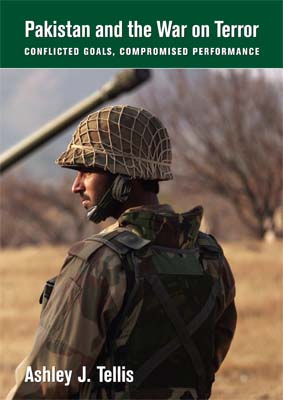
Pakistan and the War on Terror: Conflicted Goals, Compromised Performance
Report

Pakistan and the War on Terror: Conflicted Goals, Compromised Performance

The United States must shift its counterterrorism policy towards Pakistan away from a reciprocal approach—requiring Islamabad to perform desirable actions to receive support—towards one encouraging Pakistan to enact effective counterterrorism policies, not for an immediate payoff, but to strengthen institutionalized trust with the U.S. over time,

Link Copied
By Ashley J. Tellis
Published on Jan 18, 2008

Additional Links

Full Text
Program mobile hero image

Program

South Asia

The South Asia Program informs policy debates relating to the region’s security, economy, and political development. From strategic competition in the Indo-Pacific to India’s internal dynamics and U.S. engagement with the region, the program offers in-depth, rigorous research and analysis on South Asia’s most critical challenges.

Learn More

The United States must shift its counterterrorism policy towards Pakistan away from a reciprocal approach—requiring Islamabad to perform desirable actions to receive support—towards one encouraging Pakistan to enact effective counterterrorism policies, not for an immediate payoff, but to strengthen institutionalized trust with the U.S. over time, according to a new report from the Carnegie Endowment.

In Pakistan and the War on Terror: Conflicted Goals, Compromised Performance, Carnegie Senior Associate Ashley J. Tellis points to growing dissatisfaction in the United States with the Musharraf regime’s commitment to counterterrorism operations, given the influx of U.S. aid. But while Pakistan’s performance in the “war on terror” has fallen short of expectations, Islamabad’s inability to defeat terrorist groups cannot simply be explained by neglect or lack of motivation. U.S. policy makers must take into account the specific and complex counterterrorism challenges facing Pakistan and move away from their current unsustainable policies.

Nine strategies for more effective U.S. counterterrorism policies towards Pakistan:

  1. Speak clearly and forcefully to Musharraf in private about U.S. frustrations with Pakistan’s counterterrorism performance to outline the prospective consequences inaction will have on the U.S.-Pakistan relationship.

  2. Continue to encourage Pakistan’s border control efforts, but prioritize the targeting of Taliban leadership operating in Pakistan as part of the current counterterrorism concept of operations.

  3. Restructure the intelligence relationship between the U.S. and Pakistan to allow both the CIA and coalition forces in Afghanistan to acquire greater insight into existing terrorist networks inside Pakistan.

  4. Continue to assist Pakistan with technology and training to prosecute small-unit counterterrorism operations more effectively.

  5. Reform accounting practices to ensure effective oversight and auditing of coalition funds disbursed to Pakistan for counterterrorism operations.

  6. The reestablishment of stable democratic order is essential to stop Pakistan’s spiraling descent into extremism and disorder. The United States must integrate the ongoing political transition in Pakistan, including a return to democracy and rule of law, into the larger war on terrorism.

  7. Commit to long-term assistance for the Karzai government in Afghanistan to address the vacuum of governance, particularly with regards to security, economic development, and narcotics production.

  8. Commit more manpower and material contributions to help NATO live up to its security obligations in Afghanistan.

  9. Accelerate the raising of the Afghan National Army (ANA) as a hedge against the possible failure of NATO to restructure the International Security Assistance Force (ISAF) to effectively fight and win the war in Afghanistan.

“The Bush administration ought to persist with its current emphasis on the noncoercive engagement of Pakistan at least so long as there is a reasonable hope that the transformation of Pakistan into a moderate Muslim state is not a lost cause, that the Musharraf regime can be persuaded to expand its counterterrorism operations to those groups that have thus far remained beyond reach, and that the United States will have sufficient opportunity to switch to an alternative strategy before the present attempt at engagement is judged to have failed irremediably.”

A limited number of print copies are available.
Request a copy

About the Author

Ashley J. Tellis

Former Senior Fellow

Ashley J. Tellis was a senior fellow at the Carnegie Endowment for International Peace.

    Recent Work

  • Paper
    Multipolar Dreams, Bipolar Realities: India’s Great Power Future

      Ashley J. Tellis

  • Commentary
    India Sees Opportunity in Trump’s Global Turbulence. That Could Backfire.

      Ashley J. Tellis

Ashley J. Tellis
Former Senior Fellow
South AsiaPakistanSecurityMilitaryForeign Policy

Carnegie does not take institutional positions on public policy issues; the views represented herein are those of the author(s) and do not necessarily reflect the views of Carnegie, its staff, or its trustees.
More Work from Carnegie Endowment for International Peace

  • Trump seated and gesturing while speaking
    Commentary
    Emissary
    The Iran War Is Making America Less Safe

    A conflict launched in the name of American security is producing the opposite effect.

      • Sarah Yerkes

      Sarah Yerkes

  • Commentary
    Strategic Europe
    Taking the Pulse: Is it NATO’s Job to Support Trump’s War of Choice?

    Donald Trump has demanded that European allies send ships to the Strait of Hormuz while his war of choice in Iran rages on. He has constantly berated NATO while the alliance’s secretary-general has emphatically supported him.

      • Rym Momtaz

      Rym Momtaz, ed.

  • India and a Changing Global Order: Foreign Policy in the Trump 2.0 Era
    Research
    India and a Changing Global Order: Foreign Policy in the Trump 2.0 Era

    Trump 2.0 has unsettled India’s external environment—but has not overturned its foreign policy strategy, which continues to rely on diversification, hedging, and calibrated partnerships across a fractured order.

      • Sameer Lalwani
      • +6

      Milan Vaishnav, ed., Sameer Lalwani, Tanvi Madan, …

  • Commentary
    Carnegie Politika
    Lukashenko’s Bromance With Trump Has a Sell-By Date

    Lukashenko is willing to make big sacrifices for an invitation to Mar-a-Lago or the White House. He also knows that the clock is ticking: he must squeeze as much out of the Trump administration as he can before congressional elections in November leave Trump hamstrung or distracted.

      Artyom Shraibman

  • Indian Prime Minister Narendra Modi, wearing an orange cap, and the Chief Minister of Uttar Pradesh, Yogi Adityanath, dressed in saffron robes, are greeting supporters of the Bharatiya Janata Party (BJP) during a roadshow ahead of the Indian General Elections in Ghaziabad, Uttar Pradesh, India, on April 6, 2024.Trump raises hands behind a lecternCarney speaking on stage
    Collection
    The Middle Power Moment?

    The world has entered an era of upheaval—a period of heightened geopolitical rivalry, deepening political polarization, quickening technological change, glaring economic inequality, accelerating environmental crises, and eroding respect for international law. This moment of disruption and fluidity is also one of opportunity, however. It provides openings for middle powers, both established and emerging, to exercise unaccustomed agency and influence the future of global order.

    Carnegie scholars are analyzing middle power responses to this moment of upheaval and assessing whether—and under what conditions—these states can contribute to practical problem solving. They are asking critical, concrete questions: What countries, precisely, are we talking about when we refer to middle powers? In what issue areas do their priorities converge and diverge, including across North-South divides? In what domains can middle powers pack a punch, rather than produce a whimper? Are they willing to shoulder actual burdens and responsibility? Finally, how can middle powers assert themselves globally, without running afoul of or threatening their relations with the United States or China?

Get more news and analysis from
Carnegie Endowment for International Peace
Carnegie global logo, stacked
1779 Massachusetts Avenue NWWashington, DC, 20036-2103Phone: 202 483 7600Fax: 202 483 1840
  • Research
  • Emissary
  • About
  • Experts
  • Donate
  • Programs
  • Events
  • Blogs
  • Podcasts
  • Contact
  • Annual Reports
  • Careers
  • Privacy
  • For Media
  • Government Resources
Get more news and analysis from
Carnegie Endowment for International Peace
© 2026 Carnegie Endowment for International Peace. All rights reserved.