
• Research
  • Emissary
  • About
  • Experts
Carnegie Global logoCarnegie lettermark logo
Democracy
  • Donate
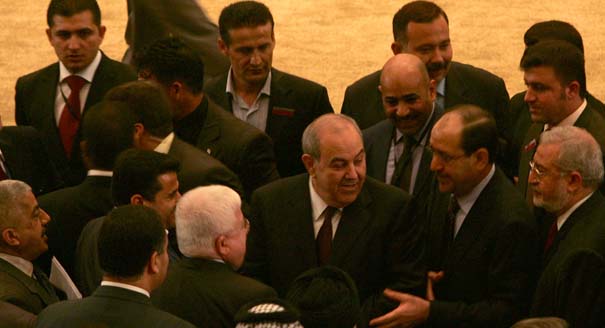
From Elections to a New Government

Source: Getty

Article

From Elections to a New Government

The formal process that leads from the elections to the formation of a new government in Iraq is extremely complicated and bound to take time, even without taking into consideration the difficulty of forming viable political alliances.

Link Copied
Published on Mar 15, 2010
Program mobile hero image

Program

Middle East

The Middle East Program in Washington combines in-depth regional knowledge with incisive comparative analysis to provide deeply informed recommendations. With expertise in the Gulf, North Africa, Iran, and Israel/Palestine, we examine crosscutting themes of political, economic, and social change in both English and Arabic.

Learn More

The formal process that leads from the elections to the formation of a new government is extremely complicated and bound to take time, even without taking into consideration the difficulty of forming viable political alliances.

  • Ballot Counting
  • Complaints Process
  • Allocation of General Seats among Lists and Candidates
  • Seating of Parliament and Election of the Speaker and the President of the Iraqi Republic
  • Formation of the Council of Ministers

Ballot Counting:

  • The ballots will be counted in each polling station and then forwarded to a provincial center for verification. From there it goes to the Independent High Electoral Commission (IHEC) Document Entry Center in Baghdad where data is entered and compiled.

Complaints Process:

  • The complaint must be filed within 48 hours of witnessing the alleged breach.
     
  • The polling station must send the original copy of the complaint to the Advisory and Complaints Office of the IHEC, and keep another copy at the station.
     
  • If the complaint is accepted, the “complained against” will be informed of the accusation. That person has two days to reply, after which the complaint office will take a decision.
     
  • The complaints are then categorized as red, green or yellow depending on their impact and their threat to the integrity of the process
    • Red complaints must be investigated within three days. 
    • Green complaints will be filed for investigation later, as they are not deemed to affect the results of the vote.
    • The yellow complaints are ignored, as they do not have real grounds.
       
  • When the Advisory and Complaints office decides on the complaint, the decision is published in three newspapers and on the IHEC website, giving affected parties the right to appeal to the electoral judicial body within the three days following the publication of the decisions. This body was created by the law setting up the IHEC and consists of three judges.

Allocation of General Seats Among Lists and Candidates

  • The number of valid votes cast in each electoral district (not including votes cast for minorities seats—are divided by the number of seats allocated to the district, thus determining the number of votes necessary to win a seat in that district. 
     
  • If a political entity obtains fewer votes than what is needed for one seat, they are excluded from the allocation of general seats, but then are eligible for the allocation of compensatory seats.
     
  • The number of votes obtained by each list is divided by the number of votes required to obtain a seat, thus determining the number of seats won by each list. Since most parties will have won votes in excess of the number of seats they are allocated in this fashion (but not enough to win an additional seat) at the end of this process there will remain unallocated or “empty” seats.
     
  • Such seats will be allocated according to a formula that favors parties that already received the largest number of seats.
     
  • The names of candidates are reorganized inside the open list based on the number of votes each got, from most to least.
     
  • The seats acquired by each list are allocated based on the new order.

Seating of Parliament and Election of the Speaker and the President of the Iraqi Republic

  • Once seats have been allocated among lists and candidates, incumbent President Jalal Talabani must “call upon the Council of Representatives to convene by a presidential decree within fifteen days from the date of the ratification of the general election results. Its eldest member shall chair the first session to elect the speaker of the Council and his two deputies. This period may not be extended by more than the aforementioned period (fifteen days).” (Article 52, Iraqi Constitution) 
     
  • The Council of Representatives (Parliament) shall elect the speaker and his two deputies by means of secret ballot and with an absolute majority. (Article 53)
     
  •  The Council of Representatives then has thirty days to elect a new president of the Iraqi Republic. The candidate who obtains the support of two-thirds of the Parliament is thus seated. (Article 67). A provisional clause in the constitution replaced the president with a presidency council, including a president and two vice-presidents, after the 2005 elections. The new Council of Representatives will elect a single president with no vice-presidents. 

Formation of the Council of Ministers

  •  The largest bloc in Parliament will set forth a nominee for the post of prime minister. (The constitution is ambiguous here, and it is not clear whether the largest bloc means the alliance that won the largest number of votes, or the largest bloc constituted within the parliament after the election—the two could be quite different at this point). Within fifteen days of his election, the president of the republic will ask the nominee to form the council of ministers. (Article 73)
     
  • The prime minister-designate has thirty days to form his government and present it to the Council of Representatives. The Council must approve, by absolute majority, the ministers and the proposed program.
     
  •  If the prime minister designate cannot form a cabinet or the cabinet does not obtain the vote of confidence of the Council of Representatives, the president must charge another nominee with the task of forming the government and the process is repeated.
Middle EastIraqGulfPolitical Reform

Carnegie does not take institutional positions on public policy issues; the views represented herein are those of the author(s) and do not necessarily reflect the views of Carnegie, its staff, or its trustees.

More Work from Carnegie Endowment for International Peace

  • Commentary
    Strategic Europe
    Europolis, Where Europe Ends

    A prophetic Romanian novel about a town at the mouth of the Danube carries a warning: Europe decays when it stops looking outward. In a world of increasing insularity, the EU should heed its warning.

      Thomas de Waal

  • Commentary
    Carnegie Politika
    Japan’s “Militarist Turn” and What It Means for Russia

    For a real example of political forces engaged in the militarization of society, the Russian leadership might consider looking closer to home.

      James D.J. Brown

  • Stack of Iranian newspapers featuring Trump's face and a burning American flag
    Commentary
    Emissary
    The United States Should Apply the Arab Spring’s Lessons to Its Iran Response

    The uprisings showed that foreign military intervention rarely produced democratic breakthroughs.

      • Sarah Yerkes

      Amr Hamzawy, Sarah Yerkes

  • Commentary
    Sada
    Sub-Saharan African Migrants in Morocco: Security Concerns and the Test of Human Rights

    Is Morocco’s migration policy protecting Sub-Saharan African migrants or managing them for political and security ends? This article unpacks the gaps, the risks, and the paths toward real rights-based integration.

      Soufiane Elgoumri

  • Police standing watch
    Commentary
    Emissary
    What’s Keeping the Iranian Regime in Power—for Now

    A conversation with Karim Sadjadpour and Robin Wright about the recent protests and where the Islamic Republic might go from here.

      Aaron David Miller, Karim Sadjadpour, Robin Wright

Get more news and analysis from
Carnegie Endowment for International Peace
Carnegie global logo, stacked
1779 Massachusetts Avenue NWWashington, DC, 20036-2103Phone: 202 483 7600Fax: 202 483 1840
  • Research
  • Emissary
  • About
  • Experts
  • Donate
  • Programs
  • Events
  • Blogs
  • Podcasts
  • Contact
  • Annual Reports
  • Careers
  • Privacy
  • For Media
  • Government Resources
Get more news and analysis from
Carnegie Endowment for International Peace
© 2026 Carnegie Endowment for International Peace. All rights reserved.