

Commentary
Before the next wave of EU enlargement takes place, the union needs to grapple with thorny questions of how power is distributed among its members.
Emil Sondaj Hansen, Ditte Brasso Sørensen
Source: Getty
Even though the Obama administration was unable to persuade President Mubarak to accept international election monitors, it is important to continue showing U.S. support for political reform and human rights in Egypt.
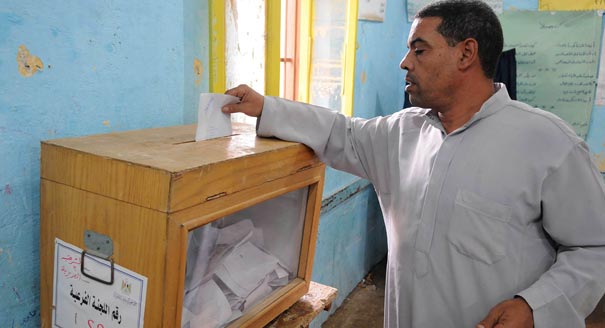
As Egypt heads toward elections for the lower house of parliament on November 28 and the presidency in 2011, Cairo’s officials have got their story straight and they are sticking to it: this proud nation needs no international observation of its elections, which will proceed according to well-established laws and constitutional precepts. There is just one problem with this story, which is the history of past elections in the country: rigged and often violent. In fact, Egyptians’ sense of trust in formal politics (never great) has deteriorated to the extent that several opposition parties will boycott and those that will participate are suffering from internal rifts because many of their members do not want to legitimize the existing system.

Former Nonresident Scholar, Middle East Program
Michele Dunne was a nonresident scholar in Carnegie’s Middle East Program, where her research focuses on political and economic change in Arab countries, particularly Egypt, as well as U.S. policy in the Middle East.

Director, Middle East Program
Amr Hamzawy is a senior fellow and the director of the Carnegie Middle East Program. His research and writings focus on Egypt’s and other middle powers’ involvement in regional security in the Middle East, particularly through collective diplomacy and multilateral conflict resolution
Carnegie does not take institutional positions on public policy issues; the views represented herein are those of the author(s) and do not necessarily reflect the views of Carnegie, its staff, or its trustees.

Before the next wave of EU enlargement takes place, the union needs to grapple with thorny questions of how power is distributed among its members.


Emil Sondaj Hansen, Ditte Brasso Sørensen

The Horn of Africa countries are among those facing a new security calculus.


Andrew Leber, Lesley Anne Warner

The European far right might fail to steer EU policy in the direction Russia wants, but they will create enough chaos inside Europe to benefit the Kremlin.

Dimitar Bechev

As the U.S. stumbles in its war with Iran, we are likely to see an acceleration of its disengagement from the region.

Michael Young

In Egypt’s dense cities, the disappearance of foliage has health implications and punishes daily commuters.

Angie Omar