• Research
  • Emissary
  • About
  • Experts
Carnegie Global logoCarnegie lettermark logo
Democracy
  • Donate
The Arab World's Education Report Card: School Climate and Citizenship Skills

Source: Getty

Paper
Malcolm H. Kerr Carnegie Middle East Center

The Arab World's Education Report Card: School Climate and Citizenship Skills

Absent a good education environment, there is little room for the Arab world’s youth to turn into responsible citizens who can consolidate and stimulate social transformation to bring about more prosperous and free societies.

Link Copied
By Muhammad Faour
Published on Feb 1, 2012

Additional Links

Full Text

The youth of the Arab world have driven much of the popular upheaval that has overtaken the region in the last year. Calling for fundamental political and economic change, they seek to remake their societies into more open, global players. But if that grassroots momentum is to be solidified, real societal reform must take place.

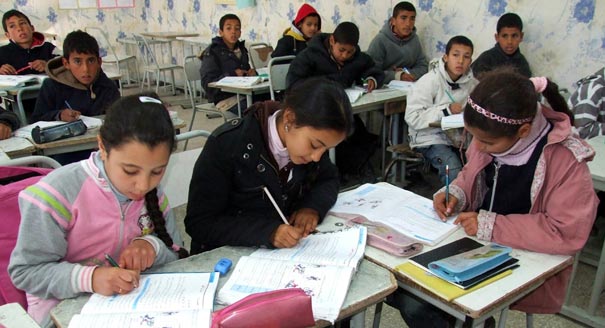
In burgeoning democracies such as Tunisia, Egypt, and Libya, schools can be change agents and effective elements in the development of long-lasting democratic skills and values such as freedom, equality, social justice, and respect for diversity and basic human rights. With more than 40 percent of people in the Arab world under the age of eighteen, schools are key social and political actors that can strongly impact the process of democratization.

A growing body of research has shown that a positive school climate is imperative to ensuring progress on this front. The character and quality of school life, which reflects values, goals, organizational structure, interpersonal relationships, and teaching and learning practices, can either promote or hinder a student’s education and future success.

Unfortunately, in much of the Arab world school climates are generally negative. Indexes that combine data from three international studies and measure schools’ safety, teaching, learning, and institutional environments in fourteen Arab countries paint a picture that is far from rosy. Many students do not feel safe physically, socially, and emotionally in schools. Substantial percentages of teachers entered their profession with deficient academic preparation and pre-service training and do not receive adequate and appropriate professional development during service. Reliance on rote memorization of facts, student and teacher absenteeism, classroom overcrowding, and limited resources all contribute to the problem as well.

Much needs to be done. First and foremost, decisionmakers must find the political will to endorse serious comprehensive education reforms that target the entire school culture. All Arab countries should improve the status and qualifications of their teachers, and establish systems of good governance at both the local and central levels along with transparency and public accountability. Absent a good education environment, there is little room for the Arab world’s youth to turn into responsible citizens who can consolidate and stimulate social transformation to bring about more prosperous and free societies.

Muhammad Faour
Former Senior Associate , Middle East Center
Muhammad Faour
EgyptGulfLevantMaghrebMiddle EastNorth AfricaPolitical ReformEducation

Carnegie does not take institutional positions on public policy issues; the views represented herein are those of the author(s) and do not necessarily reflect the views of Carnegie, its staff, or its trustees.

More Work from Carnegie Endowment for International Peace

  • Commentary
    Carnegie Politika
    In Uzbekistan, the President’s Daughter Is Now His Second-in-Command

    Having failed to build a team that he can fully trust or establish strong state institutions, Mirziyoyev has become reliant on his family.

      Galiya Ibragimova

  • Commentary
    Strategic Europe
    Europolis, Where Europe Ends

    A prophetic Romanian novel about a town at the mouth of the Danube carries a warning: Europe decays when it stops looking outward. In a world of increasing insularity, the EU should heed its warning.

      Thomas de Waal

  • Commentary
    Carnegie Politika
    Japan’s “Militarist Turn” and What It Means for Russia

    For a real example of political forces engaged in the militarization of society, the Russian leadership might consider looking closer to home.

      James D.J. Brown

  • Stack of Iranian newspapers featuring Trump's face and a burning American flag
    Commentary
    Emissary
    The United States Should Apply the Arab Spring’s Lessons to Its Iran Response

    The uprisings showed that foreign military intervention rarely produced democratic breakthroughs.

      • Sarah Yerkes

      Amr Hamzawy, Sarah Yerkes

  • Photo of Duma Boko in a gray suit waving at a crowd.
    Article
    Africa’s Democratic Kaleidoscope: Trends to Watch in 2026

    Supporters of democracy within and outside the continent should track these four patterns in the coming year.

      Saskia Brechenmacher, Frances Z. Brown

Get more news and analysis from
Carnegie Endowment for International Peace
Carnegie global logo, stacked
1779 Massachusetts Avenue NWWashington, DC, 20036-2103Phone: 202 483 7600Fax: 202 483 1840
  • Research
  • Emissary
  • About
  • Experts
  • Donate
  • Programs
  • Events
  • Blogs
  • Podcasts
  • Contact
  • Annual Reports
  • Careers
  • Privacy
  • For Media
  • Government Resources
Get more news and analysis from
Carnegie Endowment for International Peace
© 2026 Carnegie Endowment for International Peace. All rights reserved.