• Research
  • Emissary
  • About
  • Experts
Carnegie Global logoCarnegie lettermark logo
DemocracyIran
  • Donate
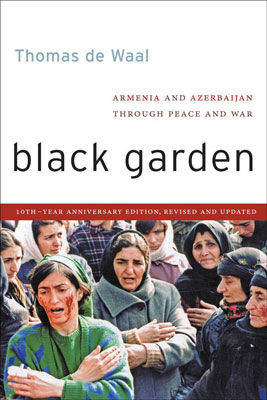
Black Garden: Armenia and Azerbaijan Through Peace and War, 10th Year Anniversary Edition
Book
Carnegie Europe

Black Garden: Armenia and Azerbaijan Through Peace and War, 10th Year Anniversary Edition

Nearly 20 years since the 1994 ceasefire, Armenia and Azerbaijan have still failed to resolve their dispute and normalize relations.

Link Copied
By Thomas de Waal
Published on Jul 8, 2013
Program mobile hero image

Program

Russia and Eurasia

The Russia and Eurasia Program continues Carnegie’s long tradition of independent research on major political, societal, and security trends in and U.S. policy toward a region that has been upended by Russia’s war against Ukraine.  Leaders regularly turn to our work for clear-eyed, relevant analyses on the region to inform their policy decisions.

Learn More

Source: NYU Press

Ten years after its initial release, Black Garden remains the definitive account of war and peace between Armenia and Azerbaijan, and the conflict over Nagorny Karabakh. Based on the author’s extensive experience in the region, Black Garden is the product of more than 120 original interviews in the South Caucasus, Moscow, and Washington, and a unique collection of historical primary sources. De Waal reveals a fascinating historical context for the conflict, including how it precipitated the end of the Soviet Union and thrust an entire region into disarray. Now nearly 20 years since the 1994 ceasefire, Yerevan and Baku have still failed to resolve the dispute and normalize relations.

In Focus

The revised and updated 10th year anniversary edition includes a new forward and an expanded conclusion that analyzes the reasons for the intractability of the conflict and the prospects for its resolution.

This edition has also been expanded to cover regional developments up to 2012, including the election of new presidents in countries, Azerbaijan’s oil boom, and the new arms race in the region.

About the Author

Thomas de Waal

Senior Fellow, Carnegie Europe

De Waal is a senior fellow at Carnegie Europe, specializing in Eastern Europe and the Caucasus.

    Recent Work

  • Article
    Rewiring the South Caucasus: TRIPP and the New Geopolitics of Connectivity
      • Areg Kochinyan

      Thomas de Waal, Areg Kochinyan, Zaur Shiriyev

  • Commentary
    Europolis, Where Europe Ends

      Thomas de Waal

Thomas de Waal
Senior Fellow, Carnegie Europe
Thomas de Waal
CaucasusRussiaAzerbaijanArmeniaSecurity

Carnegie does not take institutional positions on public policy issues; the views represented herein are those of the author(s) and do not necessarily reflect the views of Carnegie, its staff, or its trustees.

More Work from Carnegie Endowment for International Peace

  • Article
    India’s Oil Security Strategy: Structural Vulnerabilities and Strategic Choices

    This piece argues that the present Indian strategy, based on opportunistic diversification and utilization of limited strategic reserves, remains inadequate when confronting supply disruptions. It evaluates India’s options in the short, medium, and long terms.

      Vrinda Sahai

  • flood wall
    Commentary
    Emissary
    BRIC Is Critical for U.S. National Security. After a Yearlong Legal Battle, It’s Back.

    Its reinstatement should be celebrated, but it retains some major shortcomings.

      Leonardo Martinez-Diaz

  • Article
    Leveraging Internal Security Cooperation with Vietnam Offers a Glimpse of Future Chinese Diplomacy with Southeast Asia

    Despite long-standing differences, China and Vietnam are reinforcing common ground for collaboration, especially in public security. This internal security–centered diplomacy offers a strengthened road map for how China moves forward with Southeast Asia.

      Sophie Zhuang

  • Commentary
    Carnegie Politika
    Is There a Place for Russia in the New Race Back to the Moon?

    Despite having the resources and expertise, the Russian space industry missed the opportunity to offer the United States or China a mutually rewarding partnership in the lunar race.

      Georgy Trishkin

  •  A machine gun of a Houthi soldier mounted on a police vehicle next to a billboard depicting the U.S. president Donald Trump and Mohammed Bin Salman, the Crown Prince and Prime Minister of Saudi Arabia, during a protest staged to show support to Iran against the U.S.-Israel war on March 27, 2026 in Sana'a, Yemen.
    Collection
    The Iran War’s Global Reach

    As the war between the United States, Israel, and Iran continues, Carnegie scholars contribute cutting-edge analysis on the events of the war and their wide-reaching implications. From the impact on Iran and its immediate neighbors to the responses from Gulf states to fuel and fertilizer shortages caused by the effective shutdown of the Strait of Hormuz, the war is reshaping Middle East alliances and creating shockwaves around the world. Carnegie experts analyze it all.

Get more news and analysis from
Carnegie Endowment for International Peace
Carnegie global logo, stacked
1779 Massachusetts Avenue NWWashington, DC, 20036-2103Phone: 202 483 7600Fax: 202 483 1840
  • Research
  • Emissary
  • About
  • Experts
  • Donate
  • Programs
  • Events
  • Blogs
  • Podcasts
  • Contact
  • Annual Reports
  • Careers
  • Privacy
  • For Media
  • Government Resources
Get more news and analysis from
Carnegie Endowment for International Peace
© 2026 Carnegie Endowment for International Peace. All rights reserved.