

Commentary
In an interview, Ian Lustick and Eli Clifton discuss their new book on why a prominent ally has so much influence in America.
Michael Young
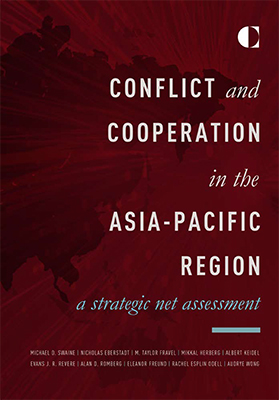
The Asia-Pacific region is undergoing enormous change, fueled by high levels of economic growth and deepening levels of integration. These and other forces are generating a shift in the distribution of economic, political, and military power across the region.
The Asia-Pacific region is undergoing enormous change, fueled by high levels of economic growth and deepening levels of integration. These and other forces are generating a shift in the distribution of economic, political, and military power across the region. This changing security environment poses a major challenge for the United States, the historically dominant power in maritime Asia. Efforts to enhance regional cooperation, reassure allies, and deter and shape potentially destabilizing behavior are demanding a more complex mixture of U.S. skills and understanding. An array of current and likely long-term forces will drive both cooperation and conflict across the Asia-Pacific region.
There are five different security environments that could emerge in the Asia-Pacific region over the next twenty-five years (in order of likelihood):
Identify U.S. interests in the Asia-Pacific. U.S. agencies should identify the United States’ longterm primary, secondary, and tertiary strategic interests in the Asia-Pacific.
Conduct an unprecedented U.S.-China strategic dialogue. An ongoing, government-supported but unofficial track 2 effort could eventually feed into a more formal track 1.5 dialogue in the military and diplomatic realms.
Undertake a range of strategic assurances between the United States and China. A variety of specific reciprocal and joint actions should be considered as near- to medium-term initiatives to provide greater strategic reassurance between Washington and Beijing.
Clarify and strengthen the U.S. position on maritime disputes. In the South China Sea, Washington should encourage all sides to lower the perceived value of the disputed islands by delineating joint fishing, hydrocarbon, seabed minerals, and environmental protection zones. The United States should also encourage the disputants to enhance crisis management.
Coordinate a force for sea lines of communication (SLOC) defense. Washington should undertake a sustained effort to establish a joint maritime force involving the United States, China, and other Asian states in SLOC defense.
Provide greater support for crisis management mechanisms. These mechanisms could help avert or manage future political-military crises over maritime territorial disputes and other contentious issues.
Establish a forum for the discussion of energy security issues. Such a forum would be a vital channel for addressing tensions over the control of energy resources and transportation routes in the region.
Strengthen engagement with the Association of Southeast Asian Nations (ASEAN) and with individual member states. The United States should promote a U.S.-ASEAN free trade agreement and strengthen ASEAN institutions by endorsing their role as action-oriented bodies that are able to tackle regional issues.

Former Senior Fellow, Asia Program
Swaine was a senior fellow at the Carnegie Endowment for International Peace and one of the most prominent American analysts in Chinese security studies.
Nicholas Eberstadt

M. Taylor Fravel
M. Taylor Fravel is the Arthur and Ruth Sloan Professor of Political Science and Director of the Security Studies Program at the Massachusetts Institute of Technology. Taylor studies international relations, with a focus on international security, China, and East Asia. His books include, Strong Borders, Secure Nation: Cooperation and Conflict in China’s Territorial Disputes, (Princeton University Press, 2008) and Active Defense: China's Military Strategy Since 1949 (Princeton University Press, 2019). His other publications have appeared in International Security, Foreign Affairs, Security Studies, International Studies Review, The China Quarterly, The Washington Quarterly, Journal of Strategic Studies, Armed Forces & Society, Current History, Asian Survey, Asian Security, China Leadership Monitor, and Contemporary Southeast Asia. Taylor is a graduate of Middlebury College and Stanford University, where he received his PhD. He also has graduate degrees from the London School of Economics and Oxford University, where he was a Rhodes Scholar. In 2016, he was named an Andrew Carnegie Fellow by the Carnegie Corporation. Taylor is a member of the board of directors of the National Committee on U.S.-China Relations and serves as the Principal Investigator for the Maritime Awareness Project.
Mikkal Herberg
Mikkal E. Herberg is Research Director of NBR's Energy Security Program. He is also a senior lecturer on international and Asian energy at the Graduate School of International Relations and Pacific Studies, University of California, San Diego.
Albert Keidel
Evans J. R. Revere
Alan D. Romberg
Alan Romberg is a distinguished fellow and the director of the East Asia program at Stimson. Before joining Stimson in September 2000, he enjoyed a distinguished career working on Asian issues including 27 years in the State Department, with over 20 years as a U.S. Foreign Service Officer.
Eleanor Freund
Former Junior Fellow, Asia Program
Rachel Esplin Odell
Former Nonresident Research Analyst, Asia Program
Odell is a nonresident research analyst in Carnegie’s Asia Program, where her research focuses on Chinese security studies, East Asian international relations, and U.S. strategy in the Asia-Pacific region.
Audrye Wong
Former Junior Fellow, Asia Program
Carnegie does not take institutional positions on public policy issues; the views represented herein are those of the author(s) and do not necessarily reflect the views of Carnegie, its staff, or its trustees.

In an interview, Ian Lustick and Eli Clifton discuss their new book on why a prominent ally has so much influence in America.

Michael Young

Germany, India, and other middle powers can’t build frontier AI alone, and they risk being cut off if they depend on the United States or China. The way through is to build the capacity for a frontier sprint while hoping never to use it.


Anton Leicht, Sam Winter-Levy

The Plaza Accord was not an externally imposed punishment of Japan but part of a broader restructuring that Japanese economists and policymakers themselves recognized was necessary. Its effects were undermined, however, when Tokyo responded to the resulting slowdown with policies that exacerbated investment, credit expansion, and the very imbalances the adjustment was intended to resolve.

Michael Pettis

Trump has promised Belarus a massive potash deal. But Minsk is seeking something greater: restored Western transit and greater room for maneuver from Russia.

Balázs Jarábik

The real test may come after the leaders leave the room.



Sheena Chestnut Greitens, Oriana Skylar Mastro, Yukon Huang, …