• Research
  • Emissary
  • About
  • Experts
Carnegie Global logoCarnegie lettermark logo
DemocracyIran
  • Donate
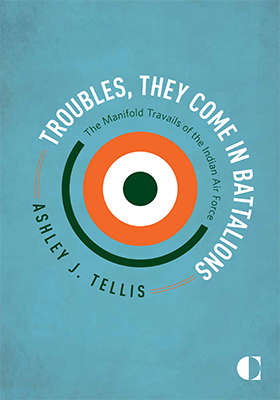
Troubles, They Come in Battalions: The Manifold Travails of the Indian Air Force
Report

Troubles, They Come in Battalions: The Manifold Travails of the Indian Air Force

The Indian Air Force’s falling end strength and problematic force structure, combined with its troubled acquisition and development programs, threaten India’s air superiority over its rapidly modernizing rivals.

Link Copied
By Ashley J. Tellis
Published on Mar 28, 2016

Additional Links

Full TextBrief
Program mobile hero image

Program

South Asia

The South Asia Program informs policy debates relating to the region’s security, economy, and political development. From strategic competition in the Indo-Pacific to India’s internal dynamics and U.S. engagement with the region, the program offers in-depth, rigorous research and analysis on South Asia’s most critical challenges.

Learn More

The Indian Air Force (IAF) is in crisis. Despite being a world-class combat arm, the IAF’s falling end strength and problematic force structure, combined with its troubled acquisition and development programs, threaten India’s air superiority over its rapidly modernizing rivals, China and Pakistan. Indian air dominance is vital for deterrence stability in southern Asia and for preserving the strategic balance in the wider Indo-Pacific region. Resolving India’s airpower crisis, therefore, should be a priority for New Delhi.

Troubles Facing the Indian Air Force

  • The IAF’s fighter force, as of early 2016, is weaker than the numbers suggest. At nominally 36.5 squadrons, it is well short of its sanctioned strength, and many of its frontline aircraft are obsolete.
     
  • China and Pakistan field about 750 advanced air defense/multirole fighters against the IAF’s 450-odd equivalents. The airfield infrastructure limitations in Tibet, however, prevent China from bringing all of its air capabilities to bear against India. Yet after 2025, China could be able to deploy anywhere between 300 and 400 sophisticated aircraft against India, in addition to the 100 to 200 advanced fighters likely to exist in Pakistan by then.
     
  • The IAF’s desire for 42–45 squadrons by 2027—some 750–800 aircraft—is compelling, if India is to preserve the airpower superiority it has enjoyed in southern Asia since 1971.
     
  • The IAF’s likelihood of reaching its 2027 goal with a high proportion of advanced fighters is poor. It is stymied by serious constraints on India’s defense budget, the impediments imposed by the acquisition process, the meager achievements of the country’s domestic development organizations, the weaknesses of the higher defense management system, and India’s inability to reconcile the need for self-sufficiency in defense production with the necessity of maintaining technological superiority over rivals.
     
  • The IAF is attempting to reach its desired end strength by acquiring the Tejas Mark 1 to beef up its lightweight segment, filling out the remainder of its Medium Multirole Combat Aircraft (MMRCA) purchase in its medium-weight segment, and continuing with the Su-30MKI acquisition and the PAK-FA co-development programs to sustain its heavyweight segment.
     
  • All three tiers of the IAF are currently in trouble. The Tejas Mark 1 is handicapped by significant technological deficiencies; the prospects for expanding the MMRCA component to compensate for the Tejas’s shortcomings are unclear; and the IAF’s reluctance to proceed fully with the PAK-FA program could undermine its fifth-generation fighter ambitions. 

Recommendations for India

  • India needs to safeguard its regional air superiority over both Pakistan and China by mustering the requisite end strength and enhancing its extant operational advantages.
     
  • The IAF should revisit some aspects of its current approach. It should be cautious about expanding the Tejas acquisition beyond six squadrons and consider enlarging the MMRCA component with the cheapest fourth-generation-plus Western fighter available. India should also reassess the decision to develop the Advanced Medium Combat Aircraft indigenously and avoid weakening the collaboration with Russia on the PAK-FA program.
     
  • India should expand its investments in advanced munitions, combat support aircraft, electronic warfare, physical infrastructure, and pilot proficiency—all current strengths—while being realistic about its domestic capacity to produce sophisticated combat aircraft. Indian policymakers must especially guard against the temptation to prioritize indigenous design and manufacture over the imperative of providing the IAF’s able
    pilots with the best fighters available.
Read Full Text

About the Author

Ashley J. Tellis

Former Senior Fellow

Ashley J. Tellis was a senior fellow at the Carnegie Endowment for International Peace.

    Recent Work

  • Paper
    Multipolar Dreams, Bipolar Realities: India’s Great Power Future

      Ashley J. Tellis

  • Commentary
    India Sees Opportunity in Trump’s Global Turbulence. That Could Backfire.

      Ashley J. Tellis

Ashley J. Tellis
Former Senior Fellow
South AsiaIndiaPolitical ReformSecurityMilitaryForeign Policy

Carnegie does not take institutional positions on public policy issues; the views represented herein are those of the author(s) and do not necessarily reflect the views of Carnegie, its staff, or its trustees.

More Work from Carnegie Endowment for International Peace

  • Aerial shot of island community
    Commentary
    One Year After the Great Aid Recession, Investments in Climate Mobility Offer Cost-Effective Returns

    Climate mobility interventions can vary, but they all present opportunities to unlock transformative results that mitigate costs associated with inaction.

      • Alejandro Rodriguez

      Alejandro Martin Rodriguez

  • Man standing next to a pile of burned cars
    Commentary
    Emissary
    The Myriad Problems With the Iran Ceasefire

    Four Middle East experts analyze the region’s reactions and next steps.

      • Andrew Leber
      • Eric Lob
      • +1

      Amr Hamzawy, Andrew Leber, Eric Lob, …

  •  A machine gun of a Houthi soldier mounted on a police vehicle next to a billboard depicting the U.S. president Donald Trump and Mohammed Bin Salman, the Crown Prince and Prime Minister of Saudi Arabia, during a protest staged to show support to Iran against the U.S.-Israel war on March 27, 2026 in Sana'a, Yemen.
    Collection
    The Iran War’s Global Reach

    As the war between the United States, Israel, and Iran continues, Carnegie scholars contribute cutting-edge analysis on the events of the war and their wide-reaching implications. From the impact on Iran and its immediate neighbors to the responses from Gulf states to fuel and fertilizer shortages caused by the effective shutdown of the Strait of Hormuz, the war is reshaping Middle East alliances and creating shockwaves around the world. Carnegie experts analyze it all.

  •  A machine gun of a Houthi soldier mounted on a police vehicle next to a billboard depicting the U.S. president Donald Trump and Mohammed Bin Salman, the Crown Prince and Prime Minister of Saudi Arabia, during a protest staged to show support to Iran against the U.S.-Israel war on March 27, 2026 in Sana'a, Yemen.
    Article
    Amid Iran War, Gulf Countries Slow the Pace of Reforms

    The return of war as the organizing factor in Middle Eastern politics has predictable consequences: governments are prioritizing regime stability and becoming averse to political and social reform.

      • Sarah Yerkes

      Sarah Yerkes, Amr Hamzawy

  • Commentary
    Carnegie Politika
    Power, Pathways, and Policy: Grounding Central Asia’s Digital Ambitions

    Central Asia’s digital ambitions are achievable, but only if policy is aligned with the region’s physical constraints.

      Aruzhan Meirkhanova

Get more news and analysis from
Carnegie Endowment for International Peace
Carnegie global logo, stacked
1779 Massachusetts Avenue NWWashington, DC, 20036-2103Phone: 202 483 7600Fax: 202 483 1840
  • Research
  • Emissary
  • About
  • Experts
  • Donate
  • Programs
  • Events
  • Blogs
  • Podcasts
  • Contact
  • Annual Reports
  • Careers
  • Privacy
  • For Media
  • Government Resources
Get more news and analysis from
Carnegie Endowment for International Peace
© 2026 Carnegie Endowment for International Peace. All rights reserved.