
• Research
  • Emissary
  • About
  • Experts
Carnegie Global logoCarnegie lettermark logo
DemocracyIran
  • Donate
Refocus the European Union: Planet, Lifetime, Technology
Report
Carnegie Europe

Refocus the European Union: Planet, Lifetime, Technology

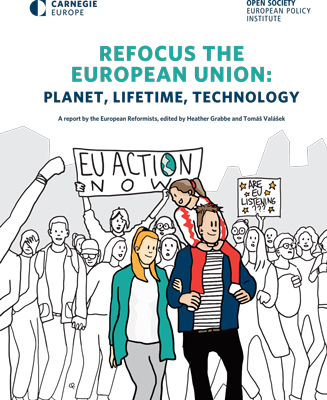
This report is a rallying cry for Europeans to pull together and mobilize the EU’s assets to manage the three biggest changes of our times.

Link Copied
By Tomáš Valášek and Heather Grabbe
Published on Apr 30, 2019

Additional Links

Refocus the European Union
Program mobile hero image

Program

Sustainability, Climate, and Geopolitics

The Sustainability, Climate, and Geopolitics Program explores how climate change and the responses to it are changing international politics, global governance, and world security. Our work covers topics from the geopolitical implications of decarbonization and environmental breakdown to the challenge of building out clean energy supply chains, alternative protein options, and other challenges of a warming planet.

Learn More
Program mobile hero image

Program

Europe

The Europe Program in Washington explores the political and security developments within Europe, transatlantic relations, and Europe’s global role. Working in coordination with Carnegie Europe in Brussels, the program brings together U.S. and European policymakers and experts on strategic issues facing Europe.

Learn More
Project hero Image

Project

The European Reformists

Powerful transformations will rock Europe over the next decades. The EU needs to focus on managing digital, climate, and social change. Can it rise to the challenge?

Learn More

This report is a rallying cry for Europeans to pull together and mobilize the EU’s assets to manage the three biggest changes of our times. Each section briefly diagnoses the consequences of climate change, aging populations, and digital revolutions and then explores the role the EU could play in supporting the inevitable transitions. The purpose is not to provide a detailed blueprint for each transition, but rather to launch a new kind of debate about the EU—a debate that does not revolve around how to tweak the current institutions but instead how to address a reordered set of priorities.

The insights and recommendations presented draw on ideas and analysis that emerged from a series of discussions between a group of Europeans with innovative ideas and a pro-reform mindset. This group, referred to as the European Reformists, was brought together by the Open Society European Policy Institute and Carnegie Europe between October 2017 and December 2018 to discuss the continent’s biggest challenges over the next fifteen years.

These challenges are not necessarily new, and the EU has started work on most of them. But much faster and more radical action is essential to avoid massive social, economic, and political disruption. The time is now ripe for two reasons. First, there is a renewed political appetite for a positive vision in which the EU provides solutions to people’s worries.1 Second, there is no time to waste.

About the Authors

Tomáš Valášek

Former Director, Carnegie Europe

Valášek was director of Carnegie Europe and a senior fellow, where his research focused on security and defense, transatlantic relations, and Europe’s Eastern neighborhood.

Heather Grabbe

Grabbe is director of the Open Society European Policy Institute.

Authors

Tomáš Valášek
Former Director, Carnegie Europe
Tomáš Valášek
Heather Grabbe

Grabbe is director of the Open Society European Policy Institute.

EuropeWestern EuropeNorth AmericaIranEUTechnologyClimate ChangePolitical Reform

Carnegie does not take institutional positions on public policy issues; the views represented herein are those of the author(s) and do not necessarily reflect the views of Carnegie, its staff, or its trustees.

More Work from Carnegie Endowment for International Peace

  • Trump and Netanyahu speaking
    Commentary
    Emissary
    The Diverging U.S. and Israeli Goals in Iran Are Making the Endgame Even Murkier

    The cracks between Trump and Netanyahu have become more pronounced, particularly over energy and leadership targets.

      • Eric Lob

      Eric Lob

  • Seoul traffic at night
    Commentary
    Emissary
    How the Hormuz Closure Is Testing the Korean President’s Progressive Agenda

    The crisis is not just a story of energy vulnerability. It’s also a complex, high-stakes political challenge.

      Darcie Draudt-Véjares

  • Commentary
    Carnegie Politika
    Why Did Messaging App Telegram Fall From Grace in Russia?

    The history of Telegram’s relations with the Russian state offers a salutary lesson for international platforms that believe they can reach a compromise with the Kremlin.

      Maria Kolomychenko

  • Commentary
    Diwan
    What Does the Strait of Hormuz’s Closure Mean?

    In an interview, Roger Diwan discusses where the global economy may be going in the third week of the U.S.-Israeli war with Iran.

      Nur Arafeh

  • Commentary
    Strategic Europe
    Russia’s Imperial Retreat Is Europe’s Strategic Opportunity

    The war in Ukraine is costing Russia its leverage overseas. Across the South Caucasus and Middle East, this presents an opportunity for Europe to pick up the pieces and claim its own sphere of influence.

      William Dixon, Maksym Beznosiuk

Get more news and analysis from
Carnegie Endowment for International Peace
Carnegie global logo, stacked
1779 Massachusetts Avenue NWWashington, DC, 20036-2103Phone: 202 483 7600Fax: 202 483 1840
  • Research
  • Emissary
  • About
  • Experts
  • Donate
  • Programs
  • Events
  • Blogs
  • Podcasts
  • Contact
  • Annual Reports
  • Careers
  • Privacy
  • For Media
  • Government Resources
Get more news and analysis from
Carnegie Endowment for International Peace
© 2026 Carnegie Endowment for International Peace. All rights reserved.