

Commentary
Richard Youngs
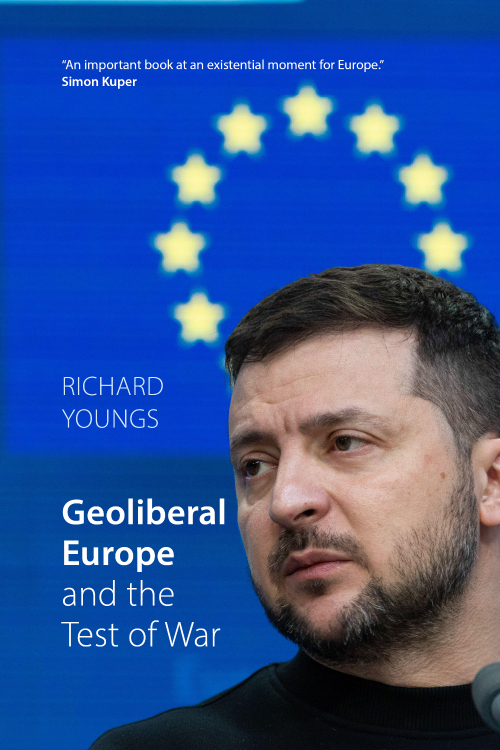
Russia’s invasion of Ukraine has pushed Europe into a new strategic era. But as the conflict persists, European governments and institutions are struggling to move past crisis-driven, short-term policies and design a new European order.
Source: Agenda Publishing
Russia’s invasion of Ukraine has pushed Europe into a new strategic era. The knock-on effects of the war have combined to open a period of reordering across the European continent. European governments and the European Union collectively have begun to fashion policies for this shift, recognizing this to be a pivotal historical moment. Richard Youngs unpacks the different dynamics that have come to characterize European policies in the wake of the war: the nature of EU integration, geopolitical power, defense priorities, European borders, liberal values, the green transition, and economic sovereignty.
The book looks to the future and outlines the issues and choices with which European governments still need to grapple. Youngs develops the notion of geoliberalism as a way of addressing these challenges and guiding European governments and the EU into the fragile order taking shape in the shadow of Ukraine’s war.
“A must-read for everyone thinking about how Europe can live up to today’s geopolitical challenges while remaining true to its liberal foundations.”
—Anna Lührmann, Minister of State for Europe and Climate, Germany.
“Russia’s unprovoked full-scale invasion of Ukraine required the European Union to rise to the urgency of the moment. Now, the task is to build a new European and global order. Youngs’ book is essential reading for anyone wanting to understand how and why that can be accomplished.”
—Erik Jones, Director, Robert Schuman Centre, European University Institute.
“Youngs poses a very big question, in clear prose: how will Russia’s invasion of Ukraine change Europe? His notion of ‘geoliberalism’ could become crucial in understanding our new era. This is an important book at an existential moment for Europe.”
—Simon Kuper, columnist, Financial Times.
“A major exploration of Europe’s shifting geopolitical landscape, a must-read for anyone hoping to understand the consequences of Putin’s war on Ukraine.”
—Norma Percy and Lotte Murphy-Johnson, producers of Putin vs the West.

Senior Fellow, Democracy, Conflict, and Governance Program
Richard Youngs is a senior fellow in the Democracy, Conflict, and Governance Program, based at Carnegie Europe. He works on EU foreign policy and on issues of international democracy.
Recent Work
Richard Youngs

Richard Youngs, Erik Jones, Dan Baer, …
Carnegie does not take institutional positions on public policy issues; the views represented herein are those of the author(s) and do not necessarily reflect the views of Carnegie, its staff, or its trustees.

Washington’s decision to support some UN functions while letting others wither is pulling the organization apart at the seams.

Stewart Patrick, Theodore Zaritsky

Are Germany’s economic, industrial, and political struggles becoming a liability for the EU’s ability to rise to the geopolitical moment?

Rym Momtaz, ed.

Russia’s ruling party would have benefited from Putin appearing as its distant patron, but as an active frontman imposing his views on the public, he has done nothing but harm both the party’s election campaign and the ruling system overall.

Andrey Pertsev

China’s police training infrastructure construction projects provide benefits to recipient countries, promote China’s image as a major global security provider, and are likely to reinforce alignment between Beijing’s security priorities and those of countries in the Global South.


Cameron Waltz, Sheena Chestnut Greitens, Kim Nguyen, …

The Bureau of Industry and Security needs to adjust its focus and practices to maintain its position as the U.S. government’s primary champion of international technological competition.

Geoffrey Irving