

Research
- +5
Herbert Crowther, Darcie Draudt-Véjares, Walter James, …
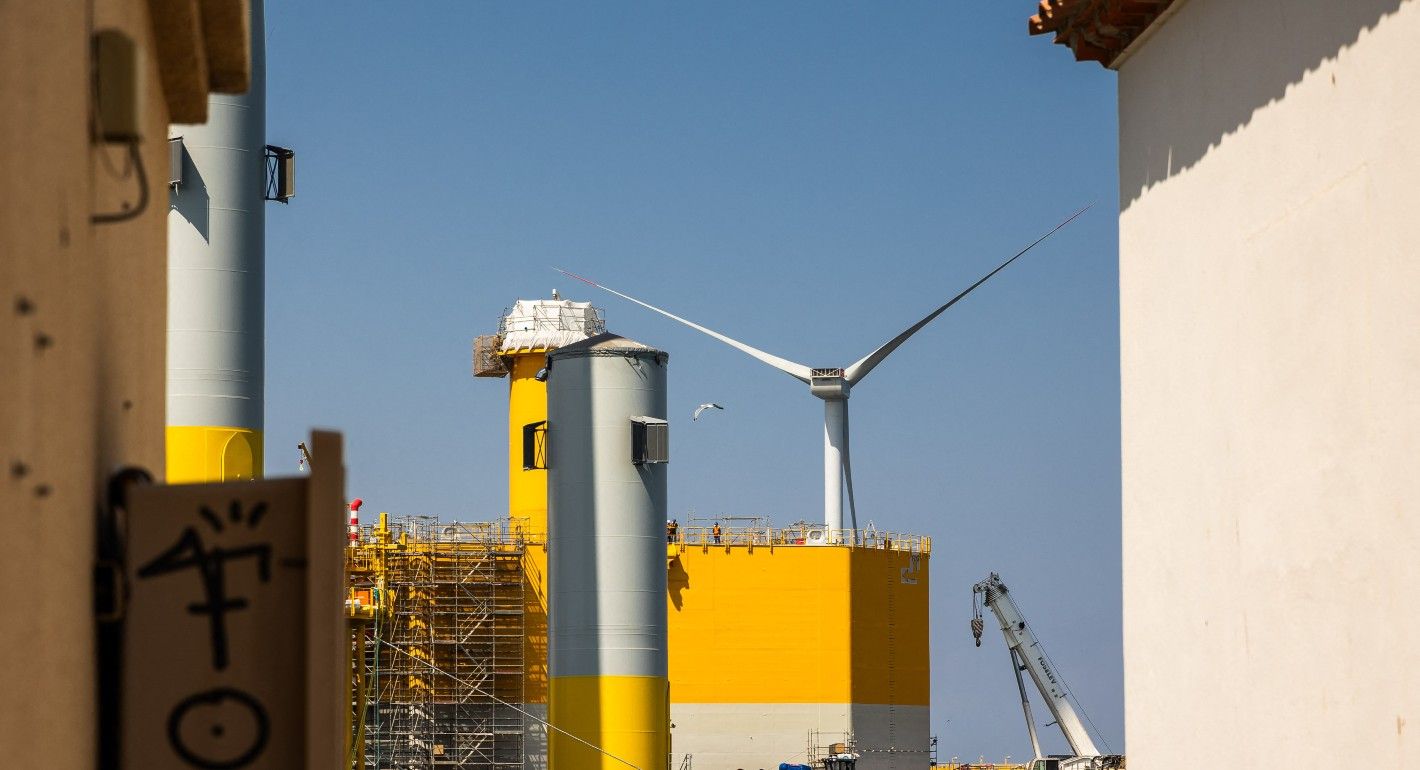
View of the assembly yard for the marine or offshore wind turbines with wind turbine assembled from the port of Port La Nouvelle in the Aude department in southern France. (Photo by JC MILHET/Hans Lucas/AFP via Getty Images)
For the sake of the global energy transition, Europe’s industrial transformation must not only persevere but thrive.
Europe faces a trilemma of maintaining its climate goals amid waning global momentum, threats to its economic competitiveness from Chinese industrial overcapacity, and the security imperatives of Russia’s war on its doorstep. In response to this precarious outlook, the European Union institutions released their Joint Communication on the EU Global Climate and Energy Vision in October to outline how the bloc might engage the world on these issues. Its emphasis on Europe’s industrial strategy, competitiveness, and security is new, but the plan also includes traditional climate priorities like promoting adaptation, fighting disinformation, and supporting carbon markets. While the joint statement acknowledges the shifting geopolitical landscape and urgent need for European competitiveness, it risks relying on multilateral gestures and methods potentially less suited for a transactional era.
A critical enabler of Europe’s clean industrial competitiveness is a concise and targeted foreign policy: one that stimulates exports in niche areas where feasible, secures supply chains where most vulnerable, and advances diplomacy for European innovation, R&D, and corporate ventures. Despite the underwhelming outcome from COP30, the EU is right to continue its leadership of the process and not abandon ship, but its broad agenda risks spreading resources thin and missing the opportunity to prioritize foreign engagements that directly benefit both European industry and decarbonization. The joint communique represents an important first step to a more pragmatic international agenda—including new institutional positions and continued financing for projects abroad—but ample work remains.
In recent years, the bloc’s original Green Deal plan has evolved in reaction to the shocks of Russia’s invasion of Ukraine and the United States’ low-carbon protectionism to focus on energy security, supply chain resilience, and, most recently, competitiveness. Europe’s latest decarbonization framework, the Clean Industrial Deal (CID), needs a foreign policy to match. The CID outlines a more selective approach to green industrial policy by focusing domestic goals on economic priorities: automobiles (including battery technology), clean industrial products, and cheap electricity prices. In recent years, the EU and member states have also begun to align foreign policy with domestic, clean industrial goals, especially minerals and hydrogen. For example, the EU’s Global Gateway mobilizes resources for projects abroad while other financing has been issued to foreign mineral projects across Africa, Latin America, and Asia. These efforts are important building blocks, but now the EU needs a focused strategy that can harmonize clean tech competitiveness goals with foreign engagements.
A cohesive international strategy aligns diplomacy in the most pressing areas of industrial importance and with partners who can deliver. One lesson learned during former U.S. president Joe Biden’s administration was to build partnerships with specific industrial goals rather than signing broad memorandums of understanding (MOUs) with a myriad of nations. The Biden administration prioritized hydrogen in its MOUs, which yielded negligible developments abroad. The EU communique specifically cites over forty bilateral MOUs for clean energy partnerships, but on their own, these pacts are unlikely to develop projects of mutual economic interest or jointly spur clean supply chains. Future partnerships should be laser focused on the most important supply chain segments across clean industrial sectors, not a myriad diffuse agreements that prioritize one or two commodities. Less is more when those select relationships are targeted and utilitarian in nature.
Europe needs a framework that identifies a specific plan of action for each clean industrial vertical and key partners who can spur green investment in these niches. This is the core question that Carnegie will address in future research and one where our existing taxonomy may help policymakers conceive a targeted approach: it requires mapping Europe’s manufacturing pipeline to gauge, by sector, where an industrial base exists (or is developing), supply chain risks are acute, and innovation potential is strong. From there, a stocktaking of EU and member states’ foreign engagement for clean energy supply chains can be benchmarked against the results to indicate where and how current agreements might be tailored.
This process can help identify, by sector, where a domestic value chain is optimal for Europe and what parts of it should be friendshored (or in a few cases, where exports are possible). European Commission President Ursula von der Leyen has recently voiced support for a “Made in Europe” initiative—a perhaps necessary break in economic approach. Although the specifics remain unclear, if the EU is to genuinely sail unchartered waters of domestic content, it will need a clearly defined vision of what stages of clean tech production should be local and what can be outsourced. For example, downstream production of strategic products like battery cells, permanent magnets, fertilizer, or steel might be “Made in Europe,” but certain minerals or energy intensive industrial inputs could be offshored to allied or trade-aligned partners. Outlining the granularities of the framework at the start will help provide clarity to both industry and foreign counterparts.
This was a challenge for the Biden administration’s roll out of the Inflation Reduction Act (IRA) and correlated foreign policy efforts. Bridging the IRA’s domestic focus with the need to build durable allied supply chains exposed the complexity of aligning industrial policy with international goals. In the end, one of the only successful deals was the minerals trade agreement with Japan, which allowed Japanese nickel used in American electric vehicle batteries to qualify for domestic content subsidies—a compelling case study.
When engaging foreign counterparts, especially those in the Global South, Europe may prioritize incubating clean industrialization in partner countries as a theory of change. Encouraging green industries abroad may prove a more durable strategy than trying to prevent high-emitting projects in those countries. The ethos of this philosophy is to lean into areas of under appreciated low-carbon potential, and to help catalyze those sectors’ growth in partner countries. India, for example, is on course to be the world’s second-largest solar PV manufacturing base and is developing low-cost inputs like clean ammonia. Brussels may consider prioritizing engagement with Delhi on supporting these specific sectors—and eventually procuring such products—that could both de-risk Europe’s supply chains and bolster India’s industrial transition.
In some instances, exports in European goods or services may be possible, but policymakers should be cautious. As the communique acknowledges, Europe is not a major exporter of clean tech goods beyond some grid infrastructure and wind, as well as hydropower and geothermal turbines (it has robust production of heat pumps and solar inverters but does not significantly export them). Chinese economies of scale and ultra-competitive costs will make stimulating European exports challenging. During the Biden years, some experts unrealistically suggested an American Green Marshall Plan when the economics of U.S. clean tech exports simply did not pencil out. Europe should be clear-eyed where industrial promotion is even feasible and where joint ventures for European firms are more realistic than the export of goods.
This challenge could emerge regarding international development and procurement. Take for example the Global Gateway, whose mandate is to pursue “smart, clean, and secure” development projects—not to improve European competitiveness. Because most wind, solar, and battery projects in the Global South are likely to procure cost-effective Chinese hardware, there is a risk that EU-backed, clean energy projects abroad will not significantly benefit European industry or this agenda. This may entail focusing on maintaining foreign operations of the European wind sector while expanding industrial footing in turbines for hydro and geothermal power, as well as power grid infrastructure and digitalization. These large-scale green infrastructure projects may not be at the scale or speed of Chinese solar or battery deployments, but they are valuable niches that buy political good will, support European industries, and complement the unstoppable flood of Chinese renewables.
Lastly, Europe should consider wielding science diplomacy—already an EU strength—in a similarly pragmatic fashion to achieve long-term goals of autonomy and competitiveness. Research delegations should be viewed as tactful facets of a cohesive international strategy in service of Clean Industrial Deal goals, not one-off opportunities for exchange. This might entail prioritizing specific technology verticals and sending European researchers abroad to study clean tech in the top labs that could provide step-change wins to Europe’s long-term energy security, decarbonization, and technological leverage. Take for example, South Korea’s recent inclusion into the Horizon Europe R&D program, which might prioritize battery innovation given Korea’s prowess in this field and batteries as a priority of the EU’s competitiveness goals. Europe can also deploy its institutions as a bargaining chip to help other nations gain know-how in industrial processes, as with helping India scale up its solar supply chain.
Successfully navigating the United States and China presents distinct challenges, and the communique is right to highlight the importance of constructive engagement on either side of the Pacific. Amid Sino-American power struggles, backed by a mutual embrace for state capitalism, Europe is taking important first steps to secure strategic supply chains through new project financing—including potential equity investments in Australian mineral projects—and by seeking to stockpile minerals. And the communique rightfully suggests action against China’s trade practices amid its omnipresent industrial overcapacity, which is now threatening European sectors from steel to wind. But being ready to fend off oversupply in strategic, low-carbon sectors may entail uncomfortable—and perhaps unorthodox—levels of intervention. For example, if Europe is to genuinely prioritize a domestic battery industry, it will need to protect its nascent industry against the influx of Chinese products as it scales. Beijing will respect actions more than words but may require some concessions to prevent retaliation.
With Washington, as we have previously evaluated, Brussels might focus its diplomacy on clean, firm power: nuclear and especially geothermal energy. The United States has leading drilling tech for geothermal—a rare clean technology that has support in Washington and Brussels—that benefits European energy security. Our analysis illustrates that these novel drilling techniques have a sizable opportunity to provide clean heat (and even power) to Europe: Germany, Italy, France, Spain, and Romania rank as some of the most ideal markets globally. The recent U.S.-UK nuclear deal could provide a template for a geothermal drilling deal in Europe. Much like the case of India’s solar manufacturing, leaning into American geothermal drilling is a savvy means of leveraging the European market to help off-ramp industrial giants abroad to develop low-carbon products.
At stake is Europe’s pursuit of low-carbon strategic autonomy amid a darkening outlook abroad and waning support of some sustainability measures at home. For the sake of the global transition, Europe’s industrial transformation must not only persevere but thrive, and the well-being of its electorate and industries are core to this long-term success. To support this critical effort, the Carnegie Endowment will build on its U.S. Foreign Policy for Clean Energy workstream to develop a “Foreign Policy for the Clean Industrial Deal.” Drawing on similar analysis of the United States, this work will provide European policymakers with a concise framework to strategize how each clean tech sector might be pursued with partner(s) abroad.
Europe is reacting to the polycrisis at its doorstep: Russia’s war, China’s overcapacity, and the United States’ fossil-first energy posture. The EU has an opportunity to offer partners something better than flooded markets or lopsided trade arrangements, but Brussels and member states must be prepared to stay focused on the sectors that matter most, while exercising new policy options in the process. A successful international product may not be an all-encompassing plan, but one that activates the most pressing sectoral and diplomatic levers. Achieving a cleaner, more competitive, secure economy, both at home and abroad, is worth fighting for, and Europe has the resources to succeed.

Fellow, Sustainability, Climate, and Geopolitics Program
Milo McBride is a fellow in the Sustainability, Climate, and Geopolitics Program at the Carnegie Endowment for International Peace.
Recent Work



Herbert Crowther, Darcie Draudt-Véjares, Walter James, …
Carnegie does not take institutional positions on public policy issues; the views represented herein are those of the author(s) and do not necessarily reflect the views of Carnegie, its staff, or its trustees.
The acknowledgment has sparked fears of a new arms race with China and Russia.

Chris O’Meara

The European Commissioner for Trade is headed to China. But after President Xi’s bridge-building visit to Washington, can a more isolated EU overcome Beijing’s stranglehold on critical raw materials? Who will blink first?

Rym Momtaz, ed.
The summit may be remembered as a fatal blunder, when Washington, Beijing, and the AI industry collectively chose ceremony over action.
Jeffrey Prescott

European NATO countries are wrestling with the possibility of U.S. disengagement from the alliance. With the continent’s security increasingly uncertain, governments must restore the credibility of their collective defense.



Hans-Dieter Lucas, Adam Thomson, Pierre Vimont

Cargo traffic through Russia’s Northern Sea Route has increased because of the disruption caused by the conflict in the Middle East, the Ukraine war, and U.S.-China tensions.

Mikhail Korostikov