

Commentary
Alexandra Prokopenko
Source: Getty
The ruling elites in contemporary Russia are not a political class, but a community of managers who are not subject to competition or public accountability. The state is becoming an operating apparatus without any internal autonomy.
When Russia launched its full-scale invasion of Ukraine on February 24, 2022, many Russian and Western observers expected that the Russian elites—liberal-minded economists and bureaucrats, businesspeople, and intellectuals—would speak out against the war, or at least quietly generate internal pressure to slow it down. After all, many of these people had assets in the West, Western education, family abroad, and considered themselves part of the interconnected world. But in the end, only a very small handful publicly condemned their country’s aggression.1
That cannot be put down solely to individual cowardice, pressure from the security services, or plain self-interest. Of course, such factors clearly had a significant impact, but they don’t answer the structural question of why the agency of the elites and their capacity for autonomous political action were replaced by loyalty and acquiescence.
Other forces were surely at work, namely depoliticization. That mechanism turned a group of people with resources and intellect into a herd that now simply implements the technical tasks that the regime puts in front of it, seemingly devoid of any agency. How was this mechanism constructed, what set it in motion, and what will it leave behind? This last question is no less important than the others: Depoliticization has a long-term cost that will have to be paid not only by the elites, but by the entire Russian population in the post-Putin period.
This paper is based on research conducted while writing the forthcoming book From Sovereigns to Servants: How the War Against Ukraine Reshaped Russia’s Elite. The author conducted several dozen interviews with senior and mid-level representatives of Russia’s federal bureaucracy, as well as with employees of state companies and major private businesses.2 The interviews were carried out over a period of several years. From 2019 to 2022, they focused on the specifics of state service; after 2022, the main topic was the war.
The analysis is rooted in both structural and ethnographic factors. The research revealed that depoliticization has helped usher in a pre-conceived, carefully designed institutional environment for the Russian elites. Meanwhile, the concept of individual “moral careers” offers material for observing how people get accustomed to a role determined by a corporation and their status within it, and how they come to accept the norms and justifications inherent to that role over time.
Any discussion about Russia’s ruling establishment requires clarification of the terminology used. Applying the traditional concept of “elites” with reference to the group of people running Russia today would be an outright error.
According to the classic definition developed by the Italian scholars Gaetano Mosca and Vilfredo Pareto,3 the difference between the elite and the non-elite lies in the possession of resources: intellect, skills, and a personal interest in representation within the power structure in order to influence decisionmaking. The elite is resourceful because it has the most to lose in the event of the state’s collapse. There have been examples in history of the ruling classes playing an active role in and changing the trajectory of conflicts between countries, but those outcomes did not involve moral choices. The deciding role was played by financial ruin and material considerations. The elites articulated these limitations within the system and translated them into political decisions and public discussions.
In 2022, the Russian elites possessed real knowledge of the constraints that made war economically irrational: hundreds of billions in foreign currency reserves held in Western jurisdictions and vulnerable to seizure, technological dependence on imports that sanctions would sever, and a state budget architecture that assumed integration with global markets. But they did not use this knowledge to formulate an argument against the invasion: not because such an argument would not have changed Putin’s mind, but because the space to make it had long since closed. They had lost not only any influence over the decision, but the capacity to articulate an alternative.
When the invasion began, this group still controlled the machinery of the state: budgets, appointments, and the distribution of resources. But they had no say in the decision to go to war. They had become administrators of a system whose direction they could not influence. Here, the classification is not so much “elites” in the traditional sense as the Roman Republic’s nobiles. The nobiles were representatives of a small circle of high-ranking officials and businesspeople who enjoyed the personal trust of the country’s leadership and were recognized within the system as being “one of us.” Russia’s nobiles had access to Putin and his inner circle—but access is not the same as influence. Nobile is an informal title combining loyalty, experience, and inclusion within the ruling stratum, but not political agency.
By nobiles, I have in mind a group of approximately 200–300 people: senior officials within the presidential administration and government agencies, the heads and senior officers of the security services, and the CEOs of state companies and major private companies that maintain close ties with the authorities. This is not a sociological class, but a functional group defined by access to strategic-level decisionmakers and personal contact with President Vladimir Putin. The next layer down in the Russian system—such as deputy ministers, heads of departments inside government ministries, and second-tier managers at state corporations—is not part of this core group, but replicates the same behavioral logic and provides the primary data for observing moral careers: the gradual process by which people absorb the norms and justifications of their professional role until those norms become their own.
The fundamental difference between the elite and nobiles in the Russian context is that the elite are forced to initiate changes to the system in order to preserve it in the face of changed circumstances or new challenges. The nobiles have neither the desire nor the ability to do that: Their role has been optimized for compliance.
The war in Ukraine has laid bare this key difference. At the same time, it’s important to clarify what kind of agency we are talking about. The nobiles certainly have the agency to adapt: the ability to survive, to optimize, and to find solutions within prevailing conditions and common understandings (in Russian, координаты). This explains why this group dealt so effectively with the economic shock following the full-scale invasion in late February 2022. Their reflexes and crisis management skills, honed to perfection over years of crises, worked like clockwork. But the nobiles are structurally deprived of the agency to change: the ability to reset the system’s prevailing conditions and common understandings themselves, to question the system’s goals, or to offer alternatives. This is not the result of personal weakness or cowardice. It is the systemic result of a quarter-century of depoliticization, during which the agency to adapt was consistently incentivized while the agency to take independent action or even to change the system itself was destroyed and rooted out.
It is also important to clarify the subject of observation. The focus of this research is primarily the civilian sector of the Russian ruling stratum, including the federal executive branch, senior bureaucrats within ministries and agencies, and the heads of state-owned and state-affiliated companies. The analysis does not extend to State Duma deputies, members of the upper house (the Federation Council), and regional elites—not because they are not important, but because the research focuses specifically on technocrats, one of the most numerous groups with the greatest potential for change.
The depoliticization of the Russian ruling elite was not a spontaneous process, but has been an institutional environment formed via a series of precedents set by Putin that have been normalized.
It’s important here to make one clarification. The Putin regime is a personalistic one. Most key decisions are made by one person. But beyond that nexus, the environment has been built around institutions that have their own logic of replication: career trajectories, demonstrations of loyalty, informal practices, and the habits necessary for survival. It is this environment, and not the personality of the leader, that is the subject of analysis here, because it is very likely that this environment will remain in place even after Putin is gone.
To understand the logic of Putin’s project to create a system of authority that could be managed through his own actions and directives, it is essential to recall the circumstances that confronted the new president when he first took power in late 1999 and from what he wanted to protect himself. After the chaos unleashed by the collapse of the Soviet Union, the stated goal of the Yeltsin-era government was to make governance as technocratic as possible: to sideline politicians, the public, and lobbyists. In reality, the weakness of the post-Soviet state allowed a small circle of oligarchs and regime insiders to dominate. Putin inherited both the aspiration and the contradiction.
For his first two presidential terms, Putin—with the support of the siloviki, the Russian catch-all term for the security services—effectively rebuilt the system of governance, which back then consisted of three key elements. The first was the legacy of the lower- and mid-level Soviet nomenklatura. The second was composed of the warring members of the sprawling team of Yeltsin-era leftovers, who continued to occupy senior positions. And the third was centered on the protégés of the oligarchic groups operating in the financial and industrial sectors of the economy who had first emerged in the early 1990s.
To adapt Russia to the new political realities of his rule, Putin needed not only to restore what became widely known as the power vertical with the Kremlin at the very top, but also to inject fresh blood into the ranks of the bureaucracy. That was no mean feat. On the one hand, civil servants had to be professional. On the other, they had to be loyal to the state, not to the oligarchs or—worse still, in Putin’s eyes—to foreign interests or non-Russian legal requirements.
The entire point of reforming the system of governance was to eliminate any alternative centers of power or to subjugate them to the Kremlin. Upon taking office, regional governors and the oligarchs were first in the new president’s sights.
The Kremlin dealt with regional leaders methodically and in stages. As a first step, governors were assigned federal “curators”: presidential plenipotentiaries whose views could have a direct impact on the careers of the regional heads. Then the governors were pushed out of the Federation Council, the upper chamber of the Russian parliament, and replaced by people appointed directly by the Kremlin. Finally, in 2004, in violation of a ruling by the Russian Constitutional Court and on the pretext of fighting terrorism, direct gubernatorial elections were abolished.4 The Federation Council, in its new configuration, approved the reform without any objections, which would have been unthinkable under its previous composition. The predictable end result was that the governors were transformed from politicians into administrators, with the extent of their power limited to the economy of the region in question. Before long, there were no more disagreements between the governors and the federal center.
At the same time, the oligarchs were also being brought to heel. The tycoon Vladimir Gusinsky was forced to sell the Media-Most holding (which controlled NTV, a popular television channel), to Gazprom Media, which was closely affiliated with the state. Boris Berezovsky, the owner of another independent television channel, ORT, soon faced criminal charges. Both men eventually emigrated. The Kremlin sent a clear message to all figures with similar ambitions: Stay out of politics.
But even then, many business leaders believed that this rule only applied to certain people.5 Any remaining doubts were dispelled by the Yukos case.6 The arrest of the Yukos oil company’s owner Mikhail Khodorkovsky in October 2003 was a pivotal moment that starkly demonstrated once and for all that political activity was incompatible with retaining private control over important assets. After Khodorkovsky’s arrest, the pressure on Russia’s business community continued. During 2004–2005, there were law enforcement raids at businesses belonging to Viktor Vekselberg (Renova), Mikhail Fridman (TNK, Alfa), Kakha Bendukidze (United Machine-Building), Mikhail Gutseriev (Slavneft), and Oleg Kiselyov (Renaissance Capital).
From the Kremlin’s point of view, such unexpected visits from prosecutors and the Federal Security Service (FSB) were part of the business community’s political education. Putin was demonstrating that the main value of any entrepreneur was not their success in business, but their political and personal loyalty. For major business leaders, entering into open conflict with the Kremlin meant risking total ruin. After all, with the support of the authorities, prosecutors were also prepared to revisit the process of 1990s-era privatization that had put lucrative assets in the hands of their current owners. The message was no less clear to the civilian bureaucracy: Interference in the actions of the siloviki would not be tolerated, even if heavy-handed actions by the authorities undermined government-led efforts, for example, to improve the country’s investment climate.
Another lesson for the elite was provided by Viktor Cherkesov, a key silovik and longtime associate of Putin who held senior FSB posts over the course of his career. In 2003, Cherkesov was named head of the Federal Drug Control Service (FSKN) and was widely seen as one of Putin’s most trusted confidantes. In October 2007, Cherkesov published an op-ed in Kommersant newspaper that criticized infighting between the security services and accused certain groups within the siloviki of seeking to illegally profit from their professional activities.7
Putin saw Cherkesov’s op-ed as a violation of the unwritten rule that internal squabbles among the elites should remain behind closed doors. No one had permission to air their dirty laundry in public—not even Cherkesov. The Kremlin’s response was swift and decisive. By early 2008, Cherkesov had fallen from favor. In May 2008, Putin formally stepped down from the presidency as required by the Russian Constitution and assumed the role of prime minister. Concurrently, he removed his old ally Cherkesov as head of the FSKN and made him head of the Federal Agency for Arms Supplies, a demotion that amounted to political exile.8 Having lost all influence, Cherkesov gradually disappeared from public view altogether.
Cherkesov served as a cautionary tale that taught the ruling class three lessons for the price of one, which soon became part of the unwritten rules of the system. First, any disagreements must be resolved behind the scenes. The public discussion of internal conflicts undermines the image of stability, which was unacceptable in Putin’s centralized system. Second, even longstanding personal ties to Putin and an impeccable service record were no protection from falling from grace: Loyalty was more important than merit. Third, no part of the security apparatus had the right to become a center of power in its own right. All agencies must act within the strictly controlled confines of a unified strategy managed and dictated by Putin.
Putin’s first two presidential terms were essentially devoted to depoliticizing the system of governance. During that process, high-level conflicts, problems, and decisions lost their political dimension and stopped being seen as the subject of public choice or debate. In practice, this meant the clear demarcation of politics and policy within the architecture of the system of governance: Technocrats were essentially being told that their function was limited to policy implementation and that the political space for resolving conflicts that previously existed was now effectively closed.
By the mid-2010s, “manual control” mode was added to this model in the form of personal interventions by Putin in key economic decisions that bypassed institutional procedures. This was not just a last resort in exceptional circumstances, but standard procedure. At a government meeting at the end of 2014, Putin openly called for “so-called manual control” of the economy.9 As usual, the government did his bidding.10 The bottom-up approval system became no more than a ritual devoid of substance. Many decisions were made before government or Kremlin meetings, which simply formalized pre-determined results.
Depoliticization is not just an institutional project imposed from above. It is a process that unfolds inside individual people that encompasses the gradual transformation of a person’s self-perception, justifications, and ultimately, their identity. The term “moral career” coined by the U.S. sociologist Howard Becker is useful in describing this process.11 Becker described how a person gradually morphs into a certain role, accepting the norms, expectations, and justifications associated with that role, and starts to abide by them. This isn’t just a career in the usual sense, but a journey of internal transformation, from who a person considers themselves to be to how they explain their actions—both to themselves and to others.
Becker devised this concept with regard to the sociology of deviance. He showed that organized groups with particular norms of behavior form a complex ideology for their members that explains why their behavior is justified and even correct. Eventually, a person starts to demand the same kind of behavior from others, and having accepted the group’s morals for themselves, starts to transmit them to other people. An important difference from Becker’s typical examples is that a Russian technocrat, unlike a jazz musician or marijuana user, over time stops acknowledging the gulf between the group norms and external morals. And that makes their moral career far less likely to be reversible.
By the time of the full-scale invasion of Ukraine, the frequent crises faced by Putin’s team during nearly a quarter-century in power meant that the bureaucracy was no stranger to the idea of external threats. Such demanding situations enabled the bureaucracy to pull together and swiftly find effective solutions, even if they were at odds with the established rules and norms of service to the state. As a result, many issues started being resolved informally, on an ad hoc basis, and were only legalized retroactively.
These informal practices gradually became a regular part of the decisionmaking system. In spring 2022, that made life much easier than it might have been for the bureaucracy and helped it to cope with the initial shocks of war. It’s worth noting that these practices are the preserve of a relatively small circle of officials (as a percentage of all civil servants), yet their impact on the overall architecture of power is disproportionately big. They have permeated Russia’s system of state governance.
These practices come in various forms, none of which are covered by management courses. Business figures close to the Kremlin, for example, receive presidential resolutions in their email inboxes, bypassing administrative procedures. Putin himself may also give a minister verbal orders to support a particular state capitalist. Issues that have trillions of rubles at stake are agreed upon without so much as a formal meeting. An agency that in theory is not responsible for economic issues, such as the FSB, might still have an opinion on the matter. The list of such situations is practically endless.
Of course, not all issues are solved in this informal way, and not all civil servants are involved in such practices. Nor does this approach guarantee in and of itself that a task will be accomplished. But thanks to the informal aspects of behavior within the bureaucracy, a select group is emerging, united by closely guarded information. Accordingly, the state bureaucracy and the state corporations spawned by it can be seen as a social structure that uses its access to such information to boost its own status. On one side are administrators who are in the know and on the other are uninformed implementers or ordinary people. The element of confidentiality simultaneously strengthens internal solidarity, sowing a feeling among those administrators that they are part of the select few.
This knowledge of informal practices and the ability to solve problems become markers of insider status, defining who belongs to the inner circle and who does not. Implementors at lower levels and external observers only see the results of how the bureaucracy is thought to work, but not the hidden mechanisms behind them. In this sense, the nobiles involved in decisionmaking processes resemble a closed corporation that speaks its own jargon and has its own secret ways of doing things.
To enter into this secret world, people have to pass through multiple filters, including competition for positions, FSB vetting, and acceptance of the unspoken rules of the game, which include the moral career. That begins right away, when young bureaucrats first encounter the gap between formal declarations and real practices.
The first reaction in such circumstances is rationalization.
“When setting such tasks [that are difficult to implement legally], the person setting them often knows perfectly well that the problem cannot be solved while staying within the written norms and rules. Often, solving it might directly contravene them,” said one state manager during an interview. “The subordinate tasked with solving the problem will never be told directly to break the rules. Sometimes they will even be told specifically to obey them. But still, when an ‘efficient’ subordinate delivers the required result, they will not be asked how they achieved it. Meanwhile, people who complain that the task is impossible will simply not keep their jobs for long.”
“We do it this way because it’s always been done like that. We don’t question why we are doing something, for whom, or why. At the end of the day, we are not killing or torturing anyone, we are not depriving anyone of life or liberty,” said another government official. Experienced colleagues take on the role of reassuring new recruits and smoothing over any doubts they may have. “Forget what you were taught at university; the rules are different here.”
The second rung in the moral career is readiness to take part in informal practices—but only under certain circumstances, when deemed appropriate. At this stage, generally accepted moral ideas stop being applicable to concrete tasks and assignments.
“Once, while waiting for a meeting with the prime minister to start, we were discussing building a road and what a pain it was to requisition land for construction. At first, such talk seemed a bit barbaric, but then I got used to it. It’s only a job, at the end of the day. And it’s not like we’re taking it for ourselves: it’s for the people,” one deputy minister recalled.12
At the third stage, this kind of thinking really takes root, since other members of the social group—other federal officials—see the situation in a similar way. Officials also start to truly believe that bureaucracies in other countries work in exactly the same way. Whataboutism goes from being a rhetorical device to an integral part of their worldview. At the same time, there is a shift in their identity. Technocrats increasingly start to identify with those around them, rather than with the so-called ordinary people outside the system.
It would be an oversimplification to portray these informal practices as an exclusively Russian phenomenon. Lobbying, behind-the-scenes agreements, the Japanese practice of nemawashi (literally “going around the roots” when preparing agreements),13 and preliminary agreements that already have the support of stakeholders before decisions are made all exist in any bureaucratic system, from Washington to Tokyo. But the limitations around these informal arenas differ.
In liberal democracies, such practices traditionally exist amid hard-fought elections, independent media, judicial and legislative oversight, and without the institutional participation of security agencies in the internal political life of the bureaucracy. Russia differs in that any formal constraints have been dismantled, while the security services have been fully integrated into the system. Instead of enforcing the official rules, they themselves are among the players setting the informal rules. As a result, the informal arena stops being separate from the norm and becomes the norm itself. It is this that has transformed Russian bureaucratic culture from a specific instance of a universal phenomenon into a system-defining principle of governance.
The system of justifications is therefore internally consistent. There are appeals to duty (“I am simply carrying out orders”) and higher goals (“for the greater good”), the minimalization of harm (“no one is getting hurt”), and dismissal of those who criticize (“they are not in my shoes”). Within the group, these rationalizations block out any feelings of guilt entirely.
By the mid-2010s, this imitation mechanism had stopped being seen as a game and had become part of the norm. The rules of survival and success inside the Russian system included the ability to adapt to the tastes of colleagues and superiors: in food, leisure, and music. “Almost imperceptibly, CDs by Grigory Leps [a chanson singer who has been a staple at pro-Putin political rallies] and various criminals appeared in people’s cars. When the boss had been drinking, he liked to sing [similar songs] at karaoke,” one official recalled. In this environment, demonstrating shared tastes is a form of informal loyalty.
Starting in the mid-2010s, with an uptick following the annexation of Crimea in 2014, FSB officers assigned to ministries and state companies started to monitor the “moral character” of state sector employees: the places they visited, where they spent their vacations, who they spent time with, their attitude toward Putin and the opposition, whether they donated funds to opposition leader Alexei Navalny, and whether they took part in protest marches. This information was compiled and passed on to the management of the organization in question, with copies retained by the FSB. By 2022, this practice was common knowledge.
This habit of efficiency goes a long way to explaining the reluctance of many technocrats to resign their posts following the full-scale invasion of Ukraine or to speak out against the war. “Just by paying taxes, we are all supporting state policy one way or another. The choice is either to leave [Russia], or to continue to do your job,” one technocrat said following the invasion. “I see no job that would offer more interesting work for an economist than the post I hold right now. We’re at the epicenter of a vast structural transformation of the economy.”14
Some civil servants are convinced that by remaining in their posts, they can at least make sure that life does not get worse for Russians, thereby possibly making amends for their silence on the war. “It’s practically impossible to influence anything while remaining in Russia but outside the system of government,” said another official. “Naturally, I don’t influence anything much from here either in the grand scheme of things, but I am close to the action, and perhaps one day I might find myself in the right place at the right time to do the right thing,” said another interviewee.15
A key feature of the system is the enduring gulf between the private and public. In private, people may express doubt and criticism. In public, they remain loyal. This gulf is in itself a mechanism of depoliticization: People get used to the fact that their real opinions are only voiced behind closed doors, and stop feeling any contradiction.
None of the people interviewed supported the invasion of Ukraine. But nor were any of them prepared to publicly state their opposition. “It won’t change anything or help anyone. And I’d be scared. What if they put me in prison?” asked one.
The annexation of Crimea was the first real test of how the system could cope with a major geopolitical crisis, and it responded just as it was supposed to.
Before that, the depoliticized system had already faced two tests that are often overlooked. The financial crisis of 2008–2009 confirmed the system could be switched to technocratic mode and keep working. Anti-crisis measures were implemented swiftly and without any public conflicts within the ruling elite. But the wave of street protests in 2011–2012 exposed the limits of conformity, and Alexei Kudrin’s resignation as finance minister was a manifestation of disagreement within the liberal wing of the government. It’s important to clarify, however, that the disagreement was not over the blatant electoral violations that sparked widespread street protests, but over the behind-the-scenes informal agreement between Putin and Dmitry Medvedev to swap jobs for a presidential term.
The Kremlin’s reaction to the protests themselves was to accelerate the introduction of further restrictions: the law on so-called foreign agents, pressure on NGOs and independent media outlets, and the gradual closing of all channels for expressing alternative opinions outside of the state apparatus. By 2014, the space for public dissent had already been dramatically reduced.
The shock among the elites from Putin’s decision to annex Crimea was real: The inevitable economic losses and political consequences were clear for all to see. But shock is not the same as agency. A depoliticized technocrat in a state of shock seeks instructions, rather than making decisions for themselves. And the instruction was simple: Keep working.
The political decision on annexation meant an enormous amount of follow-on bureaucratic work to integrate Crimea into Russia’s legal system. There were discussions over various schemes to set up an offshore zone in Crimea with its own laws. The goal was to make entrepreneurs less wary of registering a business in annexed territory. Revenues from income tax started to flow into the regional budget, a Crimea ministry was created, and Ukrainian citizens and companies on the peninsula had their property confiscated. This was all carried out by hundreds of civil servants and did not spark any internal conflict within them, since they were simply following orders needed to overcome the initial shock.
In 2014–2015 “Fortress Russia” began to take shape, centered on a financial and economic architecture designed to withstand international isolation and sanctions pressure. The de-dollarization of the corporate sector, new regulations for banks’ foreign currency portfolios, the designation of state banks as “too big to fail,” and making the balance of payments less open to risks were all decisions that made market sense, but which also strengthened the regime and made it more resistant to external pressure.
Crimea revealed an important feature of the depoliticized system: its ability to swiftly normalize. Just a few months after the annexation, one deputy prime minister gifted the ambassador of a European country a selection of Crimean wine.16 The ambassador declined the gift, but this kind of trolling was considered perfectly acceptable within the system as a light-hearted joke. Political awkwardness dissolved among the routine of business as usual. Normalization was achieved not by convincing anyone to change their mind, but through practicalities.
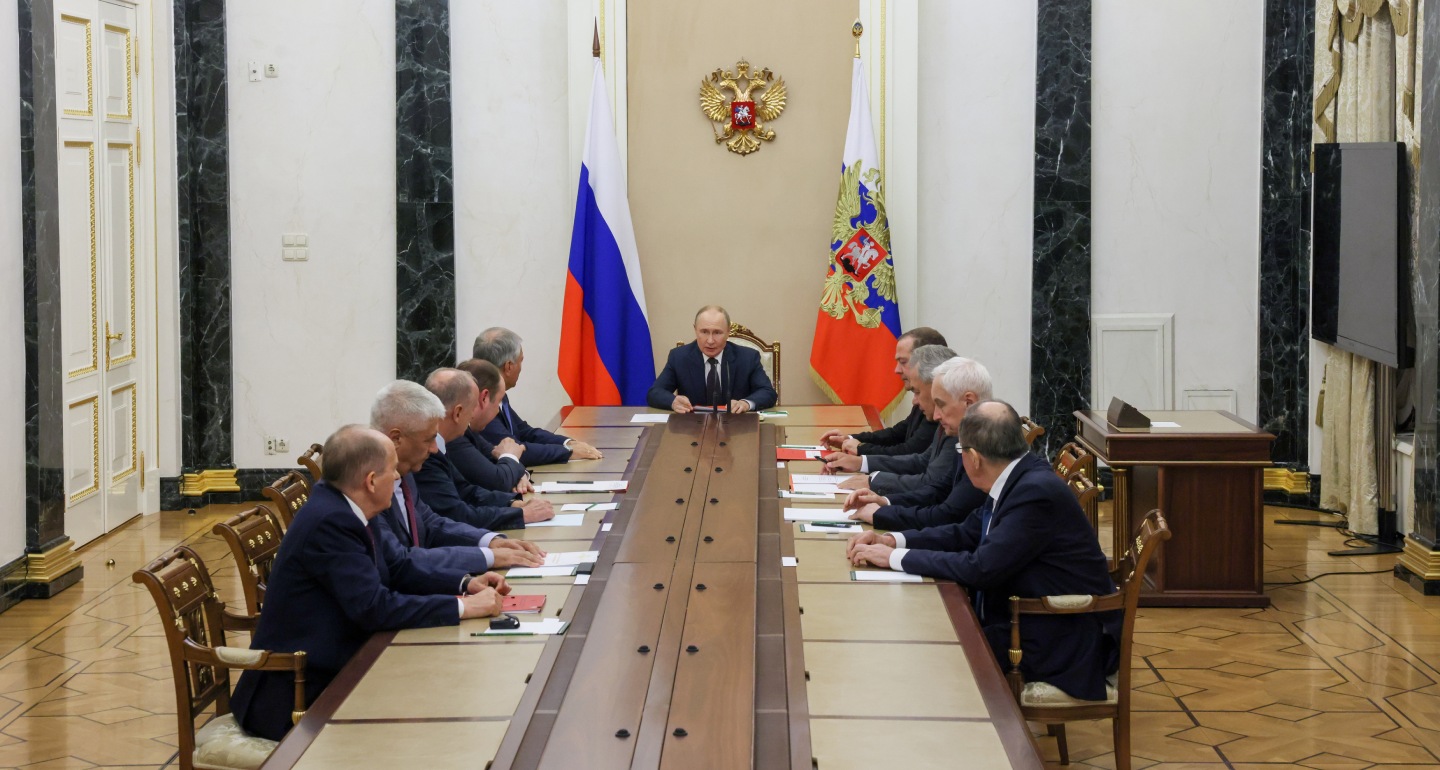
The televised meeting of the Security Council that took place on February 21, 2022, and the full-scale invasion of Ukraine that followed three days later confirmed every line in the scenario that had been written over the previous twenty years. One moment in the Security Council meeting was particularly telling. Putin had called the meeting to formally recognize Ukraine’s Donetsk and Luhansk regions as independent “people’s republics.” Members of the Security Council, with the appearance of schoolchildren who had been called up to the blackboard without prior warning, spoke in favor of the initiative one after another. Sergei Naryshkin, head of Russia’s foreign intelligence service, the SVR, misspoke, and instead of talking about “recognizing” the republics, he spoke (presciently, as it turned out) of “incorporating them into Russia.” Putin interrupted him, visibly irritated, which only served to discombobulate Naryshkin further.17 It looked less like a scene of political infighting than an illustration of depoliticization in action: The people occupying senior posts within the state were present at the formalizing of a decision that they had not made or participated in themselves.
In the first few hours of the invasion, professional self-protective reflexes kicked in faster than any moral instinct. The central bank and the government entered their habitual crisis management mode.18 Stress tests carried out a month earlier had depicted a grim picture: A schism with the West would threaten negative growth of more than 10 percent of GDP, unemployment would soar from 4 percent to 12 percent, banks would immediately lose five to six trillion rubles, interest rates would soar to 20–30 percent, and the ruble would plummet to 150–200 against the dollar. Then there was the threat of an embargo on important Western technological inputs that could set the country’s development back years.
But on February 24, 2022, no one knew for certain what sanctions would be imposed on Russia and how the Kremlin would respond. In this instance, shock and predictability are not incompatible; they simply operate on different levels. The shock was over the decision and what it entailed: the scale of the war, the speed of its escalation, and the break with the West. The behavioral reaction was entirely predictable, given the architecture of the system: Seek out instructions, carry them out, delegate responsibility, and don’t publicly break character.
On the day of the invasion, Putin met with representatives of big business. The gist of the conversation was effectively that business should demonstrate patriotism and loyalty, and in exchange, the state would guarantee support through the budget and favorable regulatory moves.19 In the part of the meeting that was open to the media, Putin repeated what he had said in his television address that morning. “What is happening is a forced measure: they left us no other choice.” Nobody left the meeting. No one objected publicly. Twenty years of depoliticization had produced a group of people for whom public dissent was simply not an option.
The reaction of the nobiles to personal sanctions was also telling. Both after the annexation of Crimea and in 2022, businesspeople and officials who were included on sanctions lists actively complained that it was unfair—but made no complaints about the Kremlin’s actions or about the regime itself. One senior interlocuter summed it up perfectly, saying that the sanctions had “cemented the elites.”
“Everyone who was thinking of some other kind of life understands that at least the next ten to fifteen years of their life now will be based in Russia. . . . These people feel wronged, but they are not going to overthrow anyone, and will make their lives here as best they can.”
For the bureaucracy and business, the partial mobilization announced in September 2022 followed a by-now familiar scenario. Putin made the decision after barely consulting with his inner circle,20 and the system immediately leapt into action to implement his will. Responsibility was swiftly delegated downward, making regional governors personally responsible for meeting recruitment quotas.
“Every forty-hours there’s some new nonsense, no one even knows what’s going on. The people responsible for actually implementing something get told about it at the last minute,” one participant recounted. “A mobilization is announced, only there’s no money allocated for that in the budget, naturally.” But even this did not lead to any public objections. “By 2022, the bureaucrats had developed a very strong habit of staying silent,” one senior official confirmed.
The few who found it in themselves to leave or publicly condemn the war, like Anatoly Chubais (a prominent Russian politician and Putin’s former envoy on sustainable development), Arkady Volozh (the founder of the IT giant Yandex), and businessman Oleg Tinkov (who was forced to sell his assets for less than their worth after he strongly criticized the war) are important precisely because they were the exception that proved how the system works. Their actions didn’t just require courage, but also necessitated a clean break with the system and with the logic of the moral career that had been constructed over years.
The Russian system of governance is largely based on the Soviet experience. The American political scientist Michael E. Urban, who researched this topic, talked about the “double bind,” in which the authorities simultaneously required their subjects to implement plans while deliberately making those plans impossible.21 Soviet officials devised three survival strategies: formalism (“I’ve done all the procedures, what more can I do?”), localism (“we’ll sort this out ourselves,”), and departmentalism (in which each agency protects its own interests and nobody else’s).
With the collapse of the Soviet Union, this logic did not disappear, but simply evolved. In Putin’s system, loyalty became feasible and was rewarded, which sets it apart from the Soviet model of chronically impossible plans. But the survival strategies of formalism, localism, and departmentalism remained and were incorporated into the new environment as a longstanding habit.
To be successful in a system like this, participants have to understand the informal expectations of their leadership and adapt to unwritten rules, either by knowing them in advance, or adapting to them after their first attempt. One of the chief adepts of informal practices is Putin himself: He distributes billions of rubles through resolutions that bypass budget procedures, and his praise is the main hallmark of success, even if winning that praise requires breaking the rules or building entire Potemkin villages. The measure of success is not the result of the work performed, but how it went down with the bosses. All attempts by the liberals within the system to reform state service and standardize the use of key performance indicators (KPIs) have run into resistance from the Kremlin.
The conformity of the Russian ruling elite is therefore not an aberration or down to the individual character of its representatives, but the structural result of institutional design. In this respect, there is nothing unique about the Russian system: Depoliticization is also seen in other authoritarian regimes. What is unique is its extent, and the almost complete lack of remaining space for alternative views, even within factions, behind the scenes, or within organizations. A significant role was played in this by the lack of career prospects outside of the system: Any trajectory, including key appointments within state corporations and business, must inevitably be approved by the Kremlin.
One of the key illusions of the post-Soviet period was the idea that a rational state was forming in Russia: It might be authoritarian, but the hope was that the state was still capable of learning lessons and balancing the interests of various groups. To some extent, this is true. What enabled the Russian government to save the country’s economy and withstand the avalanche of sanctions was in-depth knowledge of market practices. This combination of a market economy and professional ad hoc solutions gave Fortress Russia the flexibility required to adapt to dramatically new conditions.
At the same time, however, the ongoing war in Ukraine, the isolation imposed by sanctions, growing internal pressure from Putin and supporters of isolationism, and fear of the siloviki are pushing the Russian system of governance toward a mere imitation of efficiency. The system today operates on the basis of short-term coercion, institutional arbitrariness, and an entirely closed decisionmaking process. Depoliticized expertise can be used to explain almost any decision by the authorities, no matter how irrational or unfair it might be.
It’s important to underline that the Russian elites swallowed the bitter pill of depoliticization long before the full-scale invasion of Ukraine. This is partly why the invasion in February 2022 was possible, and why the elites adapted to it so quickly.
The almost complete de-institutionalization of governance has rewarded Putin with an authoritarian dividend: The preponderance of manual control means the state management system has become extremely flexible. In such a system, decisions—including sensitive fiscal measures—can be taken quickly and without any political resistance. The State Duma simply rubber stamps them without discussion, society has been stripped of any mechanisms for providing feedback, and big business is incapable of expressing dissent.
This managerial “efficiency” comes at a high institutional cost. First, it expands the scope for violations of standard procedures. Decisions are made at the top, often arbitrarily, and then simply formalized in keeping with protocol. One example is how businesses are encouraged to offer financial incentives for “volunteers” to go and fight at the front.22
Second, state policy is giving way to a series of improvisations designed to have an immediate effect, such as the government’s battle against rising egg prices, which has led to overproduction and losses for farmers.23
Third, the distortion of information has reached such heights that even senior bureaucrats are now working with incomplete or skewed pictures of reality. Since the start of the full-scale war, Russia has stopped disclosing a significant proportion of its economic and legal statistics. This information is not just unavailable to external observers, but to officials and businesspeople too.
As a result of the combination of these three factors, representatives of the elites, who should act as a counterbalance to the autocrat, are losing their agency and turning into mere implementors of Putin’s will. They are flatterers and sycophants who are sensitive to any change in the autocrat’s mood and put his comfort above anything else.
Sanctions have changed not only the external contours of the Russian economy, but the behavior of the ruling stratum too. In these conditions, their behavior is determined by at least three key factors. First, they remain dependent on the center for the legitimization of their property. Putin remains the main distributor of resources. His control over access to property remains both symbolic and fully operational. The redistribution of assets—both from foreign companies who have quit Russia and among Russian asset owners themselves—has become part of the new political and economic logic. This strengthens vertical dependency and cements the personalized system of guarantees.
Second, sanctions have unlocked new opportunities. The exodus of Western companies and the transformation of trade and logistics routes have presented the nobiles with a new chance to fill gaps in the market. For example, Arnest, a little-known group reportedly connected to First Deputy Prime Minister Denis Manturov, has consolidated assets in chemicals, cosmetics, beer brewing, and beer packaging worth over $1 billion.24
This logic is especially close to the hearts of businessmen and officials who cut their teeth in the 1990s. Their way of thinking is black and white: focused on the deal, on power, and on clear and tough decisions. This is precisely why political leaders like U.S. President Donald Trump appeal to them. They see him as one of them: a self-made man, as opposed to coming from old money. In this respect, the ruling establishment is projecting its hopes for change in the sanctions regime outside of the system.
Third, sanctions against individuals have destroyed the previous model of diversified security. Assets that were kept in stable jurisdictions were suddenly frozen or otherwise made inaccessible. The backup plan of leaving for other institutional regimes has also turned out to be unfeasible. The prominent 1990s-era oligarch Mikhail Fridman has knocked at virtually every door in the West in an attempt to have individual sanctions against him lifted.25 He has openly called the war a tragedy, offered money to Ukraine,26 organized a collective letter in his defense from the Russian opposition,27 and appealed to Western courts28—but all in vain. Individual sanctions have drastically reduced the mobility of Russian capitalists and have left them more vulnerable at home.
Against this backdrop, a new trend could emerge of the gradual return of capital to domestic politics. There is no question of an attempt to seize power or create opposition to the Kremlin; rather of entering into local or regional configurations upon which the resilience of business directly depends.
In a situation in which the president is focused on geopolitics and is paying less and less attention to arbitrating among the elites, a kind of decentralization of decisionmaking takes place. For businesses operating under these conditions, relations with regional administrations, governors, and the local FSB and prosecutors become crucial. Without these relationships, entrepreneurs, deprived of any channels for influencing the local government, are left vulnerable, even if they are completely loyal to the federal center.
One interviewee described the situation as follows. Governors have one boss—the presidential administration—and see businesses purely as a nonbudgetary source of funds. In this mindset, local businesspeople are obliged to pay for the needs of troops at the front, to build sports facilities, to chip in for transport for the local hospital, and so on. Yet in exchange, entrepreneurs are given no protection from the security services, no support in negotiations with the federal center, and no substantial tax breaks. Business is being turned into a function of the state, even though it has not agreed to take on that role. The practical response to this is the targeted cultivation of one’s own regional elites who are capable of providing at least basic political insurance.
The irony is that the Kremlin has largely achieved its goal: capital has “returned home.” But for it to continue to function, certain types of infrastructure are needed, including political infrastructure. Amid a fractured institutional environment, business interests find themselves forced to return to politics as a way of ensuring predictability, protection, and stability.
But this is still not the agency of change. None of those involved in this reconfiguration are casting any doubt on the logic of the system, which consists of personalistic guarantees, informal proceedings, and the lack of legal protections. Localizing the search for protection reproduces the system’s logic in miniature rather than defying it.
The contemporary ruling elite in Russia is not a political class, but a community of managers who are not subject to competition or public accountability. In this configuration, the state does not have its own will or strategy, but is becoming an operating apparatus without any internal autonomy, an empty shell capable of performing functions, but not of generating meaning.
Once Putin leaves the stage, the system will be faced with a critical deficit of agency. The ruling elite have no experience of strategic thinking, public debate, or working with alternatives. The resulting vacuum will most likely be filled not by reformers, but by conflicts between elite groups and a protracted battle for control over the collapsing system. The prospects of democratization are minimal, not because there is no appetite for change among the public, but because among the elites, there are no figures capable of formulating and implementing that change.
For Western observers, there can be one conclusion. Post-Putin Russia will not automatically become a different Russia. The void created by a depoliticized ruling elite won’t necessarily be filled by democratic actors. It will be filled by whatever force proves to be best organized at the moment a political vacuum emerges. As history reminds us, that is far from certain to be the outcome for which many people in both Russia and the West are hoping right now.
The Carnegie Endowment’s project on the Future of Russian Power is a multidisciplinary initiative that seeks to frame, assess, and energize debates on the ways in which Russia’s invasion of Ukraine, intensifying domestic repression, and wider geopolitical disruptions have reshaped Moscow’s long-term power and influence. Building on Carnegie’s rich tradition of policy-relevant research on the region, scholars based in Washington, Berlin, Brussels, Kyiv, and beyond will examine the drivers and implications of Russia’s power across the military, diplomatic, trade, energy, cultural, and technological domains over the next five to ten years and will explore options for Western policy.

Senior Fellow, Carnegie Russia Eurasia Center
Alexandra Prokopenko is a senior fellow at the Carnegie Russia Eurasia Center.
Recent Work
Alexandra Prokopenko
Alexandra Prokopenko
Carnegie does not take institutional positions on public policy issues; the views represented herein are those of the author(s) and do not necessarily reflect the views of Carnegie, its staff, or its trustees.

Despite public disputes over trade and immigration, the strategic partnership’s foundations remain sturdy.

Sameer Lalwani
Russia spent years building a “sovereign internet,” concentrating web infrastructure exclusively within Russian territory. Ukrainian drone attacks have shown how vulnerable that approach has left the Russian internet.

Maria Kolomychenko

With its public finances in shambles, the far right polling at 35 percent ahead of the 2027 presidential election, and a growing protest movement, is France’s crisis a threat to the EU’s geopolitical awakening?

Rym Momtaz, ed.

Putin’s conservative staffing policies and search for ever greater control have cemented parliament’s transformation into a bureaucratic appendage of the executive branch.

Andrey Pertsev

Russia’s AI-driven propaganda campaigns operate in a fragmented, chaotic, and often illogical manner. That’s not necessarily a problem for the Kremlin, though: It’s much easier to mimic genuine public debate that way.

Ilya Klishin