For more than a year, the Bashar al-Assad regime has been unable to amass troops in every contested area around the country. Strategic bombing campaigns have attempted to counter this waning military capacity, and over the last month, Russia has joined Assad in these efforts. Most Russian air strikes have targeted American, Turkish, and Gulf-backed rebels and those living under their control in northern and central Syria. Early evidence confirms accusations that the Islamic State is only a secondary target of Russian President Vladimir Putin’s most recent foreign incursion, the primary aim of which is to bolster Syria’s increasingly depleted dictator by reversing territorial losses near the regime’s strongholds. As reporting from his recent visit to Moscow indicates, the military offensive is also meant to ensure that the Assad regime prevails as the most viable ruling force in Syria before embarking upon a negotiated political solution.
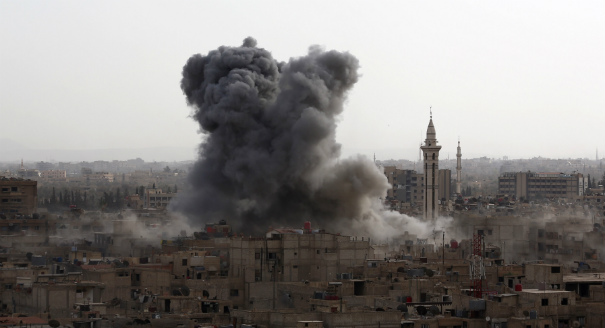
Russia’s military intervention is exacerbating the disastrous effects of the regime’s tactic of bombarding civilians living under opposition control. Since the civil war escalated in 2012, the Syrian government has consistently sought to make everyday life in rebel-controlled areas unlivable. One of the key tactics in its strategic arsenal is destroying any and all attempts by armed opposition groups to establish alternative systems of governance. Through aerial bombings and the infamous “barrels of death” (baramil al-mawt)—canisters filled with oil, explosives, and shrapnel—the Syrian government has repeatedly targeted markets, hospitals, schools, and burgeoning municipal councils operated by local civil society groups or armed rebels. In doing so, government forces kill many and terrify those who remain, destroying the fabric of society in areas outside of the Assad regime’s control.
Russia’s recent airstrikes have compounded these developments. Although the Kremlin has a penchant for attacking military targets of “moderate” rebels, Russian warplanes have repeatedly used cluster bombs and unguided explosives, which pepper wide tracks of land with deadly blasts whose inaccuracy threatens civilians. The outcome is that even when Russian planes target military positions, civilians and residential areas are often hit instead. Since early October, missiles have reportedly struck seven hospitals or medical facilities in rebel-held territory in Hama, Idlib, and Aleppo provinces. Relief workers on the ground believe Russian planes are deliberately targeting medical facilities. These bombardments come in the wake of twelve regime attacks on medical facilities in August. One opposition spokesperson believes that this is part of the Assad’s strategy to increase pressure on opposition groups by forcing those that live under their rule to flee. Such attacks ensure that only government-controlled areas can provide the stability civilians crave, increasing the likelihood that Assad remains a necessary part of any future political solution.
The regime’s bombing tactics have a tangible political and military impact. In order to establish their legitimacy and gain civilian consent for their rule, rebel groups have tried to mimic public services offered by the government. Replicating these functions has been a crucial tool through which the most successful rebel forces, including moderate groups but also Jabhat al-Nusra and the Islamic State, have gained popular legitimacy. The Assad regime has consistently attempted to undo these developments in places like Aleppo, Idlib, and Daraa, mainly through aerial bombing campaigns. These efforts have destroyed public service infrastructures established by opposition groups. The ability of rebel groups to meet the needs of civilians under their control has been repeatedly curtailed. In the absence of a legitimate or functioning alternative, the Assad regime can confidently assert itself as the only political authority capable of maintaining order and providing a modicum of governance.
Cluster and barrel bombs send an unambiguous warning to those towns and neighborhoods still pondering their allegiances. Coupled with blockades and sieges, such efforts erode the rebels’ support base, violently pacifying many inclined to support their cause. This became especially clear earlier this month when regime planes reportedly dropped leaflets and civilians received text messages in opposition-controlled towns north of Homs after a series of Russian bombings in the area. The messages attempted to persuade townspeople to leave rebel-controlled territory, explicitly drawing attention to the tenuous nature of opposition rule. In devastating the governance and military capacities of the moderate rebel groups that remain, Russian military efforts will only exacerbate the continued hemorrhaging of veteran fighters and civilians into more radical and well-funded groups. Their goal is to leave Syrians no option but to choose between the Assad regime and jihadists, making the U.S. mission of supporting moderate forces an increasingly impossible endeavor.
Putin’s intervention may well tip the military balance of the war back in the Assad regime’s favor. However, its impact on civilians and the opposition’s ability to govern is equally significant and will ultimately prove far more devastating. Reports already indicate that tens of thousands of civilians in areas hit by Russian bombings are relocating. They may flee abroad or to regime-held territory, where Assad has consolidated control over international emergency food aid and used Iranian credit to provide basic necessities. By terrorizing civilians and destroying rebel groups’ attempts at local governance, Russian military assistance is helping Assad present his government as the only viable ruling force in Syria. If their efforts succeed, the recent bombing campaign will have fundamentally altered the outlook of the Syrian conflict. Putin’s revamped support for Assad may ensure that any potential political solution will occur on their preferred terms.
José Ciro Martínez is a PhD candidate in the Department of Politics and International Studies at the University of Cambridge. Brent Eng is an Amman-based Syria analyst.