The rise of the Islamic State (IS) group in Syria and Iraq further complicates the seemingly contradictory relationships among Hamas and Salafi-jihadi groups in the Gaza Strip and Egypt’s Sinai Peninsula. While the historically tense and often openly antagonistic relationship between Hamas and Gaza-based Salafi-jihadi groups is well known, several Israeli news articles over the past month have claimed that Hamas is in fact working with IS-linked factions in Sinai to bring weapons into Gaza and carry out attacks against Egyptian security forces. These reports are largely an over-simplification of the situation, which is contextualized by the political and economic realities in the strip.
After Hamas took over the strip in 2007, Gaza faced international isolation and dire restrictions on the inflow and outflow of goods and people. Gaza’s relationship with neighboring Egyptian Sinai deepened as the latter became its only access to the outside world. The informal tunnel economy soon became essential to keep the strip and its economy afloat, while providing the Hamas government “tax” revenue and the group’s military wing, the Qassam Brigades, a channel for both arms and cash.
The tunnels also established extensive economic relations along the Sinai–Gaza border. Egypt’s impoverished North Sinai governorate became a boomtown for traders in everything from consumer goods to medical supplies, construction materials, and fuel. Meanwhile, Bedouin smugglers and criminal arms dealers collaborated to send increasingly sophisticated weapons to Hamas—key militant leaders in Sinai, whatever ideology they claim to support, have financial interest in the perpetuation of this underground economy.
Egypt has conducted an extensive crackdown on the Gaza–Sinai informal economy and tunnel system—since an August 2012 border attack, but especially following the ouster of President Mohamed Morsi. In addition to its decision essentially to seal the Gaza–Sinai border, this has only added pressure to both the humanitarian situation in Gaza and the Hamas government. Recent public opinion polls show that the overall level of satisfaction with conditions in the strip stands at 15 percent. A rise in public protests and strikes reflect a growing sense of frustration over the economic situation, the ongoing energy crisis, the ever-rising taxes imposed by Hamas, and the still-not-resolved salary crisis for Gaza’s public employees.
Hamas’s relationship with self-proclaimed “Islamic State supporters” in Gaza and with the amorphous, small, and largely unsophisticated Salafi-jihadi camp in general is also affected by the group’s precarious situation in the strip. Hamas is indeed treading carefully.
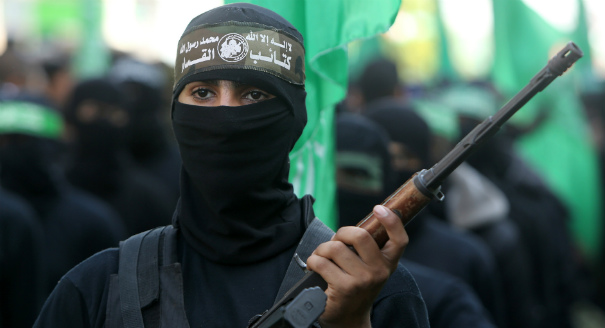
Amid rising internal discontent, a fragile economic situation, growing support for an armed intifada, and with ten percent of Gaza’s residents reportedly believing the Islamic State represents “true Islam,” Hamas worries its interest in maintaining its ceasefire with Israel—which means cracking down on individuals and cells that openly defy the group—could generate a backlash. It is especially concerned about the potential for defections from the group’s armed wing, or from Gaza’s security sector, to the Salafi-jihadi camp. Indeed, with the latest ongoing wave of violence between Israelis and Palestinians, Hamas’s decision not to openly fire rockets during the current cycle of confrontation has generated heated internal debates and external public pressure.
As a result, while Hamas has no interest in allowing an IS-inspired camp to operate in Gaza, as shown in its crackdown on self-declared pro-IS cells in Spring 2015, it has shown more restraint in recent months. It is reasonable to expect Hamas to continue to monitor and occasionally crack down on rising pro-IS cells in Gaza. However, overall Hamas’s grip on Gaza and on competing armed factions’ freedom of maneuver may relax, while its own rhetoric and support for armed violence may increase.
The relationship between Hamas and Sinai-based jihadis is more complex. Hamas’s Qassam Brigades have a longstanding and mutually beneficial economic relationship with Shadi al-Menai, a Wilayat Sinai leader, and other Egyptian militants in the peninsula. That relationship made sense when Menai was a criminal smuggler, and it made sense when he helped found Ansar Bayt al-Maqdis—a Sinai-based jihadi group that grew out of Gazan militancy. The economic links and contacts, still mutually beneficial, continued when Menai’s group joined the IS fold in November 2014. This feeds the claim that Hamas is cooperating with the Islamic State. But such an assessment largely over-represents the nature of the economic, convenience-driven relationship and fails to account for the complex economic system in place along the Gaza–Sinai border.
Hamas is no fan of the jihadi groups in Sinai. What is more, conscious of the threat that Gaza’s jihadis pose to stability in the strip, Hamas regards potential collaboration between pro-IS cells in Gaza and Wilayat Sinai with suspicion. Avoiding antagonism with the far more sophisticated Sinai group provides Hamas leverage against such a threat. Protecting Sinai province leaders, or at least acquiescing to their presence in Gaza, means Hamas’s intelligence corps know exactly where these figures are in case of trouble.
In sum, the Hamas government in the Gaza Strip is actively involved in keeping the broader Salafi-jihadi camp from stirring up internal trouble or goading Israeli action against the strip, which includes preventing strong ties between Gaza- and Sinai-based jihadis. Likewise, to end its isolation, Hamas’s political leaders also hope to reverse a deterioration of relations with Egypt, even though the group’s military leaders are deepening their relations with some figures within the very same Salafi-jihadi camp that is fighting Egypt—and which Hamas is fighting in Gaza. This is because the ongoing economic restrictions and aggressive campaign against the tunnel economy have given Hamas’s military wing a powerful incentive to deal with any group—jihadi, criminal, or both—that could provide the weapons and financial resources it needs. In this sense, the Hamas–IS relationship is primarily driven by economic transactions. Such ties, however, also result in ad hoc cooperation, and according to Egyptian and Israeli intelligence sources, the Qassam Brigades are selling or providing weapons and offering training to IS-linked fighters with the goal of clearing its “lifeline” passage.
On the surface, Hamas’s cooperation with groups associated with or inspired by the Islamic State seems illogical: Hamas is a Muslim Brotherhood-linked group that needs good relations with Egypt and quiet stability with Israel, while the Islamic State regularly threatens Israel and Hamas, mocks the Muslim Brotherhood, and murders Egyptian security forces and civilians. However, internal Gaza power and economic dynamics explain the nature of this seemingly illogical yet temporarily convenient, economically-driven relationship.