A number of analysts have recently rung alarm bells regarding Washington’s increasingly Kurdish-centric strategy against the Islamic State (IS), warning that empowering the Kurds is creating an imbalance in their relationship with nearby communities. What this argument presents as a problem, however, may instead be an opportunity for the Kurds to play a role in bringing about a sustainable peace in Turkey, Syria, and Iraq.
Since the conflict has dragged on, the chances of a decisive victory for any of the combatants appears increasingly slim. Deadlocked opponents need to find a negotiated way out of such a mutually hurting stalemate. While major powers push for a diplomatic solution to the Syrian conflict—notwithstanding the destructive and complex nature of the civil war—Kurdish groups in Syria and Iraq could potentially help bring about such a power-sharing agreement. The Kurds’ success in reversing IS gains in both Iraq and Syria has turned them into key U.S. allies in the fight against the Islamic State and empowered such potential diplomatic players as the Kurdish–Arab–Christian Syrian Democratic Forces (SDF).
In addition, the size of the Kurds and their dispersion among the key Middle Eastern states of Turkey, Iran, Iraq, and Syria means that their inclusion in any power-sharing agreement in Syria would impact Kurd–state relations in other countries home to sizeable Kurdish communities. The Kurds are one of the largest ethnic groups in the Middle East, making up roughly 20 percent of the total population in both Turkey and Iraq and 10 percent of the total population in Iran and Syria. But their division in the aftermath of World War I turned them to ethnic minorities in newly forged states, and dozens of twentieth-century Kurdish uprisings challenged these states’ aggressive assimilationist policies. All of the major Kurdish uprisings from the 1920 Barzinji revolt in Iraq to the 1979 rebellion in Iran were decisively crushed. Their more recent conflicts break this pattern: the 1991 uprising in Iraq was a victory for the Kurds, and the Kurdistan Workers’ Party (PKK) conflict in Turkey has continued on-and-off since 1984. Yet none of these conflicts had a negotiated settlement, so conflict kept reemerging—or in the case of the PKK, continuing.
Long-term stability in Turkey, Iran, Iraq, and Syria is impossible without addressing Kurdish demands, which in turn necessitates creating systems more open to minority power-sharing. As such, the current context in Syria offers some hope not only for a solution to the Syrian civil war, but also for policy changes that could address festering problems between Baghdad and the Kurdistan Regional Government and between Ankara and the PKK.
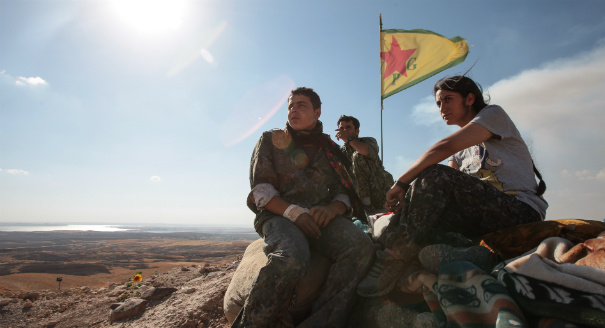
In Syria, U.S. support for the new, Kurdish-Arab Syrian Democratic Forces (SDF) could push IS out of northern Syria completely. The autonomous cantons led by the Democratic Union Party (PYD), which it views as “a model for a future decentralized system of federal governance in Syria,” could then be applied in more parts of the country where Kurds are not a majority. The PYD hopes the United States will protect this “democratic confederalism” as long as the SDF keeps the border with Turkey quiet and does not commit serious human rights abuses in their areas of control. Because the Syrian Kurds are neither allies of the Assad regime nor its implacable enemies, this model might offer a way to settle things down in Syria. While the SDF cantons are not the first choice of either Assad or the Arab rebels, they can offer a way out of the all-or-nothing struggle going on in Syria, setting the stage for expanding ceasefires and multiplying local administrations. These cantons would formally remain a part of Syria but allow local communities to rule over and protect themselves.
A quiet Turkish–Syrian border would in turn help show Ankara that there are alternatives to trying to shoot its way out of its problem with the PKK and the millions of Kurds who support it. It is important that Turkey make peace with its own Kurds and recognize the Kurdish reality across its borders. Without a Turkish rapprochement with the Kurdish political movement in Turkey and Syria, instability will continue to plague the area long after the Islamic State is gone. Turkish relations with the Kurds in Iraq show how mutually beneficial such a reconciliation can be. Turkey once considered a Kurdish entity in northern Iraq unacceptable and a direct threat to its national security. Today, following the collapse of Turkish Prime Minister Ahmet Davutoglu’s “zero problems with neighbors” policy—especially since the Turkish military shot down a Russian aircraft on November 24, 2015—Turkey’s only friend in the neighborhood remains the Kurdistan Regional Government in Iraq.
In Iraq, more support for the Kurds, irrespective of Baghdad’s wishes, would force Baghdad to acquiesce to a greater number of Kurdish demands regarding decentralization, power sharing, and control of important parts of the oil industry. This is not necessarily a bad thing, as Iraq’s problem has always been authoritarianism, excessive centralization of power, and the resulting all-or-nothing struggle for control in Baghdad. A better-armed Iraqi Kurdistan will remove any temptation on Baghdad’s part to settle differences with the Kurds militarily. Indeed, Baghdad’s efforts to forcefully sideline Iraqi Arab Sunnis after 2010 led to many of today’s problems with IS in Iraq. As the Nouri al-Maliki led government increasingly ignored the 2005 constitution’s provisions for decentralization, it alienated not just the Iraqi Kurds, but the Arab Sunnis as well. Resulting Sunni alienation paved the way for the return of the al-Qaeda in Iraq, now known as the Islamic State. Finally implementing Kurdish demands for decentralized federalism in Iraq, which always included regard for other governorates and regions besides Kurdistan, could go a long way towards reassuring Arab Sunnis, as well as local Shia who favor greater autonomy in places like Basra.
Kurds can in fact serve as peacemaker in war-torn Syria and Iraq and help strengthen existing democratic institutions in Turkey. If allowed to do so, Kurdish parties would also have much less incentive to make risky bids for secession from any of these states. Failure to address legitimate Kurdish demands for equality is likely to lead to more Kurdish attempts to break away from the authoritarian states ruling over them. This would in turn strengthen the authoritarian tendencies of central governments, which could use the threat of Kurdish uprising to impose harsher security measures on their societies. In states where the Kurds cannot be free as Kurds, no one is likely to have much liberty, especially other minorities and those who would express dissent against ruling parties.
Mehmet Gurses is an associate professor of Political Science at Florida Atlantic University. David Romano is the Thomas G. Strong Professor of Middle East Politics at Missouri State University.