

Commentary
Matt Sheehan
{
  "authors": [
    "Matt Sheehan"
  ],
  "type": "commentary",
  "centerAffiliationAll": "dc",
  "centers": [
    "Carnegie Endowment for International Peace"
  ],
  "collections": [
    "China and the World"
  ],
  "englishNewsletterAll": "asia",
  "nonEnglishNewsletterAll": "",
  "primaryCenter": "Carnegie Endowment for International Peace",
  "programAffiliation": "AP",
  "programs": [
    "Asia"
  ],
  "projects": [
    "China AI Initiative"
  ],
  "regions": [
    "North America",
    "United States",
    "East Asia",
    "China"
  ],
  "topics": [
    "Climate Change"
  ]
}
Source: Getty
It’s the latest in a long tradition of California officials engaging with China on climate issues.
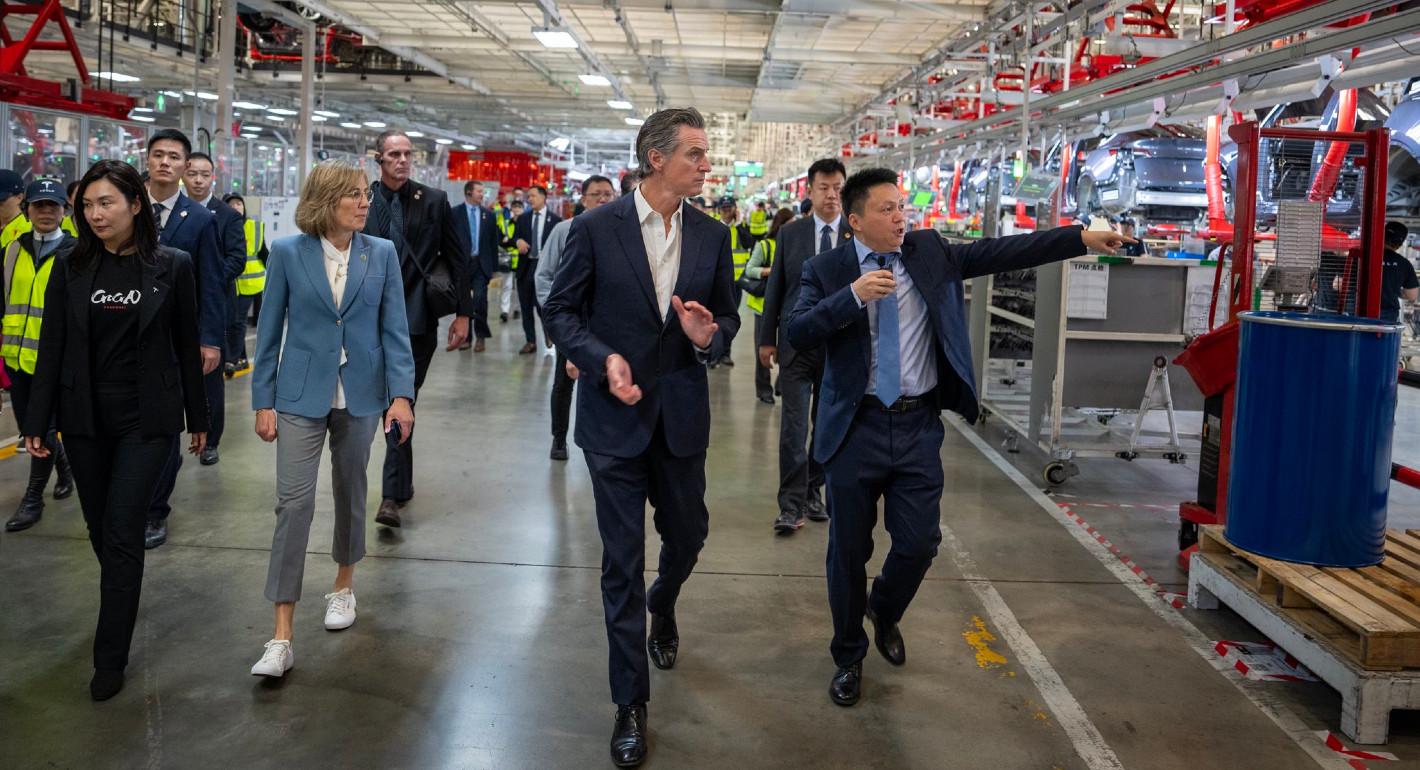
Over the past week, California Governor Gavin Newsom went on a whirlwind tour of China to promote engagement on climate change. The trip had Newsom test-driving Chinese electric vehicles and visiting a Tesla factory, and it culminated in a meeting with President Xi Jinping. Critics speculated widely about the motives for the trip, including framing it as part of Newsom’s “shadow campaign” for president or a Chinese propaganda operation designed to capture photos of Americans in China smiling.
But the reality is both more mundane and meaningful: Newsom’s trip is the latest in a long tradition of California governors, mayors, and public officials engaging with China on climate. Those deep and multifaceted ties stretch back two decades, contributing to technological, regulatory, and commercial advances in carbon reductions. They’ve spanned one Republican governor and two Democrats, all of whom visited China and two of whom met with Xi. Most importantly, these ties have had a real impact on reducing carbon emissions in both countries. The impacts have been practical and symbolic, commercial and diplomatic.
Visits by two California governors and one mayor helped lay the groundwork for Chinese electric-vehicle juggernaut BYD to set up a factory in California. That factory is now the largest electric bus factory in North America, employing 500 union workers who have built and shipped more than 500 electric buses operating around the United States. Policy exchanges between the California Air Resources Board and Chinese regulators helped China shape its ambitious zero-emissions vehicle mandate and clean up the air in Beijing. California’s Lawrence Berkeley National Laboratory also played an important role in developing Chinese energy-efficiency standards and labels.
And these exchanges are a two-way street. For years, California was the beacon of environmental best practices and green technologies, and Chinese officials were eager to learn from their counterparts abroad. But today, California can learn just as much from China, which has turbocharged its clean energy industries and turned itself into the dominant player in electric batteries and other key technologies.
As China pushes ahead in these areas, California research labs, universities, and companies will need to maintain ties to their counterparts in China. Over the past twenty years, Chinese entrepreneurs built rich connections to the U.S. technology ecosystem, helping these Chinese technologists to absorb new technical breakthroughs and business models that they could apply domestically within China. Those ties were important in helping China, a technological laggard at the time, catch up with the world-leading U.S. companies. Today, the script is flipped in green technology, and it’s the American players who can use these ties to catch up with world-leading Chinese industries.
The symbolic power of these trips can also have major real-world impacts. No mayor or governor can directly engineer technical research collaborations, but trips like these can grease the wheels of these transpacific partnerships. In China, university presidents and corporate executives must constantly read the political tea leaves to assess whether these kinds of international partnerships will be encouraged or frowned upon. They know that a shift in political winds can render their investment moot or turn a productive research workshop into a mark against them. In recent years, several of these research partnerships and joint ventures in low-carbon technology have been canceled or allowed to expire by managers who feared political blowback. The Newsom trip and the warm reception from China’s political leadership provide much-needed political cover for people working in the trenches of carbon-reducing technologies and businesses.
Newsom’s trip came with its share of political missteps, from echoing problematic Chinese talking points to accidentally bulldozing a Chinese kid while playing basketball. These are to be expected when a governor new to the international stage ventures abroad. If Newsom does have presidential ambitions, he will need to widen the aperture when dealing with China, giving greater play to human rights and security issues rather than focusing solely on climate.
But for now, Newsom is still a governor, one who inherited two decades of work on these issues. Productive diplomacy requires consistency. While U.S. federal policy on both China and climate change have swung wildly and unpredictably, California’s engagement has been the one constant. Whoever serves as the next governor of the Golden State should continue that tradition.

Senior Fellow, Asia Program, and Co-Director, China AI Initiative
Matt Sheehan is a senior fellow at the Carnegie Endowment for International Peace, where his research focuses on global technology issues, with a specialization in China’s artificial intelligence ecosystem. He is also co-director for the China AI Initiative.
Recent Work
Matt Sheehan
Matt Sheehan
Carnegie does not take institutional positions on public policy issues; the views represented herein are those of the author(s) and do not necessarily reflect the views of Carnegie, its staff, or its trustees.

A leak of Russian gas price data helps establish that China is paying Russia far less than Central Asian countries and Gazprom’s former European customers.

Sergey Vakulenko

China’s political future will be shaped between now and next October. As the Communist Party enters its intense “campaign season” to prepare for a major political transition in 2027, reading Beijing's actions and responses may become more difficult as domestic politics weigh on its behavior more than usual.

Damien Ma

The EU can impose sanctions but struggles to enforce them without the United States. With Washington increasingly disinterested in backing European interests, the bloc must now fend for itself.


Nicu Popescu, Tiago Antunes

Rubio’s recent visit brought welcome attention, but more capital requires governance changes that may be a hard sell for regional governments.

Jennifer B. Murtazashvili

America’s foreign-policy objectives have grown more demanding while Americans have demanded greater focus on their own affairs.

Stephen Wertheim