

Research
- +5
Herbert Crowther, Darcie Draudt-Véjares, Walter James, …
{
  "authors": [
    "Darcie Draudt-Véjares"
  ],
  "type": "commentary",
  "blog": "Emissary",
  "centerAffiliationAll": "dc",
  "centers": [
    "Carnegie Endowment for International Peace"
  ],
  "collections": [
    "Korea: Emerging Player",
    "Economic Risk in Asia"
  ],
  "englishNewsletterAll": "asia",
  "nonEnglishNewsletterAll": "",
  "primaryCenter": "Carnegie Endowment for International Peace",
  "programAffiliation": "AP",
  "programs": [
    "Asia"
  ],
  "projects": [],
  "regions": [
    "South Korea",
    "China",
    "United States"
  ],
  "topics": [
    "Economy",
    "AI",
    "Technology",
    "Trade",
    "Domestic Politics",
    "Foreign Policy"
  ]
}
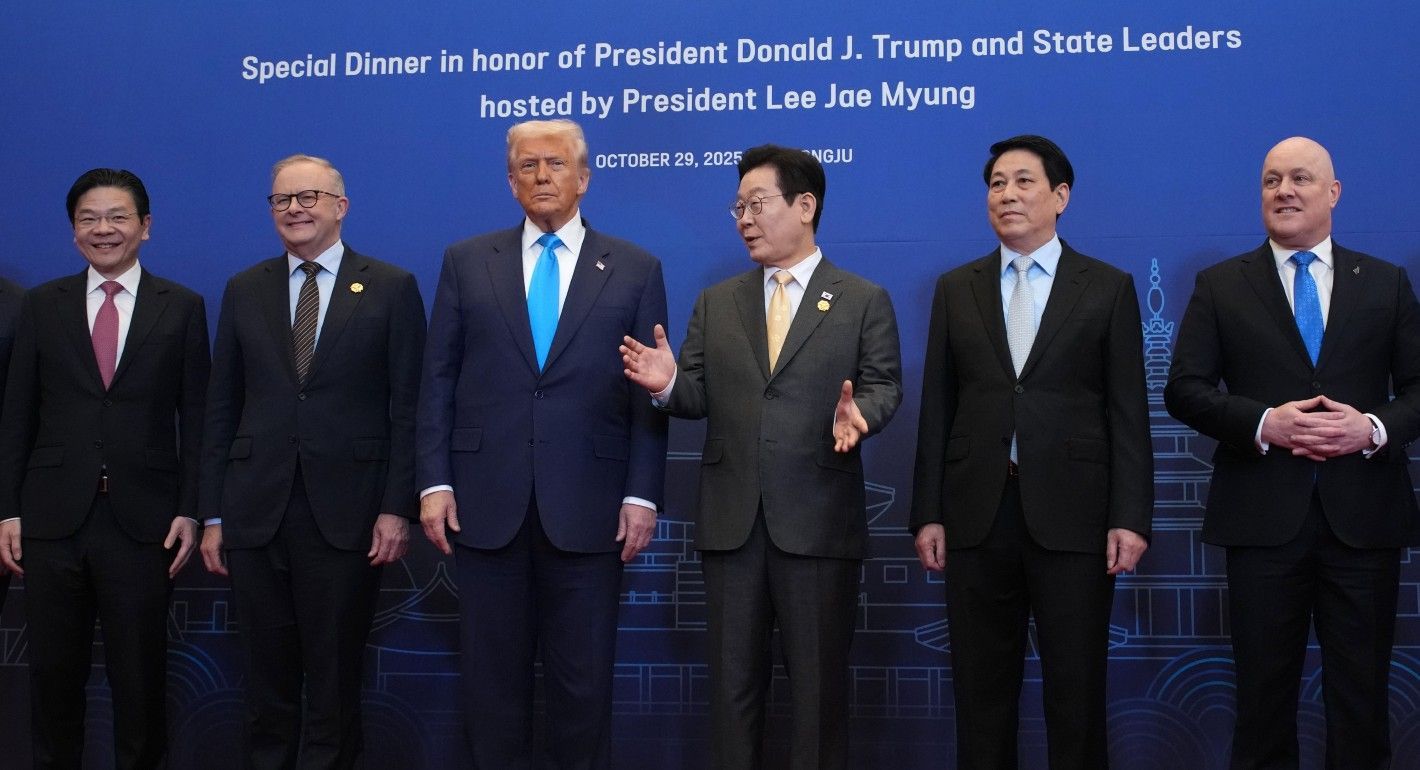
Leaders at an APEC dinner on October 29, 2025 in Gyeongju, South Korea. (Photo by Andrew Harnik/Getty Images)
Seoul is aiming to advance its regional governance in an era of competition—and trying to get other middle powers to follow its lead.
This week, South Korea hosts the Asia-Pacific Economic Cooperation (APEC) annual summit in the historic city of Gyeongju. Representing over 60 percent of global GDP and comprising twenty-one economies spanning the Pacific Rim—from Russia to Indonesia and from Chile to Canada—APEC has evolved significantly since its 1989 founding as a forum for advancing regional economic integration.
Hosting the summit is both a massive undertaking and a critical opportunity to craft an agenda that advances the country’s national interests and regional priorities. This year, Korea has another challenge: how to restore legitimacy and efficacy to a forum that is facing unprecedented strain from great power rivalry—not unlike Korea and other countries caught between superpowers. Media attention around the event has centered almost exclusively on the U.S. and Chinese presidents’ bilateral talks on the summit’s sidelines, not the substantive docket at a moment of immense geopolitical reordering and economic uncertainty.
Korea’s APEC agenda represents an attempt to advance three interconnected national priorities: enhancing supply chain security, positioning itself as a technological rulemaker, and diversifying economic partnerships beyond the United States and China. Korea’s substantive program reveals a strategic focus on issue areas where domestic imperatives and regional leadership ambitions converge around shared concerns. This approach suggests how countries like Korea can leverage domestic industrial capabilities and policy expertise to influence regional economic agenda-setting, though success depends on both the credibility of their industrial experience and the nature of each economic domain.
APEC hosting rotates among member economies, with Korea securing the chairmanship last year through the forum’s established sequence—its first opportunity since the 2005 summit in Busan. Hosting major multilateral summits provides midsized countries with unique agenda-setting opportunities, allowing them to shape discussions, convene specialized ministerial meetings, and position domestic policy frameworks as regional templates over an extended chairmanship period.
Korea’s APEC chairmanship illustrates how middle powers can use hosting diplomacy to advance leadership in international agenda-setting and rulemaking. Korea is renowned for its world-class digital infrastructure, advanced manufacturing base, and experience in rapid economic development, which provide credible foundations for leadership on technological governance, supply chain resilience, and energy transition. Through its yearlong chairmanship process, Korea used specialized ministerial meetings to help shape an agenda that also dovetails its national industrial aspirations—from comprehensive AI legislation to clean energy commitments—as templates for regional adoption. It focused on its own industrial comparative advantages, which allowed it to position itself as a preferred partner for coalition-building among midsized and large economies seeking alternatives to great power dominance.
Korea remains caught within these great power dynamics, with Seoul scheduling significant bilateral meetings on the APEC sidelines—including with U.S. President Donald Trump on Wednesday as a follow-up to Lee’s Washington visit that put pressure to solve disagreement about Korea’s $350 billion investment pledge, and with Chinese President Xi Jinping in what would be his first visit since 2014 at a moment of strain between Seoul and Beijing. These bilateral imperatives risk clouding the focus of highest-level officials on the regional cooperation that APEC should prioritize, potentially overshadowing Korea’s multilateral agenda even as Seoul attempts to create space for coordination that transcends bilateral pressures.
Korea’s agenda, organized around the theme Building a Sustainable Tomorrow: Connect, Innovate, Prosper, reflects how the forum’s priorities have evolved since it last hosted twenty years ago. Where the 2005 summit focused primarily on trade liberalization, this year’s agenda addresses what Korean officials call “new challenges such as climate change and technology development” that demand collective regional responses. Three of these priority areas—strengthening connectivity amid supply chain fragmentation, fostering AI governance and digital inclusion, and addressing demographic change alongside energy transition—indicate how Seoul has positioned itself as an essential broker when great power competition threatens regional economic stability.
The agenda also suggests how regional powers can position themselves as essential brokers when great power competition threatens regional economic stability. As U.S.-China tensions intensify around technology, supply chains, and industrial policy, Seoul has crafted a program that addresses the economic security concerns these rivalries create for APEC member states—while simultaneously advancing Korea’s own aspirations for regional economic leadership.
The focus on supply chain resilience directly responds to how U.S.-China competition has exposed dangerous dependencies across the region. Korea’s emphasis on critical materials coordination and supply chain diversification is an attempt to create regional dialogue around alternatives to choosing between American and Chinese economic spheres. For Seoul, this represents both genuine policy necessity—Korea has experienced firsthand the costs of supply chain vulnerabilities from semiconductor shortages to rare earth dependencies—and strategic opportunity to position itself as an indispensable coordinator for economies seeking to reduce bilateral dependencies on either superpower.
Korea’s digital governance initiatives similarly seek to offer an alternative to U.S.-China tech competition. While Washington and Beijing compete to set global AI standards, most APEC economies lack the resources to develop independent frameworks. Seoul’s comprehensive AI legislation and digital infrastructure experience offer smaller economies a potential third path—learning from a technologically advanced democracy that isn’t trying to dominate the global tech landscape. This agenda also enhances Korea’s soft power while addressing a genuine regional need for technology standards that serve non-superpower interests.
The energy domain also showcases how Korea transforms its vulnerabilities into regional leadership opportunities. Import-dependent APEC economies face mounting pressure to navigate energy transitions without becoming overly dependent on either Chinese renewable technology or American energy infrastructure. Korea’s renewable energy targets and institutional leadership through hosting organizations such as the Global Green Growth Institute represent an effort to establish Seoul as a potential coordinator for energy diversification strategies. Even Korea’s diplomacy in this domain seeks to counteract its mixed domestic renewable record—it can speak credibly about the practical challenges facing import-dependent economies rather than lecturing from a position of energy abundance.
Seoul’s agenda systematically identifies areas where U.S.-China competition creates regional vulnerabilities, then attempts to position Korean experience and institutions as potential solutions that could serve both shared regional interests and Korea’s own economic development goals.
As economic nationalism, supply chain securitization, and great power competition intensify, regional economic coordination and goal-setting become increasingly vital. Global APEC headlines may be fixated on U.S.-China sideline meetings, but the quieter, essential outcomes will be accomplished through Korea’s ability to advance practical frameworks that demonstrate how regional economic coordination can serve both national sovereignty and collective prosperity.
The APEC summit should be measured not by transformative breakthroughs in great power relations, but by Korea’s ability to convene diverse economies toward practical frameworks that demonstrate how regional economic coordination can serve both national sovereignty and collective prosperity. This approach offers a template for countries navigating a shifting order: one that acknowledges structural constraints while creating space for action. It’s a particularly relevant model as more countries seek to navigate complex interdependence without sacrificing flexibility.

Fellow, Asia Program
Darcie Draudt-Véjares is a fellow in the Carnegie Asia Program.
Recent Work


Herbert Crowther, Darcie Draudt-Véjares, Walter James, …
Darcie Draudt-Véjares
Carnegie does not take institutional positions on public policy issues; the views represented herein are those of the author(s) and do not necessarily reflect the views of Carnegie, its staff, or its trustees.
Fatima El Mansouri is the country’s first female prime minister. She’s also a privileged insider in a largely ceremonial position.

Sarah Yerkes

The acknowledgment has sparked fears of a new arms race with China and Russia.

Chris O’Meara

The summit may be remembered as a fatal blunder, when Washington, Beijing, and the AI industry collectively chose ceremony over action.

Jeffrey Prescott

The real test may come after the leaders leave the room.



Sheena Chestnut Greitens, Oriana Skylar Mastro, Yukon Huang, …

The Horn of Africa countries are among those facing a new security calculus.


Andrew Leber, Lesley Anne Warner