

Commentary
The real test may come after the leaders leave the room.
- +1
Sheena Chestnut Greitens, Oriana Skylar Mastro, Yukon Huang, …
{
  "authors": [
    "Aaron David Miller",
    "Daniel C. Kurtzer"
  ],
  "type": "commentary",
  "blog": "Emissary",
  "centerAffiliationAll": "dc",
  "centers": [
    "Carnegie Endowment for International Peace"
  ],
  "englishNewsletterAll": "americanStatecraft",
  "nonEnglishNewsletterAll": "",
  "primaryCenter": "Carnegie Endowment for International Peace",
  "programAffiliation": "ASP",
  "programs": [
    "American Statecraft"
  ],
  "projects": [],
  "regions": [
    "Israel",
    "Palestine",
    "United States"
  ],
  "topics": [
    "Foreign Policy",
    "Domestic Politics"
  ]
}
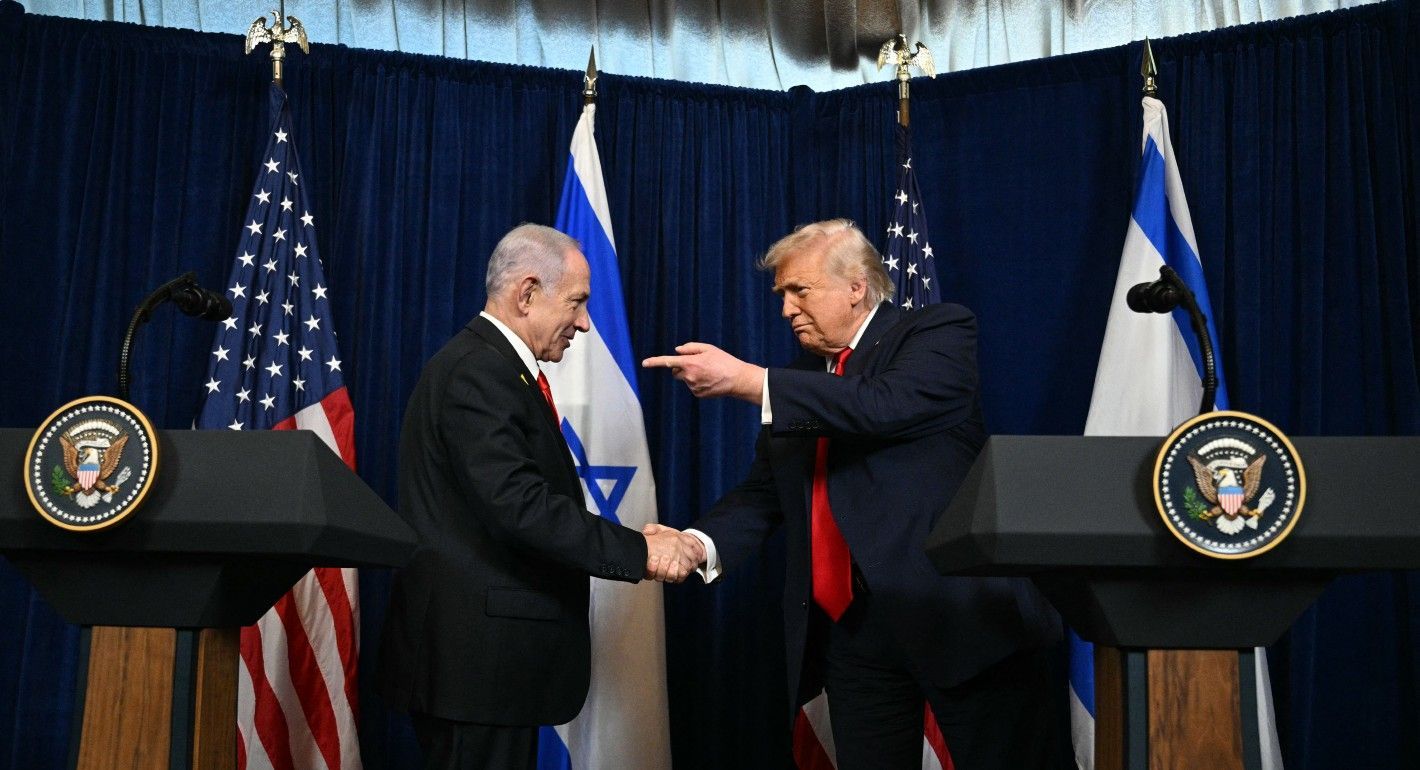
Trump and Netanyahu at Mar-a-Lago on December 29, 2025. (Photo by Jim Watson/AFP via Getty Images)
Trump’s unmatched leverage over Netanyahu gives the prime minister little room to maneuver.
This week, U.S. President Donald Trump announced that the Board of Peace, the part of his twenty-point Gaza peace plan that will oversee the strip’s transitional governance, has been formed. The announcement also included a fifteen-member Palestinian technocratic committee for administering Gaza. Given the realities on the ground—a divided, dysfunctional, and still sporadically violent Gaza—much of this move to the peace plan’s second phase seems performative and untethered from reality. Indeed, an extraordinary amount of work needs to be done to move forward. And although much of it will focus on how to deal with Hamas’s demilitarization and resurgence in Gaza, Trump's relationship with Israeli Prime Minister Benjamin Netanyahu will prove critical to the peace plan’s success or failure.
The two of us have spent a combined eight decades studying, working in, and writing about the Middle East. We can say with some certainty that nowhere are Trump’s policy idiosyncrasies more clearly on display than in his relationship with Israeli Prime Minister Benjamin Netanyahu. Trump has been preternaturally pro-Israel and pro-Netanyahu while also applying an extraordinary and unprecedented degree of pressure on the Israeli leader. He has often ignored Netanyahu’s suggestions or blindsided him on important policy decisions. For Netanyahu, who has based much of his appeal on his ability to “control” American policy, Trump has reversed the dynamic—it is Trump who sets the content and tone of this relationship.
The result is that Trump today has unmatched leverage on Israel. Indeed, no president in any administration—Republican or Democrat—ever compelled an Israeli prime minister to accept a U.S. peace initiative. And no Israeli prime minister has ever had less leverage or capacity to maneuver around a U.S. president or push back than Netanyahu, who needs Trump to parry his domestic pressures and win an election in 2026. Should Trump choose to use the leverage he has, he might have an opportunity to advance U.S. and Israeli interests across the region.
What makes Trump unique in terms of his relations with an Israeli leader has been his ability to pressure, work around, even ignore Israeli interests without much cost or consequence. After all, what separates Trump from all of his predecessors is the list of his regional actions taken independently of Israel (or over its objections): He opened a dialogue with Hamas without Israel’s express approval, cut a deal with the Houthis that Israel learned about after the fact, opened direct negotiations with Iran, removed sanctions on Syria over Israel’s objections, sidelined Israel on his first trip to the Middle East in his second term, forced Netanyahu to issue an apology for striking Qatar, and threatened to walk away if Netanyahu didn’t accept his twenty-point Gaza initiative.
Trump can apply the vinegar to Israel because he had smothered Netanyahu with honey. No one can doubt his pro-Israel credentials. The president’s son-in-law told one of us in 2017 that Trump was going to make it impossible for Israel to say no to him.
In his first term, Trump strung together an unprecedented series of pro-Israel policies: recognizing Jerusalem as Israel’s capital and moving the U.S. embassy there, shuttering the Palestine Liberation Organization office in Washington, closing the Jerusalem consulate, recognizing Israeli sovereignty over the Golan Heights, and noting that settlements do not conflict with international law. In his second term, Trump brought about a ceasefire in Gaza and return of all living Israeli hostages, and the United States joined Israel’s twelve-day war targeting Iran’s nuclear infrastructure. And in an extraordinary gesture, Trump publicly asked the president of Israel to pardon Netanyahu for his alleged crimes, and followed up with a formal letter.
That’s a significant amount of capital in Trump’s political bank, allowing him to apply pressure without cost or consequence on any number of issues, including the International Stabilization Force in Gaza and the Palestinian technocratic government. Trump could decide—and Netanyahu will be hard-pressed to object—that Türkiye will have a role in Gaza and that the Palestinian Authority will be part of governance in Gaza.
But Trump is remarkably unsentimental when it comes to thinking about Israel and its future. Trump isn’t Bill Clinton, who wrote in his memoirs that he loved Yitzhak Rabin as he loved no other man. He’s not Joe Biden, a self-described Christian Zionist whose love and bonds for the people and idea of Israel were constantly on display and who seemed wounded personally in wake of the October 7 attacks. He is also not George W. Bush, who, after the September 11 attacks, bonded with Israel’s security vulnerabilities, quipping while flying over Israel’s narrow waist, “We’ve got driveways in Texas longer than this country is wide.” Trump is unencumbered by that kind of emotion or personal identification.
The sense one gets is that Trump’s support for Israel is transactional and functional, designed for broad political purposes to engage evangelicals and to use his pro-Israeli sensibilities to paint Democrats as enemies of a Jewish state. Indeed, his cavalier relationship with right-wing extremists and antisemites such as Nick Fuentes and his own racist dog-whistling, including trading in antisemitic tropes, raises questions about Trump’s own stereotypes about Jews.
In addition, no U.S. president has had as much freedom of maneuver at home to decide on Israeli policy without fear of a backlash from his own party. While MAGA neo-isolationists and traditional Republican internationalists squabble, Trump has maneuvered in support of and opposition to both. Trump owns the GOP and control of Congress. Netanyahu has no other body to appeal to, as he had when he end-ran Barack Obama in a play to sink the Iran nuclear deal. Moreover, anger over Israeli policies is rising in Democratic circles—and not just on part of progressives against the Netanyahu government. Public polling clearly shows, especially on the part of younger Americans, a rise in anti-Israeli sentiment. Rarely if ever has the political environment in the United States been more conducive and less costly to upping pressure on Israel, should an American president choose to do so.
Many observers anticipated that the president’s meeting with Netanyahu in Florida—the sixth in 2025—would lead to Trump reading Netanyahu the Riot Act on a range of issues. Far from it, the tone of the press conferences seemed to suggest that the pro-Israel side of Trump had replaced the tougher side. Netanyahu had requested the meeting and was clearly worried by reports that Trump’s advisers had grown frustrated with him. But the two seemed in sync on some issues, and Trump’s public embrace of Netanyahu likely was tactical, creating space for more difficult discussions in private.
The reality is that neither Trump nor Netanyahu wanted a public crisis, and there was no need for one. The second phase of Trump’s Gaza plan—by the president’s own admission—would be implemented as quickly as possible, but it’s clear there’s more work to be done before it can be realized. Since much of the next step rests on Hamas’s demilitarization, on which Hamas is balking, there was no reason for Trump to lay responsibility on Netanyahu at this time, let alone to pick a fight.
The reality is that these two leaders—both adept at the art of the con—have reached an understanding for now. As long as Netanyahu plays along, doesn’t overreach (as he did in attacking the Hamas leadership in Qatar), or willfully tries to crater the Gaza deal, Trump will manage (rather than exploit) their differences. He will continue to back Netanyahu publicly, praising him, as he did in Florida, as essential to Israel’s survival. How long this bargain lasts—with a mercurial president and a prime minister trying to keep two extremist ministers from bolting over Trump’s Gaza plan—is unclear. Clearly Netanyahu is playing for time, hoping Hamas will continue to reject demilitarization, or that Trump, focused on Ukraine or Iran or Venezuela, will lose interest.
Netanyahu is now the longest governing prime minister in Israel’s history. He’s also running for reelection, with sagging poll numbers and any number of domestic issues—from ultra-Orthodox conscription to a scandal tying close aides to payments from Qatar to a public increasingly focused on his government’s accountability for October 7. Then there’s his trial, now five years running, that despite his determined and underhanded efforts just won’t go away. Trump cannot reelect Netanyahu, but he can hurt Netanyahu very badly if he crosses him. Netanyahu needs Trump to keep repeating what he said at Mar-A-Lago: Without Netanyahu, Israel wouldn’t exist, thereby validating the prime minister’s indispensability.
Netanyahu cannot say no to Trump on an issue the president really cares about, and Trump knows that. If Trump believes Netanyahu stands between him and a big win, he will not think twice about sacrificing Netanyahu’s preferences for the victory. Netanyahu does not have the funds that the Saudis and Emiratis have used so effectively to buy Trump’s support—the lavish gifts and promises of massive investment in the American economy. Netanyahu is a taker, and for a transactional president, that only increases the leverage he possesses.
And if Netanyahu balks? Ask Venezuela (or Canada, or Europe, or India) what happens when Trump does not get his way. For Trump, Israel and Netanyahu are just another set of pieces on his personal, gold-plated chessboard. If he needs to sacrifice any of those pieces for the good of his own game, watch out.
The latest from Carnegie scholars on the world’s most pressing challenges, delivered to your inbox.

Senior Fellow, American Statecraft Program
Aaron David Miller is a senior fellow at the Carnegie Endowment for International Peace, focusing on U.S. foreign policy.
Daniel C. Kurtzer
Lecturer and S. Daniel Abraham Professor of Middle East Policy Studies, Princeton University
Daniel C. Kurtzer is the S. Daniel Abraham Professor of Middle East Policy Studies at Princeton University’s School of Public and International Affairs. During a twenty-nine-year career in the U.S. Foreign Service, Ambassador Kurtzer served as the U.S. ambassador to Israel and as the U.S. ambassador to Egypt. He was also a speechwriter and member of secretary of state George P. Shultz’s Policy Planning Staff and served as deputy assistant secretary for Near Eastern Affairs and principal deputy assistant secretary for Intelligence and Research.
Carnegie does not take institutional positions on public policy issues; the views represented herein are those of the author(s) and do not necessarily reflect the views of Carnegie, its staff, or its trustees.

The real test may come after the leaders leave the room.



Sheena Chestnut Greitens, Oriana Skylar Mastro, Yukon Huang, …

The Horn of Africa countries are among those facing a new security calculus.


Andrew Leber, Lesley Anne Warner
Why governance of rapidly evolving technology will be distributed and complex.


Stewart Patrick, Scott Singer
It should address the shortcomings of previous crisis communication efforts and adapt to the demands of frontier AI.

Lucy Luo

Washington’s decision to support some UN functions while letting others wither is pulling the organization apart at the seams.
Stewart Patrick, Theodore Zaritsky