• Research
  • Emissary
  • About
  • Experts
Carnegie Global logoCarnegie lettermark logo
DemocracyIran
  • Donate
{
  "authors": [
    "Kevin Slaten"
  ],
  "type": "legacyinthemedia",
  "centerAffiliationAll": "dc",
  "centers": [
    "Carnegie Endowment for International Peace"
  ],
  "collections": [],
  "englishNewsletterAll": "asia",
  "nonEnglishNewsletterAll": "",
  "primaryCenter": "Carnegie Endowment for International Peace",
  "programAffiliation": "AP",
  "programs": [
    "Asia"
  ],
  "projects": [],
  "regions": [
    "North America",
    "United States",
    "Iraq",
    "East Asia",
    "China"
  ],
  "topics": [
    "Security",
    "Military",
    "Foreign Policy"
  ]
}
Source: Getty

In The Media

The Decline of U.S. Hegemony: Regaining International Consent

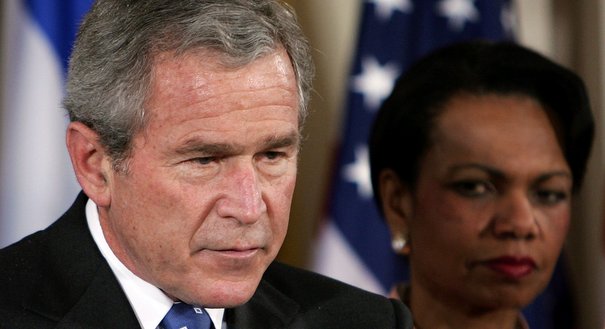
Through various policies of the Bush administration, the United States lost a considerable amount of international authority. Amidst a system of rising powers, this could have grave consequences for global stability. However, the future depends on the Obama administration’s efforts to regain American authority.

Link Copied
By Kevin Slaten
Published on Mar 15, 2009
Program mobile hero image

Program

Asia

The Asia Program in Washington studies disruptive security, governance, and technological risks that threaten peace, growth, and opportunity in the Asia-Pacific region, including a focus on China, Japan, and the Korean peninsula.

Learn More

Source: The Journal of Politics & International Affairs

The Decline of U.S. Hegemony: Regaining InternatioAfter September 11, the Bush administration chose to confront contemporary threats to national and global security—terrorism, rogue regimes, drug trafficking, and WMDs—with a Bush Doctrine that left little room for negotiation. Moreover, in March of 2003, the U.S., without United Nations approval, invaded and proceeded to occupy Iraq. In June of 2006, America’s closest ally, Great Britain, had a public that only held a 56% favorable opinion of the U.S. while other western states held far lower opinions – 39, 27, 23, and 43% for France, Germany, Spain, and Russia, respectively. Through its actions and attitudes, the United States has lost a large amount international consent.

This essay argues that during the Clinton administration, the U.S. possessed a significant amount of authority over most NATO countries – enough authority that America lead hegemony among those states – and those states consented to American actions in international relations. Additionally, the study shows that this authority declined significantly due to policy changes during the Bush administration.
 
In hegemony, the hegemon – the United States – and its subordinates are endowed with certain role expectations; expectations that are held by subordinates that consent to the hegemon’s authority and, likewise, expectations that are projected by the hegemon onto subordinates. The more that subordinate states conform to role expectations, the stronger the hegemony. Two methodologies are used to measure the role conformity among various states during the 1990’s and 2000’s. The first method uses United Nations General Assembly voting data to compare the voting record of the U.S. against other states and groups of states. Voting similarly to the United States is a subordinate role expectation, so the more a state votes with America, the more that state is conforming to the subordinate role expectation. The second method looks at cross-national attitude surveys, which reflect various public’s consent for and perception of American authority; strong consent for and positive perception of American authority is expected in the case of hegemony. As mentioned, attitudes have recently taken a large unfavorable downturn for the United States among NATO nations.
 
After examining the results of both of these measures, some possible outcomes of a system of declining hegemony are discussed from differing theoretical perspectives. The essay concludes with a normative argument pertaining to what the United States’ policy ought to be amidst a system of declining hegemony. Ultimately, the interests of America as well as the global community are best served by a policy that seeks to regain international consent.
 
The author's views expressed in this article are his own and do not necessarily reflect the views of the Carnegie Endowment.

About the Author

Kevin Slaten

Former Junior Fellow, China Program

Kevin Slaten
Former Junior Fellow, China Program
SecurityMilitaryForeign PolicyNorth AmericaUnited StatesIraqEast AsiaChina

Carnegie does not take institutional positions on public policy issues; the views represented herein are those of the author(s) and do not necessarily reflect the views of Carnegie, its staff, or its trustees.
More Work from Carnegie Endowment for International Peace

  • Commentary
    Carnegie Politika
    Multiple Wars Are Ruining Central Asia’s Efforts to Diversify Its Trade Routes

    This year’s wars have made alternative routes to transit through Russia no less risky for Central Asian countries.

      Galiya Ibragimova

  • Three people standing outside a fancy building
    Commentary
    Emissary
    The Latest Iran Deal Ignores the Lessons of the Past

    By burying disagreements in imprecision, the new deal risks same fate as its predecessors.

      James M. Acton

  • Man sitting in a chair reading a newspaper with Trump's face above the fold
    Commentary
    Emissary
    Iran Wanted to Survive the War. Now What?

    The United States and Israel may have unwittingly revived the Islamic Republic’s “zombie regime.”

      Suzanne Maloney, Aaron David Miller, Karim Sadjadpour

  • Aerial view of burned-out cars and homes
    Commentary
    Emissary
    The Overlooked Link Between Disaster Response at Home and U.S. Power Abroad

    Natural disasters are no longer local incidents but sources of systemic risk that threaten vital infrastructure and the economy—and public support for international engagement.

      Leonardo Martinez-Diaz

  • Commentary
    Strategic Europe
    Taking the Pulse: Is European Diplomacy on Iran Outdated?

    When the U.S.-Iran memorandum of understanding was announced, the UK, France, Germany, and Italy declared their readiness to help demine the Strait of Hormuz and lift nuclear sanctions on Tehran. But does Europe need new tools to recover a diplomatic role?

      • Rym Momtaz

      Rym Momtaz, ed.

Get more news and analysis from
Carnegie Endowment for International Peace
Carnegie global logo, stacked
1779 Massachusetts Avenue NWWashington, DC, 20036-2103Phone: 202 483 7600
  • Research
  • Emissary
  • About
  • Experts
  • Donate
  • Programs
  • Events
  • Blogs
  • Podcasts
  • Contact
  • Annual Reports
  • Careers
  • Privacy
  • For Media
  • Government Resources
Get more news and analysis from
Carnegie Endowment for International Peace
© 2026 Carnegie Endowment for International Peace. All rights reserved.