

Commentary
Dmitri Trenin
{
  "authors": [
    "Dmitri Trenin"
  ],
  "type": "legacyinthemedia",
  "centerAffiliationAll": "",
  "centers": [
    "Carnegie Endowment for International Peace",
    "Carnegie Russia Eurasia Center"
  ],
  "collections": [],
  "englishNewsletterAll": "",
  "nonEnglishNewsletterAll": "",
  "primaryCenter": "Carnegie Russia Eurasia Center",
  "programAffiliation": "",
  "programs": [],
  "projects": [],
  "regions": [
    "North America",
    "United States",
    "Caucasus",
    "Russia"
  ],
  "topics": [
    "Security",
    "Foreign Policy",
    "Nuclear Policy",
    "Nuclear Energy"
  ]
}
Source: Getty
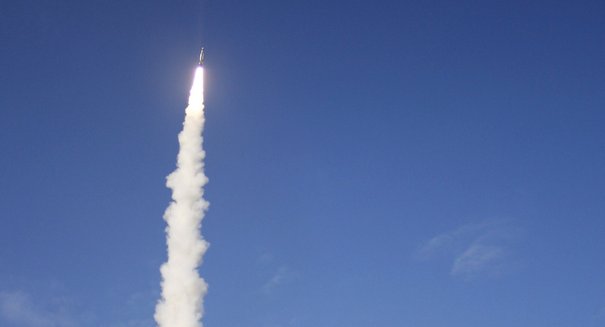
U.S. plans to build a global missile defense system have caused consternation in Moscow, where a potential U.S. first-strike capability is still viewed as the most serious external military threat to Russia.
Source: The Moscow Times

Quid pro quo or not, Moscow felt compelled to respond. After meeting with Obama in New York in late September, President Dmitry Medvedev made it clear that he was leaving the option open for tough sanctions against Iran. It would be unrealistic to expect a radical shift in Russia’s policy toward Iran, of course, but an increased willingness to use the stick as well as the carrot may be in the cards. What has probably changed the most is the Kremlin’s attitude toward the U.S. administration. Moscow now feels that it can do business with Obama. Thus, the “reset” may be real indeed.
The missile defense story, however, is not over. European missile defense has been redesigned, not dismissed. There will be a new configuration. Its elements will be in place sooner than had been previously scheduled. Deployment will not be confined to southeastern Europe and the eastern Mediterranean. The SM-3 system of missile interceptors might one day appear in Poland, too. Originally designed to shoot down shorter range missiles, they can be modernized and upgraded in the future.
More important, however, U.S. plans to build a global missile defense system, which caused so much consternation in Moscow, is by no means off the agenda. Obama has ordered the reconfiguration of some plans and the scaling back of others, but he has not abandoned the global program. By 2015, this program will have progressed substantially. Faced with the reality that U.S. strategic missile defense capabilities will be strengthened in the next five years, Russia may decide to err on the side of prudence, which means it may overreact.
It should be remembered that the Kremlin interpreted plans to deploy elements of a missile defense system in Central Europe — the so-called U.S. “third position” after Alaska and California — as part of much larger U.S. plans to construct a global shield. What concerned the Kremlin the most was the prospect, however remote, that the United States would be protected against Russian missile strikes, thus completely undermining the strategic balance between the two countries and destroying the concept of deterrence, which has done so much to prevent a military conflict between the major powers for more than 60 years.
To demonstrate how serious the Kremlin views the issue of U.S. missile defense capabilities, look at Russia’s national security strategy, released in May. The document calls a U.S. first-strike capability, which is attainable once the United States builds a seamless global missile defense system, the most serious external military threat to Russia. Short of an actual first strike, a shift in the strategic balance would allow the United States to blackmail Russia politically. This may be paranoia, but there are reasons for it. In a situation when the United States and Russia are not allies, or even strategic partners, nuclear deterrence has become the unique pillar of Moscow’s strategic independence vis-a-vis Washington.
Can anything be done about this rift?
Negotiations to replace the Strategic Arms Reduction Treaty, or START, are progressing well, and this can only help U.S.-Russian relations. But no amount of START can completely close the book on the Cold War. Offensive nuclear arms reductions do not change Moscow’s fundamental strategic paradigm that defines the bilateral relationship: mutual assured destruction, or MAD. In addition, further reductions in strategic arms beyond the levels that the two sides will agree when the new treaty to replace START is signed are highly unlikely. Considering the degree to which Russia’s conventional military forces lag behind those of the United States, the Kremlin relies on its nuclear deterrence like never before.
Of course, Russia’s accession to NATO or its formal alliance with the United States could theoretically eliminate the need for MAD. Back in the early 1990s, there was a window of opportunity to achieve these two goals, but now it is clearly unrealistic — at least for the foreseeable future.
Russia’s acquiescence to U.S. strategic superiority can be easily ruled out. The country’s political and foreign policy elite are the only ones in the world to flatly reject this notion, which it sees as limiting its sovereignty. The Chinese, for example, are relatively relaxed about the issue, content for decades with a minimum of deterrence postures. But not the Russians, who had been historically obsessed with attainment of nuclear parity with the United States and continue to cling to the idea of parity in force capabilities.
It may be that the “silver bullet” to replace the remaining aftershocks of the Cold War with a nonadversarial strategic relationship could be missile defense, the present bone of contention. If one can imagine that the United States and Russia could agree on building a joint missile defense system, then the Kremlin’s national security strategy would have to be updated. This could actually be a 21st-century equivalent of Russia’s membership in NATO or a bilateral security alliance with the United States.
Both Moscow and Washington seem to welcome cooperation on strategic defenses on a declarative level, but when action is required they move gingerly. The United States is focused more on working with Russia on building a U.S.-designed theater missile defense system, while Russia is talking more about a global system without offering a lot of details about what it might look like.
Moscow and Washington need to put missile defense right in the center of their post-START strategic agenda. A good starting point would be unfreezing the 1998 agreement on the joint data exchange center in Moscow and expanding U.S.-Russian cooperation to include NATO allies. Building trust and improving cooperation would allow joint development of a new generation of interceptor missiles and new space-based tracking and targeting systems.
Today, this may look like a fantasy, but the failure to work more closely together could mean 40 more years of MAD. Surely, there is a much better paradigm for ensuring global peace and improving bilateral relations.
Former Director, Carnegie Moscow Center
Trenin was director of the Carnegie Moscow Center from 2008 to early 2022.
Recent Work
Dmitri Trenin
Dmitri Trenin
Carnegie does not take institutional positions on public policy issues; the views represented herein are those of the author(s) and do not necessarily reflect the views of Carnegie, its staff, or its trustees.
Despite the agreement’s uncertainty, it’s still a significant development in regional and nuclear policy.


Andrew Leber, Jane Darby Menton
“AI safety in parallel” is modest and pragmatic but vital.

Matt Sheehan

Trump is distracted and Ukraine wants Europe to step up. The continent’s leaders must find their voice and assert it in talks with Russia.

Alissa de Carbonnel

Unresolved tensions within the AfD may ultimately constrain the its potential as a leader among European and global populist forces.
Jeremy Cliffe

There is a deeply rooted assumption in post–Cold War American statecraft that overwhelming military and economic power translates directly into favorable political outcomes. But force alone is rarely enough. To meet the challenges of the mid-21st century, Washington needs a cultural shift toward a mindset that takes negotiation far more seriously.

Cecily Brewer