

Q&A
S. Akbar Zaidi
{
  "authors": [
    "S. Akbar Zaidi"
  ],
  "type": "other",
  "centerAffiliationAll": "dc",
  "centers": [
    "Carnegie Endowment for International Peace"
  ],
  "collections": [],
  "englishNewsletterAll": "democracy",
  "nonEnglishNewsletterAll": "",
  "primaryCenter": "Carnegie Endowment for International Peace",
  "programAffiliation": "DCG",
  "programs": [
    "Democracy, Conflict, and Governance",
    "South Asia"
  ],
  "projects": [],
  "regions": [
    "North America",
    "United States",
    "South Asia",
    "Afghanistan",
    "Pakistan"
  ],
  "topics": [
    "Political Reform",
    "Democracy",
    "Security",
    "Military",
    "Foreign Policy"
  ]
}
Source: Getty
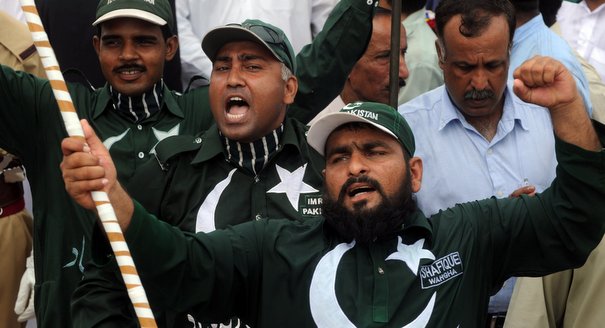
A longer-term U.S. engagement and commitment to civilian and development aid in Pakistan might result in strengthening democracy in the country instead of reinforcing the military dominance that thwarts U.S. counterterrorism goals.
After 9/11 and again following the killing of Osama bin Laden, questions have been raised about the purpose of aid from the United States to Pakistan. If aid was primarily meant for military and counterterrorism support, the results from an American perspective have been inadequate at best. Washington has accused the Pakistani government and military of duplicity, and of protecting key militant leaders living within Pakistan. The United States continues to ask the government of Pakistan to “do more.”
There are Pakistani voices, however, who argue that this is America’s war, not a global or Pakistani war. The fighting has cost Pakistan three times as much as the aid provided and 35,000 victims. Sympathizers of militant groups in Pakistan’s army have also been found to protect insurgents and have been involved in terrorist activities themselves.
Clearly, trust is low.
The lack of trust didn’t start following 9/11—Pakistan’s aid relationship with the United States has a tortured history. In the 1950s and 1960s, U.S. aid stimulated growth for Pakistan and did not focus excessively on military assistance to the detriment of development programs. Following the Soviet invasion of Afghanistan in 1979, problems emerged that haunt the aid relationship to this day. American efforts against the Soviets unintentionally strengthened Pakistan’s military and intelligence agencies, their supremacy over civilian institutions, and rising jihadism that would grow to engulf both the country and the region.
Then after 9/11, the spigot of aid nominally meant to help the fight against terrorism instead supported the military acquisitions of the Pakistani army and only modest progress in counterterrorism operations. With military aid much higher than economic aid, U.S. assistance has strengthened the hand of Pakistan’s military in the country’s political economy and failed to support the civilian government and democratic institutions.
But changes in the U.S. and Pakistani administrations in 2008 shifted aid toward development. Perhaps a longer-term engagement and commitment to civilian and development aid might result in strengthening democracy in Pakistan instead of reinforcing the military dominance that thwarts U.S. counterterrorism goals. This shift can illuminate how American aid to Pakistan can address both U.S. and Pakistani objectives and concerns.
Former Visiting Scholar, South Asia Program
Zaidi was a visiting scholar in the Carnegie Endowment’s South Asia Program. A visiting professor at Johns Hopkins University’s School of Advanced International Studies (SAIS), his research focuses on development, governance, and political economy in South Asia.
Recent Work
S. Akbar Zaidi
S. Akbar Zaidi
Carnegie does not take institutional positions on public policy issues; the views represented herein are those of the author(s) and do not necessarily reflect the views of Carnegie, its staff, or its trustees.

Despite public disputes over trade and immigration, the strategic partnership’s foundations remain sturdy.

Sameer Lalwani
It signals a new era of tech diffusion and warfare.

Steve Feldstein

With its public finances in shambles, the far right polling at 35 percent ahead of the 2027 presidential election, and a growing protest movement, is France’s crisis a threat to the EU’s geopolitical awakening?

Rym Momtaz, ed.

Putin’s conservative staffing policies and search for ever greater control have cemented parliament’s transformation into a bureaucratic appendage of the executive branch.

Andrey Pertsev

Russia’s AI-driven propaganda campaigns operate in a fragmented, chaotic, and often illogical manner. That’s not necessarily a problem for the Kremlin, though: It’s much easier to mimic genuine public debate that way.

Ilya Klishin