Although the full ramifications of the rulings by the Egyptian Supreme Constitutional Court are not yet evident, they suggest that democracy—in the sense of majority rule with minority rights—is now losing badly in Egypt.
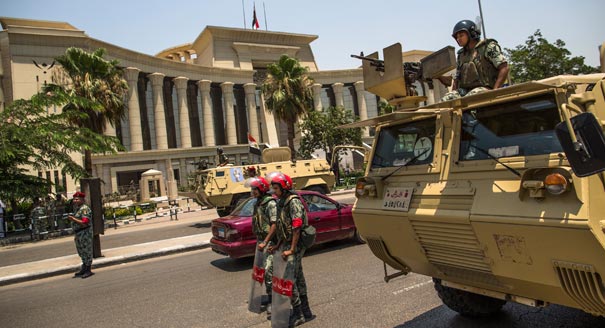
In March 2011, I paid a visit to Egypt's Supreme Constitutional Court (SCC), located on the banks of the Nile in the Cairo suburb of Maadi. Two things immediately struck me. First, there was a tank parked outside of a structure that hardly seemed to be a military site. Second, the court was a beehive of activity. Since at the time Egypt had no constitution, I could not figure out why the employees were so busy.
Now it is clear that I was too quick to dismiss what I saw both inside and outside the building. The SCC's actions today, occurring in the context that they do, reshape Egypt's transition process -- so much so that some Egyptians will likely wonder if they are in any "transition process" at all. That concern is justified. The "process" part was already dead. Now the "transition" part is dying.
The problem with the rulings is not primarily legal. There is a strong, though not inevitable, logic to the rulings taken individually. The political exclusion law, which was clearly aimed at specific individuals (most notably Omar Suleiman) and which deprived people of political rights without criminal charges or judicial process was obviously open to challenge. The parliamentary election law also ran against past SCC rulings requiring independents to have the same chances to get elected as party members. Of course, since the two-thirds of seats assigned to party lists were written into the constitutional declaration (as amended in September 2011), so that could not be challenged easily. But for the remaining one-third the case of unconstitutionality was easier to make. (Past rulings rested in part on constitutional rights in the 1971 constitution that had been removed from the March 2011 constitutional declaration, as Harvard's Tarek Masoud has pointed out. But there was still strong jurisprudence suggesting that the court regarded the system as discriminatory against Egyptians who were not members of any party.)
The content of the rulings were therefore not shocking -- they were the most likely outcomes, though hardly the only possible ones. But the immediate rulings, particularly the timing and speed, were a big surprise. In the past, the SCC has been rather more deliberate in its rulings. In 1987, the SCC dissolved a parliament elected in 1984. In 1990, it dissolved a parliament elected in 1987. In 2000, it struck down a parliamentary election law just as the parliament elected under that law was completing its term. The court delayed ruling on a constitutional challenge of trials of civilians in military courts until an amendment removed the constitutional basis for the challenge in 2007. Today, by contrast, it dissolved a parliament elected earlier the same year and it ruled on a case involving a presidential candidate on the same day it heard the case.
The full ramifications of the ruling are not yet evident, and it will take time to clear the legal brush. What happens to the constitutional assembly just elected? The question is both legal and political: legally, can a constitutional assembly elected by an unconstitutional parliament still sit? Does the parliament's passing of a constitutional assembly law remain valid even if the parliament is dissolved and the Supreme Council of the Armed Forces (SCAF) has not approved the law? Even if the constitutional assembly is not dissolved by this ruling (and as I write this, that question is not clear) can the fact that the parliament elected some of its own members to the body (even if they are no longer parliamentarians) be used to challenge the body? And politically, will those who were going to boycott it now agree to take their seats? And in the legal realm, a new parliamentary election law is needed. Who will issue it? The SCAF in its waning days by decree? The new president by decree? And more generally, will the SCAF use the absence of parliament to parachute in a new constitutional declaration so that it does not have to surrender all its power to the president at the end of the month? Or will it revive the 1971 constitution it cancelled last year?
If the details are unclear, the overall effect is not. What was beginning to look like a coup in slow motion is no longer moving in slow motion. The rulings themselves are perfectly defensible. The SCC is diverse enough in its composition that it is not anybody's tool. (Faruq Sultan, the chief justice considered suspect by some because of his past ties with the military, recused himself from the Shafiq case). The SCC clearly felt threatened by recent parliamentary moves against the court, though I do not know how much that sense of threat influenced the justices. Therefore, I do not see this as what Egyptians call "telephone justice" -- in which a call from a high official to a judge decides a case.
But that may not matter in the long run. The dispersal of parliament, the sudden constitutional vacuum, the Shafiq surge, the reversion of state-owned media, the revival of a key element of the state of emergency by a decree from an unaccountable justice minister -- all these things point in one direction. Last March I wrote that, "unless the SCAF has the appetite for a second coup, or somehow discovers a way to shoehorn in its puppet as president, the constitutional vehicle that gave the military such political authority will soon turn into a pumpkin." Now it appears that the SCAF has regained its appetite and an old-regime candidate may soon win the presidency.
Democracy -- in the sense of majority rule with minority rights -- is now losing badly. Earlier this year, in an article on the Egyptian judiciary, I wrote that the real struggle in Egypt was "between the forces of politics, popular sovereignty, and democracy on the one hand and bureaucracy, expertise, and professionalism on the other." Now it is clear who is winning. In light of recent events, there will likely no longer be an Egyptian majority able to act coherently.
Civilian political forces are already engaged in bitter recriminations. Non-Islamist forces are holding the Muslim Brotherhood responsible for the result because the Islamists seemed willing to cut a separate deal with the military. The charge has some plausibility. And suspicions will be deepened by the Brotherhood's meek response so far and by rumors about the content of recent SCAF-Brotherhood contacts. But the reverse charge is just as true: non-Islamists openly and repeatedly sided with the military against the Islamists on the explicit grounds that the Islamists had too much popular support and by regularly making the implausible claim that the popularly-elected parliament had no democratic legitimacy.
The Egyptian "deep state" is neither as deep nor as coherent as the term implies. But it seems to have more depth and coherence than those outside of it. And that is enough to mean that at the end of June, Egypt's transition may well be from military dictatorship to presidential dictatorship.
Nathan J. Brown, a professor of political science and international affairs at George Washington University, is a distinguished scholar and author of nine books on Arab politics and governance, as well as editor of five books.
Nathan J. Brown, a professor of political science and international affairs at George Washington University, is a distinguished scholar and author of nine books on Arab politics and governance, as well as editor of five books.
Carnegie does not take institutional positions on public policy issues; the views represented herein are those of the author(s) and do not necessarily reflect the views of Carnegie, its staff, or its trustees.
More Work from Carnegie Endowment for International Peace
Ex-president Gurbanguly Berdimuhamedov remains interested in politics, but his son Serdar, Turkmenistan’s current president, is becoming increasingly independent and willing to break with his father’s legacy. If their covert rivalry goes too far, both risk losing power.
A notable degree of participative democracy has firmly arrived in Europe. But to have more far-reaching impact, democratic deliberation needs to move into a radically new phase.
Today’s global democratic recession is partly rooted in a common perception that democracies have a delivery problem, with many citizens in both autocracies and democracies alike now believing that strongmen can achieve better governance outcomes. But a study of four countries in Africa reveals that democratic-leaning governments have demonstrated better governance performance than autocratic governments.
The domestic impacts of how long it is taking to end the war in Ukraine have pushed the French electorate to the political extremes and compromised the country’s diplomatic capacity.