

Commentary
Sarah Chayes
{
  "authors": [
    "Sarah Chayes"
  ],
  "type": "legacyinthemedia",
  "centerAffiliationAll": "dc",
  "centers": [
    "Carnegie Endowment for International Peace"
  ],
  "collections": [],
  "englishNewsletterAll": "democracy",
  "nonEnglishNewsletterAll": "",
  "primaryCenter": "Carnegie Endowment for International Peace",
  "programAffiliation": "DCG",
  "programs": [
    "Democracy, Conflict, and Governance"
  ],
  "projects": [],
  "regions": [
    "North America",
    "United States",
    "Middle East",
    "North Africa",
    "South Asia",
    "Afghanistan",
    "Southeast Asia"
  ],
  "topics": [
    "Political Reform",
    "Foreign Policy"
  ]
}
Source: Getty
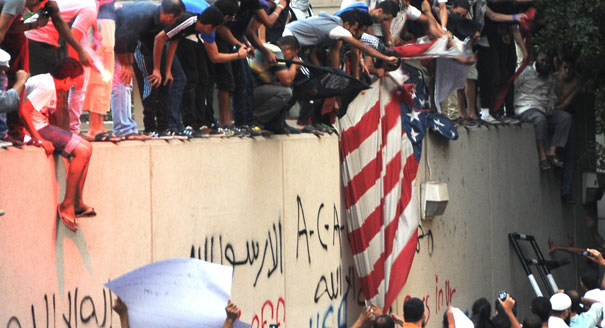
"Innocence of Muslims," the film whose video trailer indirectly led to the death of U.S. Ambassador J. Christopher Stevens among others, is not, arguably, free speech protected under the U.S. Constitution.
Source: Los Angeles Times

Holmes' test — that words are not protected if their nature and circumstances create a "clear and present danger" of harm — has since been tightened. But even under the more restrictive current standard, "Innocence of Muslims," the film whose video trailer indirectly led to the death of U.S. Ambassador J. Christopher Stevens among others, is not, arguably, free speech protected under the U.S. Constitution and the values it enshrines.
According to initial media investigations, the clip whose most egregious lines were apparently dubbed in after it was shot, was first posted to YouTube in July by someone with the user name "Sam Bacile." The Associated Press reported tracing a cellphone number given as Bacile's to the address of a Californian of Egyptian Coptic origin named Nakoula Basseley Nakoula. Nakoula has identified himself as coordinating logistics on the production but denies being Bacile.According to the Wall Street Journal, when the video failed to attract much attention, another Coptic Christian, known for his anti-Islamic activism, sent a link to reporters in the U.S., Egypt and elsewhere on Sept. 6. His email message promoted a Sept. 11 event by anti-Islamic pastor Terry Jones and included a link to the trailer.
The current standard for restricting speech — or punishing it after it has in fact caused violence — was laid out in the 1969 case Brandenburg vs. Ohio. Under the narrower guidelines, only speech that has the intent and the likelihood of inciting imminent violence or lawbreaking can be limited.
Likelihood is the easiest test. In Afghanistan, where I have lived for most of the past decade, frustrations at an abusive government and at the apparent role of international forces in propping it up have been growing for years. But those frustrations are often vented in religious, not political, terms, because religion is a more socially acceptable, and safer, rationale for public outcry.
In the summer of 2010, Jones announced his intent to publicly burn a copy of the Muslim holy scripture, the Koran, that Sept. 11. He was eventually dissuaded by a number of religious and government officials, including Secretary of Defense Robert Gates, who called him to say his actions would put the lives of U.S. soldiers in Iraq and Afghanistan at risk. On the Joint Chiefs of Staff, where I worked at the time, consensus was that the likelihood of violence was high.
When Jones did in fact stage a public Koran burning on March 20, 2011, riots broke out in Afghanistan, killing nearly a dozen people and injuring 90 in the beautiful, cosmopolitan northern city of Mazar-i-Sharif. Seven of the dead were United Nations employees; the rest were Afghans.
In Afghanistan, and in all of the Arab nations in transition, an extremist fringe is brawling for power with a more pluralistic majority. Radicals pounce on any pretext to play on religious feeling. I could pick out the signs of manipulation in Afghanistan — riots that started on university campuses where radicalized Pakistani students abound, simultaneous outbreaks in far-flung places, the sudden appearance of weapons. By providing extremists in Libya and elsewhere such an opportunity, the makers of "Innocence of Muslims" were playing into their hands.
As for imminence, the timeline of similar events after recent burnings of religious materials indicates that reactions typically come within two weeks. Nakoula's video was deliberately publicized just before the sensitive date of Sept. 11, and could be expected to spark violence on that anniversary.
While many 1st Amendment scholars defend the right of the filmmakers to produce this film, arguing that the ensuing violence was not sufficiently imminent, I spoke to several experts who said the trailer may well fall outside constitutional guarantees of free speech. "Based on my understanding of the events," 1st Amendment authority Anthony Lewis said in an interview Thursday, "I think this meets the imminence standard."
Finally, much 1st Amendment jurisprudence concerns speech explicitly advocating violence, such as calls to resist arrest, or videos explaining bomb-making techniques. But words don't have to urge people to commit violence in order to be subject to limits, says Lewis. "If the result is violence, and that violence was intended, then it meets the standard."
Indeed, Justice Holmes' original example, shouting "fire" in a theater, is not a call to arms. Steve Klein, an outspoken anti-Islamic activist who said he helped with the film, told Al Jazeera television that it was "supposed to be provocative." The egregiousness of its smears, the apparent deception of cast and crew as to its contents and the deliberate effort to raise its profile in the Arab world a week before 9/11 all suggest intentionality.
The point here is not to excuse the terrible acts perpetrated by committed extremists and others around the world in reaction to the video, or to condone physical violence as a response to words — any kind of words. The point is to emphasize that U.S. law makes a distinction between speech that is simply offensive and speech that is deliberately tailored to put lives and property at immediate risk. Especially in the heightened volatility of today's Middle East, such provocation is certainly irresponsible — and reveals an ironic alliance of convenience between Christian extremists and the Islamist extremists they claim to hate.
This article was originally published in the Los Angeles Times.
Former Senior Fellow, Democracy, Conflict, and Governance Program
Sarah Chayes is internationally recognized for her innovative thinking on corruption and its implications. Her work explores how severe corruption can help prompt such crises as terrorism, revolutions and their violent aftermaths, and environmental degradation.
Recent Work
Sarah Chayes
Carnegie does not take institutional positions on public policy issues; the views represented herein are those of the author(s) and do not necessarily reflect the views of Carnegie, its staff, or its trustees.

Trump has promised Belarus a massive potash deal. But Minsk is seeking something greater: restored Western transit and greater room for maneuver from Russia.

Balázs Jarábik

Before the next wave of EU enlargement takes place, the union needs to grapple with thorny questions of how power is distributed among its members.


Emil Sondaj Hansen, Ditte Brasso Sørensen

The real test may come after the leaders leave the room.



Sheena Chestnut Greitens, Oriana Skylar Mastro, Yukon Huang, …

The Horn of Africa countries are among those facing a new security calculus.


Andrew Leber, Lesley Anne Warner

The European far right might fail to steer EU policy in the direction Russia wants, but they will create enough chaos inside Europe to benefit the Kremlin.

Dimitar Bechev