

Commentary
Yukon Huang, Isaac B. Kardon, Matt Sheehan
{
  "authors": [
    "Yukon Huang"
  ],
  "type": "legacyinthemedia",
  "centerAffiliationAll": "dc",
  "centers": [
    "Carnegie Endowment for International Peace",
    "Carnegie China"
  ],
  "collections": [
    "China’s Foreign Relations"
  ],
  "englishNewsletterAll": "asia",
  "nonEnglishNewsletterAll": "",
  "primaryCenter": "Carnegie China",
  "programAffiliation": "AP",
  "programs": [
    "Asia"
  ],
  "projects": [],
  "regions": [
    "East Asia",
    "China",
    "Japan"
  ],
  "topics": [
    "Economy",
    "Trade",
    "Security"
  ]
}
Source: Getty
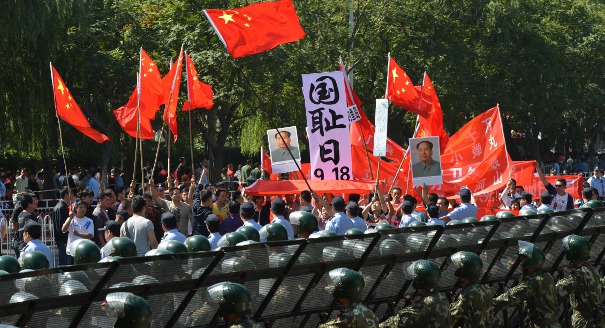
China and Japan both stand to lose if territorial disputes disrupt normal economic relations. Changing roles in the regional production sharing network, energy needs, and political rhetoric are all complicating the picture.
Source: Financial Times

Neither Chinese nor Japanese leaders are well positioned to handle a prolonged confrontation given pressures to revive their respective economies. And politically, both sides cannot afford to be distracted at a time when Beijing is trying to complete a complicated once-in-a-decade leadership transition and Tokyo’s political scene is in disarray as it gears up for yet another election. Nor can either side afford to be seen as caving in to nationalistic pressures.
The more level-headed realise that there is much to be gained in fostering closer economic ties and cooling tensions. Both sides could use “benign neglect” to postpone emotionally charged issues until sentiments allow for a softening in animosities. This is a path that mainland China and Taiwan have followed with some success in recent years.
Clearly both China and Japan would stand to lose if the disputes led to a breakdown in relations that interrupted production and triggered boycotts. Bilateral trade has tripled over the past decade to more than $340bn. China is now Japan’s major export market and Japanese investment in China has been running at twice that of the US and South Korea in recent years.
It would seem obvious that both sides have more to lose in disrupted economic relations than they could gain from controlling a few mostly inconsequential islands. But if combative rhetoric and political grandstanding prevail, then the economic calculus may shift from protecting mutual benefits to assessing which side will be hurt more if economic pressures are brought to bear.
Japan has a much more substantial economic presence in China’s domestic market than vice versa. Japanese chain restaurants are quite popular and their retail outlets sell everything from cars to electronics in China. But most Chinese consumers would not consider switching to European and other Asian brands much of a sacrifice and on this score Japan could be more vulnerable to a trade breakdown or boycott. However, China also stands to lose – most of these goods are produced by Chinese-owned companies with local labour and materials – and thus the second-round effects would take a toll on China’s interests.
The more important consequences in terms of the impact on growth, however, come from the complementary roles that the two countries play in the east Asian production network. China may be the face of this network, as the assembly plant for the world, but the largest share of the sophisticated components for assembly originates from Japan. China, however, has benefited greatly from the jobs generated in export-oriented industries. And both China and Japan have thrived because these arrangements make use of their relative advantages, allowing them to specialise and achieve scale economies. China’s large trade surplus with the west, which emerged partly because of this network structure, has fomented considerable tensions with the US. But often overlooked is that Japan accounts for a large share of this surplus in value-added terms.
Assessing the relative costs for the two sides if the production network became hostage to the island disputes is more complicated because other countries are also involved and roles are evolving. Increasingly, China has the potential to operate at both the low and high ends of the technology spectrum. In the past, with its abundance of surplus labour and relative technological backwardness, China had a greater advantage in labour-intensive sectors. But rapidly rising wages, appreciation of the renminbi and a shrinking labour force have pushed it into competing at the higher end of the value chain. By aggressively upgrading its technological capacity and solidifying its infrastructure, China has strengthened its position in more skill-intensive production lines.
Increasing transport costs and the complexities of a dispersed supply chain are also encouraging firms that previously outsourced components to integrate more within China. As Chinese technology-intensive companies such as Huawei expand, local linkages have deepened. Processing-related imports and exports have fallen by about 10 percentage points as a share of total trade over the past decade as production has become more integrated within China. The net effect is that forces are pushing China to become more of a competitor with Japan in the production network rather than a complementary partner.
Regional economic and trade considerations also affect the calculus. Both countries are competing for access to resources from hydrocarbons to base metals. Bilateral tensions are raised every time a deal is struck, such as determining the route for the Russian oil pipeline serving Asia or awarding extraction contracts in Myanmar. As a mature economy, Japan’s growth is less resource intensive than China’s. But its vulnerabilities may not be any less, given special factors such as China’s near-monopoly position in rare earths that are vital to Japan’s more sophisticated production lines.
How both sides handle politically tinged regional trade agreements also matters. Japan may now feel that joining the Trans-Pacific Partnership would draw Japan closer to an American-led trade bloc as a hedge against China’s growing economic clout. But along with America’s “pivot” toward Asia, this may reinforce insecurities among China’s hardliners that this is all part of a “containment” strategy and that stronger economic ties with Japan may not be worth it.
All this is a reminder that seemingly minor but emotionally charged disputes can trigger actions with far-reaching negative consequences for everyone. Both sides need to put this dispute on the back burner where it belongs.

Senior Fellow, Asia Program
Huang is a senior fellow in the Carnegie Asia Program where his research focuses on China’s economy and its regional and global impact.
Recent Work


Yukon Huang, Isaac B. Kardon, Matt Sheehan
Yukon Huang, Genevieve Slosberg

As the Iran war shocks oil prices, countries that have invested in renewables, EVs, and battery development since the 2022 Russian invasion of Ukraine are seeing the value of their investments.

Noah Gordon

Neither the Abraham Accords nor the presence of large U.S. bases are enough to protect Arab Gulf states.

Marwan Muasher

Not only does the fighting jeopardize regional security, it undermines Russian attempts to promote alternatives to the Western-dominated world order.

Ruslan Suleymanov

The U.S.-sponsored TRIPP deal is driving the Armenia-Azerbaijan peace process forward. But foreign and domestic hurdles remain before connectivity and economic interdependence can open up the South Caucasus.



Thomas de Waal, Areg Kochinyan, Zaur Shiriyev

Assessing U.S. compliance with the international laws of war is essential at a time when these frameworks are already fraying.

Federica D’Alessandra