

Article
C. Raja Mohan, Darshana M. Baruah
{
  "authors": [
    "C. Raja Mohan"
  ],
  "type": "legacyinthemedia",
  "centerAffiliationAll": "dc",
  "centers": [
    "Carnegie Endowment for International Peace",
    "Carnegie China",
    "Carnegie India"
  ],
  "collections": [
    "China’s Foreign Relations"
  ],
  "englishNewsletterAll": "ctw",
  "nonEnglishNewsletterAll": "",
  "primaryCenter": "Carnegie India",
  "programAffiliation": "SAP",
  "programs": [
    "South Asia"
  ],
  "projects": [],
  "regions": [
    "South Asia",
    "India",
    "East Asia",
    "China"
  ],
  "topics": [
    "Security",
    "Foreign Policy"
  ]
}
Source: Getty
Delhi must discard its current diplomatic style towards China, which involves avoiding difficult issues, and discuss the serious differences between the two nations.
Source: Indian Express
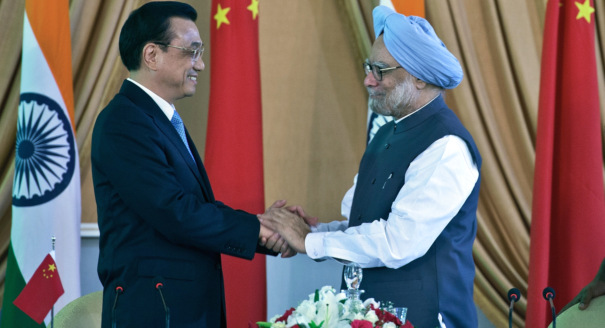
The Chinese premier Li Keqiang's visit to India this week is a good moment to inject much-needed realism into Delhi's China policy. Through the second term of the UPA government, Delhi has allowed ideological romanticism and political timidity to overwhelm common sense in dealing with China. Worse still is the relentless mystification of Chinese policies. Consider the recent psycho-babble in Delhi about the logic behind China's Depsang intrusion. Delhi is unlikely to ever divine the complexities of Beijing's bureaucratic politics. Nor is it necessary.
What mattered, and is lying in plain sight, is Beijing's growing assertiveness on territorial disputes with all its neighbors. In the last few years, China has used military force in pushing its extraordinary territorial claims against Vietnam, the Philippines and Japan.
Is Beijing's behavior out of line? Not really; historians of international relations tell us that rising powers tend to demand a revision of territorial status quo. Confident of its expanding economic and military clout, Beijing is doing precisely that.
Consider, for example, three recent developments in Jammu and Kashmir, all during the second term of the UPA rule. China has stepped up its military presence in Pakistan-Occupied Kashmir, issued stapled visas to Indian citizens from J&K and begun to "dis-count" the length of the Sino-Indian border. China now says the border between the two countries is about 2000 km; the official Indian count for the operational length of the border is nearly 3500 km. The Chinese number makes sense only if J&K is taken out of the equation. The problem, then, is not about the opaqueness of Chinese intentions; it is entirely about Delhi's self-deceptions.
Delhi persuaded itself that a China currently preoccupied with territorial disputes in the east would make nice with India. This is rooted in a profound misreading of Beijing's sense of its own power, and a terrible underestimation of the new Chinese determination to make good on its long-standing territorial claims everywhere, including those against India. Delhi deluded itself that a boundary deal with Beijing was around the corner, even as the evidence pointed in the other direction. China had, in fact, walked back from the earlier understanding, arrived in April 2005, on a three-stage solution to the boundary dispute.
The UPA government also bet that by reinventing the rhetoric of non-alignment and slowing down its relations with the US, it could persuade Beijing to do the boundary deal. This, again, has been a massive misjudgement of Chinese attitudes towards Washington. Beijing does not believe it needs Delhi on its side to change the balance of power with the US. Beijing is convinced that American power is in terminal decline and it can compel Washington to do a deal on Chinese terms.
Delhi's return to realism involves redressing four imbalances that have cast a dark shadow over the relationship with China. The first is the military imbalance on the border. Delhi should know that Depsang will not be last incident on the long and contested frontier with China. The structural conditions that generated it — including the dramatic modernization of Chinese military capabilities in Tibet — are likely to endure, at least for the foreseeable future. Prime Minister Manmohan Singh must leave the visiting Chinese leader in no doubt that India is determined to restore the military balance on the ground. While India could consider new military confidence-building measures on the border, Singh must impress upon Li that without an early resolution of the boundary dispute, military tensions are bound to grow, and inevitably threaten the rest of the relationship.
The second imbalance is about relations with other countries. In the last few years, Delhi has bent over backwards to assure Beijing that it will not join the US, Japan and Vietnam to contain China. Beijing has offered no such assurances to Delhi. It has persisted in deepening its long-standing strategic alliance with Pakistan. China has expanded nuclear and missile cooperation with Pakistan in defiance of international rules, and signaled that it will help Pakistan maintain strategic parity with India.
The third imbalance relates to Tibet and Kashmir. While Delhi acknowledges China's sovereignty over Tibet, Beijing's position on J&K has become increasingly hostile to India. Singh must tell Li that the respect for core concerns, including territorial sovereignty, must be mutual and cannot be one-sided.
The fourth imbalance is economic. Delhi has been right in seeking a significant expansion of the economic relationship with Beijing, despite unresolved political contentions. This approach has widened the base of bilateral relations and lent greater stability. The sky is the limit to future economic cooperation. Singh, however, must tell Li that the expanding trade deficit — now more than $40 billion in total two-way trade of $66 billion — will severely undercut the political support in India for building an economic partnership with China. Delhi must offer a pathway to greater Chinese investment in Indian infrastructure and manufacturing, and Beijing must open the door for Indian exports to the Chinese market.
In dealing with these imbalances, Delhi must discard its current diplomatic style towards China, which involves pushing difficult issues under the carpet, masking major disputes in resounding rhetoric about anti-Western solidarity, and conflating enduring interests with empty slogans. In his talks with Li, Singh might want to dispense with the usual verbiage associated with the Sino-Indian relations. He should focus, instead, on discussing honestly the serious differences between the two nations and finding practical solutions to them.
Chinese leaders are steeped in the realist tradition and appreciate the logic of power politics. Li might respond more positively to a frank discourse from Singh than Delhi's self-deceptions that have so misled India's Chinese interlocutors.
Former Nonresident Senior Fellow, Carnegie India
A leading analyst of India’s foreign policy, Mohan is also an expert on South Asian security, great-power relations in Asia, and arms control.
Recent Work

C. Raja Mohan, Darshana M. Baruah


Alexander Gabuev, Paul Haenle, C. Raja Mohan, …
Carnegie does not take institutional positions on public policy issues; the views represented herein are those of the author(s) and do not necessarily reflect the views of Carnegie, its staff, or its trustees.

Russia’s AI-driven propaganda campaigns operate in a fragmented, chaotic, and often illogical manner. That’s not necessarily a problem for the Kremlin, though: It’s much easier to mimic genuine public debate that way.

Ilya Klishin

Ahead of a tough winter for Ukraine, Donald Trump’s swing back toward Russia bodes ill. But instead of panicking, Kyiv’s European allies are focusing on action.

Rym Momtaz

Without a ceasefire with Ukraine on attacking each other’s energy infrastructure—to which the Kremlin is unlikely to agree—the diesel agreement between Putin and Trump is largely for show, rather than representing a genuine increase in the volumes of Russian diesel on the global market.

Sergey Vakulenko

Funding Ukraine remains a priority for European leaders. As Russia’s war of aggression heads into another winter, two feasible options to mobilize support for Kyiv should be fast-tracked.


Vladyslav Rashkovan, Gregory P. Wilson

Russian strikes are weakening the economy sustaining Ukraine’s war effort. Closing the growing funding gap will require more European support and politically contentious reforms in Kyiv.

Balázs Jarábik