

Q&A
- +1
Amr Hamzawy, Andrew Leber, Eric Lob, …
{
  "authors": [
    "Marwan Muasher"
  ],
  "type": "legacyinthemedia",
  "centerAffiliationAll": "dc",
  "centers": [
    "Carnegie Endowment for International Peace",
    "Malcolm H. Kerr Carnegie Middle East Center"
  ],
  "collections": [],
  "englishNewsletterAll": "menaTransitions",
  "nonEnglishNewsletterAll": "",
  "primaryCenter": "Carnegie Endowment for International Peace",
  "programAffiliation": "MEP",
  "programs": [
    "Middle East"
  ],
  "projects": [],
  "regions": [
    "North America",
    "United States",
    "Middle East",
    "Israel",
    "Palestine",
    "Levant"
  ],
  "topics": [
    "Political Reform",
    "Security",
    "Foreign Policy"
  ]
}
Source: Getty
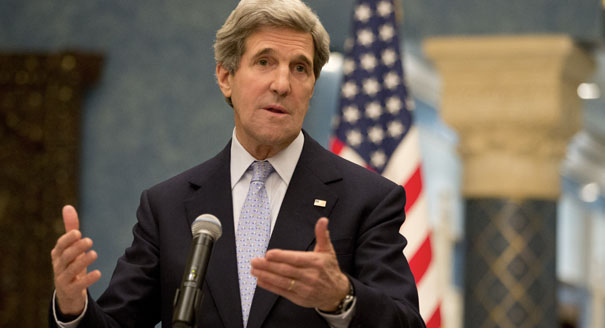
The peace process between Israelis and Palestinians have been marked by minor steps forward and major ones back. Now, the two sides are talking again for the first time in three years.
Source: NPR’s Weekend Edition
LINDA WERTHEIMER, HOST:
In the Middle East, the peace process between Israelis and Palestinians have been marred by minor steps forward and major ones back. Now, the two sides are talking again for the first time in three years. This week, U.S. Secretary of State John Kerry met with negotiators to set the stage for conversations expected to last for months. Of course, since the last meetings of the two parties, the whole region has been through some massive changes, namely the Arab Spring. We spoke with Marwan Muasher of the Carnegie Endowment for International Peace, where he oversees research on the Middle East. He says the talks are important for a couple of reasons.
MARWAN MUASHER: One, because the chances for a two-state solution are closing with the demographic issue with the number of settlements in the West Bank and also the Arab Spring has had the added effect of Arab governments that are now more democratic, answering to their people, and so probably more critical of the Israeli occupation than the previous governments were. So, whereas the chances for peace have always been rather slim, I'm afraid that if peace does not come to the Middle East anytime soon, we might have the window closed for the foreseeable future.WERTHEIMER: Do you think that the negotiators on, I don't know, should we say all three sides are factoring that into their discussions?
MUASHER: I am not very hopeful. I think both the Palestinians and the Israelis have impediments that are standing in the way of a settlement. The Israeli government basically ideologically would find it difficult to give the compromises necessary for a two-state solution. And the Palestinians on the other side are not convinced that they will get any solution that would be acceptable by the people. That is why I think it is important for a third party, such as the United States, to bring to the table at some point a guiding parameter that will guide the negotiators as they attempt an agreement.
WERTHEIMER: I guess one of the problems that these negotiators are going to face are unstable Syria, unstable Egypt, Iraq, Lebanon. So, how do you think that changes the way in which the negotiators move forward?
MUASHER: The Arab Spring does affect what is going on in the region. Ten years ago, the Arab peace initiative was launched by all Arab states, promising peace and security for Israel and all Arab states, not just those Arab states that have contiguous borders with Israel. But 10 years later, this has not happened and these Arab states are now - some of them - Egypt, Syria, are entangled in their own domestic issues which will maybe prevent them from offering the kind of support that the Palestinians in particular might now. But let's remember, the process that Secretary Kerry is launching is a Palestinian-Israeli agreement. It is not one between Israel and Syria or Israel and Lebanon.
WERTHEIMER: So, what do you think is the possibility that Secretary Kerry can accomplish something? What do you think would look like success to him in nine months?
MUASHER: Success, obviously, would be in the form of an agreement reached. And I think that to do so, Secretary Kerry is going to have to enlist the support, the proactive support, of the White House. That is the missing formula so far. Whereas the White House, of course, has offered its generous support, no agreement between the Palestinians and the Israelis have been possible. If it involved only the efforts of the State Department and did not invoke at some stage the active participation of the White House, of the U.S. president himself, what looks to be the case, is that the White House feels that this has a very small chance of success and therefore has given the secretary some general form of support that the parties in the region do not see as enough to sort of push them into an agreement that has that support.
WERTHEIMER: Marwan Muasher oversees research on the Middle East at the Carnegie Endowment for International Peace. Thank you very much.
MUASHER: Thank you.
This interview was originally broadcast on NPR’s Weekend Edition.

Vice President for Studies
Marwan Muasher is vice president for studies at Carnegie, where he oversees research in Washington and Beirut on the Middle East. Muasher served as foreign minister (2002–2004) and deputy prime minister (2004–2005) of Jordan, and his career has spanned the areas of diplomacy, development, civil society, and communications.
Recent Work



Amr Hamzawy, Andrew Leber, Eric Lob, …
Marwan Muasher
Carnegie does not take institutional positions on public policy issues; the views represented herein are those of the author(s) and do not necessarily reflect the views of Carnegie, its staff, or its trustees.
Washington needs to recognize that influence in the Western Hemisphere comes from presence, delivery, and reliability. It also must recognize that while the United States remains the key external actor, it no longer operates in a permissive environment and cannot presume deference from regional players who have other options, namely China.
Juan S. Gonzalez

Minsk clearly expected the dialogue with Washington to yield more results, in particular the lifting of EU sanctions and permission to export potash.

Artyom Shraibman

A summer of escalation in the Black Sea has hurt Ukraine economically and is exacerbating world food security. A truce is needed—as is a broader reframing of Europe’s Ukraine strategy.

Thomas de Waal

As the U.S. stumbles in its war with Iran, we are likely to see an acceleration of its disengagement from the region.

Michael Young
Why governance of rapidly evolving technology will be distributed and complex.


Stewart Patrick, Scott Singer