

Q&A
- +1
Amr Hamzawy, Andrew Leber, Eric Lob, …
{
  "authors": [
    "Marwan Muasher"
  ],
  "type": "legacyinthemedia",
  "centerAffiliationAll": "dc",
  "centers": [
    "Carnegie Endowment for International Peace",
    "Malcolm H. Kerr Carnegie Middle East Center"
  ],
  "collections": [],
  "englishNewsletterAll": "menaTransitions",
  "nonEnglishNewsletterAll": "",
  "primaryCenter": "Carnegie Endowment for International Peace",
  "programAffiliation": "MEP",
  "programs": [
    "Middle East"
  ],
  "projects": [],
  "regions": [
    "United States",
    "Middle East",
    "Syria",
    "Levant"
  ],
  "topics": [
    "Political Reform",
    "Security",
    "Foreign Policy"
  ]
}
Source: Getty
Contrary to the conventional view, America’s image could benefit from what the Arab street might deem a triumph of democracy.
Source: National Interest
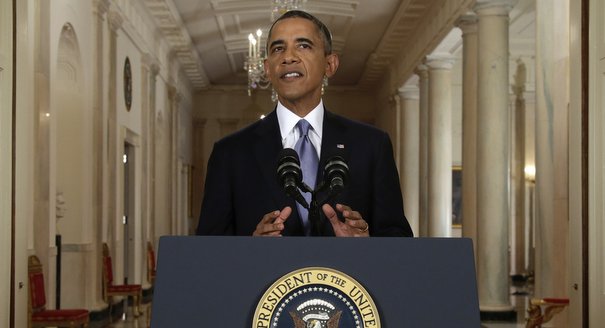
Critics claim that Obama’s half-step to seek congressional approval for a U.S. strike on Syria and subsequent backtracking after Putin’s eleventh hour diplomacy gave him a way out, but made him look weak. But contrary to the conventional view, America’s image could benefit from what the Arab street might deem a triumph of democracy. What many have called a political and diplomatic debacle may actually provide an opening for long-term public engagement in the Middle East.
To be sure, many U.S. allies in the region were not pleased with Obama’s backsliding from U.S. military strikes on Syria. To them, the move opened the door for the Assad regime to nickel and dime the dismantling effort and engage in a never-ending process of procrastination while it carries on a war through conventional means. Russian tactics in the UN Security Council have so far been sufficient to block international action in a conflict that has claimed more than one-hundred thousand lives, and sent more than two million refugees to Jordan, Lebanon, Turkey, and Iraq. Further, the possibility of boosting the regime in Iran by sparing Assad is not a prospect that U.S. allies, including Saudi Arabia or Turkey, will look favorably upon.
Indeed, some fault the president for focusing on the chemical issue, when the real question is how to stop the violence and implement a political process that saves what is left. A Syria governed by a more inclusive system is certainly more palatable to U.S. interests than is the status quo.
Criticism of Obama’s strategy is not absent from the U.S. domestic debate either: last week, former Secretary of Defense Leon Panetta said, “When the president of the United States draws a red line, the credibility of this country is dependent on him backing up his word.”
But these arguments ignore the most significant take-away from the Arab uprisings: that the opinion of the Arab masses—as opposed to that of only the regimes and elites—should matter. While all polls suggest that a solid majority of Arab public opinion is against the Assad regime, there is also a solid majority against a U.S. military strike. The memories of the Iraq war are still vivid not only among the American public, but also in the Arab consciousness. A U.S. military strike of any magnitude is seen by many as complicating the problem—a limited, short-sighted solution designed more as a face-saving measure than a campaign to bring an end to the conflict. This pattern is particularly troublesome to many Arabs.
At the same time, Obama’s announcement that he would seek the approval of the U.S. Congress before ordering military strikes on Syria has shown the world that America actually believes in the democratic system it espouses. His actions made him look more like an accountable elected official - and less like a dictator in disguise - and provided a sharp contrast to leaders who may use elections to come to power, but have no further use for democracy. There is no doubt that those who took to the streets to protest authoritarian regimes in their own countries will look favorably upon Obama’s deferral to the people and to the international community.
Arabs have come to expect a dominant executive, where one person can make decisions that affect the people for generations. In this context, evidence of a decision-making process that operates, even in crisis, within a system of checks and balances looks remarkable.
Regardless of their opinions of the Assad regime, in recent weeks Arabs have witnessed a process whereby the executive willingly turns over some of his power to the legislature—even when the former has the legal authority to proceed without approval. Many are no doubt comparing these recent events to the process in their own countries, where the will of the people often has little to do with the executive’s decisions, and where no system of checks and balances exists.
In effect, a democratic structure has forced the leader of the most powerful country on Earth to listen to his constituents. Their views, regardless of the merits or the repercussions on that leader’s image at home or abroad, have the power to determine the outcome. It was incumbent on the executive to sell his case to the American public in order to receive the support needed to take military action.
It remains to be seen whether the Russian proposal to dismantle Assad’s chemical weapons arsenal will be a flop. Its success or failure, however, is only one concern. There are huge potential long-term benefits from this display of democracy at work. The effects of the Arab awakening, especially the elevation of the will of the people, will reverberate for generations.
It is true that U.S. credibility in the region is starting from a perilously low point. While a new era of U.S. engagement with people in the Middle East seemed imminent after Obama’s 2009 Cairo speech, his policy in the region has since then seemed to lack an ideological trajectory. The decision-making process he has employed with Syria is one for which Arabs have yearned—for decades. It is what the Arab street sees as the best American democracy can offer. If Washington hopes to take advantage of the long-term opportunities presented by the Arab uprisings, U.S. policymakers would do well to continue championing the democratic process—at home and abroad.
This article was originally published in the National Interest.

Vice President for Studies
Marwan Muasher is vice president for studies at Carnegie, where he oversees research in Washington and Beirut on the Middle East. Muasher served as foreign minister (2002–2004) and deputy prime minister (2004–2005) of Jordan, and his career has spanned the areas of diplomacy, development, civil society, and communications.
Recent Work



Amr Hamzawy, Andrew Leber, Eric Lob, …
Marwan Muasher
Carnegie does not take institutional positions on public policy issues; the views represented herein are those of the author(s) and do not necessarily reflect the views of Carnegie, its staff, or its trustees.

It signals a new era of tech diffusion and warfare.

Steve Feldstein

With its public finances in shambles, the far right polling at 35 percent ahead of the 2027 presidential election, and a growing protest movement, is France’s crisis a threat to the EU’s geopolitical awakening?

Rym Momtaz, ed.

Putin’s conservative staffing policies and search for ever greater control have cemented parliament’s transformation into a bureaucratic appendage of the executive branch.

Andrey Pertsev

Russia’s AI-driven propaganda campaigns operate in a fragmented, chaotic, and often illogical manner. That’s not necessarily a problem for the Kremlin, though: It’s much easier to mimic genuine public debate that way.

Ilya Klishin

Ahead of a tough winter for Ukraine, Donald Trump’s swing back toward Russia bodes ill. But instead of panicking, Kyiv’s European allies are focusing on action.
Rym Momtaz