

Commentary
Regardless of the outcome, there’s another path to ensuring that progress doesn’t stall.
Zaur Shiriyev
{
  "authors": [
    "Tedo Japaridze"
  ],
  "type": "commentary",
  "centerAffiliationAll": "",
  "centers": [
    "Carnegie Endowment for International Peace",
    "Carnegie Russia Eurasia Center"
  ],
  "collections": [],
  "englishNewsletterAll": "",
  "nonEnglishNewsletterAll": "",
  "primaryCenter": "Carnegie Russia Eurasia Center",
  "programAffiliation": "",
  "programs": [],
  "projects": [],
  "regions": [
    "Caucasus",
    "Russia",
    "Georgia",
    "Western Europe"
  ],
  "topics": [
    "Political Reform",
    "Democracy",
    "Foreign Policy"
  ]
}
Source: Getty
From Tbilisi’s perspective, deeper integration with the EU is a policy trajectory that enjoys consensual support, in a political landscape that is otherwise not prone to consensus politics. Now, the post-Vilnius challenge is to retain this legitimacy and continue to develop qualitative anchorage.
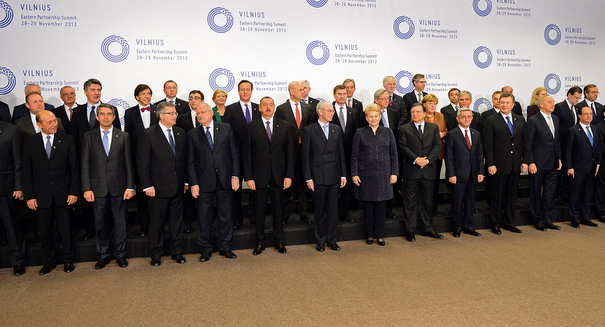
The Eastern Partnership summit in Vilnius did not benefit from an East-versus-West framing of the event. This being the case, which is undisputable, raised the stakes of bravado politics in Moscow. But also around, including in Tbilisi, sometimes forgetting or ignoring the fact that we all have made just the first step on that thorny and tumultuous uphill way, a long-term process of how to become a European democratic state.
As far as Georgia is concerned, there is a sense of double irony here. First, a historical irony, since Russia was since the 18th century the anchor of Georgia in Europe, though in a bit specific, imperial way but still that is fact on the ground; second, a political irony, since up until the mid-1990s Russia outpaced Georgia and all post-Soviet polities in the processes of the EU and even NATO integration. Following this observation, the knee jerk reaction for an analyst is to contrast the Yeltsin and Putin presidential terms. However, from a Georgian perspective, given that Russia took a position by proxy in support of secessionist forces early on, already in the first years of Georgia’s independence, this is a less than straightforward conclusion.
Be this as it may, from Tbilisi’s perspective, there is no turning back. Deeper integration with the EU is a policy trajectory that enjoys consensual support, in a political landscape that is otherwise not prone to consensus politics. Now, the post-Vilnius challenge is to retain this legitimacy and continue to develop qualitative anchorage. “What happens next” is the main question not merely for political elites but, perhaps most importantly, the average voter. In this respect, the benefits of European Neighborhood Policy must be tangible, whilst bridges must not be burned with those who have failed to make the Vilnius appointment.
Focusing on Georgia, it is significant that Tbilisi is provided with more not less leeway to engage with breakaway republics, a point that can be transposed to Chisinau. The “more-for-more” principle should thus be framed in a manner that facilitates rather than obstructs negotiations. Georgia should be seen as a land of opportunity, not despite but because of the fact that it constitutes a political islet of European commitment in the South Caucasus. In this respect, progress in the Visa Liberalization Action Plan could be of tremendous significance, but one also needs to consider plans to widen the opportunities for education or small and medium enterprises development with a bi-communal angle. In sum, Georgia should become more attractive as a partner because of its choice.
From a regional perspective, the dilemma is not merely between transactional and transformational EU engagement. Ultimately, it is about foresighted transactions that allow for transformational ambitions. Zero sum rhetoric can only be averted in practice. As stated during my speech in Vilnius, for Tbilisi, being in Europe is not an anti-Russian statement, but more of a statement about Georgia: competitiveness, rule of law, respect for cultural diversity, solid multilateralism, consensus driven policy, a reliable social safety net, a social partnership culture, respectable institutions, and a commitment to human rights. This makes sense for us, in terms of what we want to be. The point about what we do not want to be comes by defect, not in principle.
Inevitably, in the short run, this may mean that relations with Moscow may be informed by a transactional rather than transformative agenda. Those who do enter in a transformational framework of engagement, such as Georgia, must be provided with a context to operate with their neighbors. Thereby, it is not only about “not burning bridges,” but in fact exploring new kinds of engagement.
In sum, Brussels must work both with and through its partners in the region and more so in the immediate aftermath of the Vilnius summit. This is why Georgia seeks its inclusion in the Visegrad+ forum. In the months and years to come, we will need the mentorship, best-practice transfer, and motivated advocacy that will ensure that a European trajectory is an independent variable, both in Tbilisi and in Brussels. Toward this end, we need a framework of engagement that is more than bilateral in scope. Without this “independent variable,” the principled consensus we now enjoy may be turned against us as an accusation of “reckless idealism.”
In the long run, Tbilisi is conclusively on the right side of history. Our region, including Russia, is European. Trade flows, foreign direct investment, culture, diasporas, and human networks testify to a common European space that emerges despite policy rather than because of it. But politics is also the realm of “here-and-now.” While ideological commitment is an important factor to ensure a long-term perspective, we need to endure through the time from now onto the future. And the Vilnius trajectory, for Tbilisi as well as for Brussels, is a marathon, not a sprint.
The views expressed in this material do not necessarily coincide with those of the Georgian government.
Tedo Japaridze is the chairman of the Foreign Relations Committee in Parliament of Georgia.
Tedo Japaridze
Member, Georgian parliament
Tedo Japaridze is a member of the Georgian parliament, former ambassador, and chairman of the Foreign Relations Committee.
Carnegie does not take institutional positions on public policy issues; the views represented herein are those of the author(s) and do not necessarily reflect the views of Carnegie, its staff, or its trustees.
Regardless of the outcome, there’s another path to ensuring that progress doesn’t stall.

Zaur Shiriyev

But their "principal to principal" model will only be as effective as the political strength of each leader back home.

Damien Ma

China’s Ministry of Public Security is often portrayed as a domestic law enforcement agency, but it is also a global security actor. This paper explores how MPS has used international law enforcement and security cooperation agreements—over 200 since 2006—to advance China’s vision of security in a changing global environment.


Sophie Zhuang, Sheena Chestnut Greitens, Cameron Waltz
The demands of the Kremlin’s war in Ukraine, demographic problems, and public hostility toward Central Asians mean Russia does not have enough workers.
Salavat Abylkalikov
Amid uncertainty caused by the Iran war, the global drive for nonproliferation has stalled. With Europe diplomatically marginalized and countries reassessing their nuclear options, efforts to curb the spread of nuclear weapons risk becoming irrelevant.

Jane Darby Menton