

Commentary
Thomas de Waal
{
  "authors": [
    "Thomas de Waal"
  ],
  "type": "commentary",
  "centerAffiliationAll": "",
  "centers": [
    "Carnegie Endowment for International Peace",
    "Carnegie Europe",
    "Carnegie Russia Eurasia Center"
  ],
  "collections": [],
  "englishNewsletterAll": "",
  "nonEnglishNewsletterAll": "",
  "primaryCenter": "Carnegie Europe",
  "programAffiliation": "",
  "programs": [],
  "projects": [],
  "regions": [
    "Caucasus",
    "Russia",
    "Georgia"
  ],
  "topics": [
    "Security",
    "Foreign Policy"
  ]
}
Source: Getty
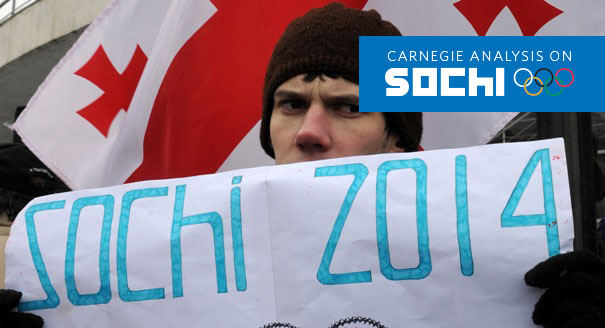
The Sochi Olympics could become the pretext for a real rapprochement between Moscow and Tbilisi. However, conversation between Russia and Georgia about the insurgency in the North Caucasus never started, and in the future this will be remembered as a missed opportunity.
Russia was lucky with the timing. If the vote on the venue of the Winter Olympics had been held in the summer of 2008, rather than a year earlier, the International Olympic Committee would surely not have awarded the 2014 games to a city located right next to a conflict zone.
Since Sochi won the right to host the Olympics in 2007, the region next door has been through war, Russia's recognition of Abkhazia and South Ossetia as independent states and a partial thaw caused by the election of the Georgian Dream government in October 2012.
Had Mikheil Saakashvili's United National Movement won the election in 2012, it is likely that Georgia would have boycotted Sochi and relations between Moscow and Tbilisi would have deteriorated even further.
Instead, for a moment in 2012, it looked as though the Sochi games could become the "peace games," the pretext for a real rapprochement between Moscow and Tbilisi. The new Georgian government announced it would not be boycotting the games. It quietly dropped its politicization of the Circassian issue. The Foreign Minister Maia Panjikidze mused aloud to me that it would be wonderful if she could get in her car and drive across Abkhazia to Sochi.
It was not to be. The Russian-Georgian dialogue established in 2012 has succeeded in restoring trade relations. The Georgian economy has received a boost from getting its wine and agricultural products back on the Russian market. The two sides are discussing visa liberalization.
Georgia is sending four competitors to Sochi and a small delegation from its Olympic Committee. Flights between Tbilisi and Sochi will operate for the duration of the games. The most recent opinion poll says that 66 percent of Georgians approve of their country participating in the games and only 17 percent disapprove.
But one important conversation never started—the one in which Russia and Georgia talk about the never-ending insurgency in the North Caucasus and what the Georgians can do about it. That would have been good for both security and politics. Instead, the Russian government's approach to securing the games has been "Don't talk to the Neighbors." Moscow has actually tightened the borders of Abkhazia and South Ossetia in the past year.
In the future this will surely be remembered as a missed opportunity.

Senior Fellow, Carnegie Europe
Thomas de Waal is a senior fellow at Carnegie Europe, specializing in Eastern Europe and the Caucasus.
Recent Work
Thomas de Waal


Thomas de Waal, Areg Kochinyan, Zaur Shiriyev
Carnegie does not take institutional positions on public policy issues; the views represented herein are those of the author(s) and do not necessarily reflect the views of Carnegie, its staff, or its trustees.
It’s time to build momentum, and Ankara is the venue of the next opportune diplomatic window to do this.

Alper Coşkun, Garo Paylan
The EU is putting together a new security strategy to meet today’s myriad challenges. But for any proposal to be effective, the union needs to grapple with its identity and ambitions.

Pierre Vimont
Three years after the Ohrid Agreement, Kosovo and Serbia remain far from normalization. To revive implementation, the EU should abandon its ambiguity and act as an even-handed arbitrator.

Miloš Pavković, Fitim Gashi, Iliriana Gjoni, …
For all the menacing rhetoric, the Armenian prime minister remains a leader with whom Putin is prepared to interact: not as an ally, but as a partner, albeit a problematic one.

Alexander Atasuntsev
The Islamic Republic’s words and actions suggest that it has changed its approach to both diplomacy and war.
Mohammad Ayatollahi Tabaar