

Commentary
Judy Dempsey
{
  "authors": [
    "Judy Dempsey"
  ],
  "type": "legacyinthemedia",
  "centerAffiliationAll": "dc",
  "centers": [
    "Carnegie Endowment for International Peace",
    "Carnegie Europe"
  ],
  "collections": [
    "Europe’s Eastern Neighborhood"
  ],
  "englishNewsletterAll": "ctw",
  "nonEnglishNewsletterAll": "",
  "primaryCenter": "Carnegie Europe",
  "programAffiliation": "EP",
  "programs": [
    "Europe"
  ],
  "projects": [],
  "regions": [
    "Russia",
    "Europe",
    "Eastern Europe",
    "Ukraine",
    "Western Europe",
    "Germany",
    "Iran"
  ],
  "topics": [
    "Foreign Policy"
  ]
}
Source: Getty
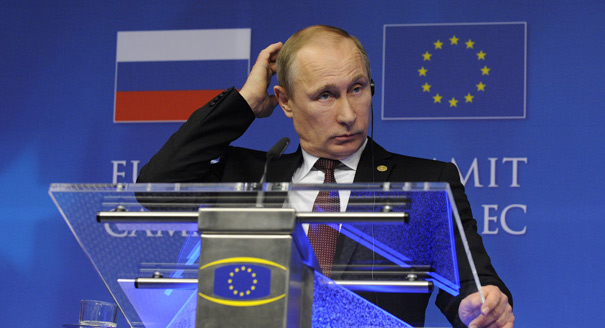
Europe is divided over how to respond to Russia’s invasion of Crimea. The most powerful figure in the diplomatic tango is Germany’s Angela Merkel.
Source: Public Radio International
Europe is scrambling to defuse the crisis over Russia’s incursion into the Crimean region of Ukraine. And the most powerful figure in the diplomatic tango is Germany’s Angela Merkel.
Merkel speaks Russian, grew up in the former Communist East Germany and leads the most powerful country in Europe. But so far, she has not been able to lead European leaders to a single point of view. Nor is there a unified view even in her own country.
“Berlin is quite divided about this,” says Judy Dempsey of Carnegie Europe. “[Merkel] knows Vladimir Putin. She knows his KGB past. She has a very difficult relationship with him and she knows exactly what’s at stake.”
But Dempsey says the German Foreign Ministry is controlled by the Social Democrats. “They’re very much this old-fashioned, ostpolitik, with a ‘keep talking, move slowly, don’t alienate Russia’ approach to dealing with Moscow.” So Dempsey says it will be up to Merkel to decide how tough Germany will be with Russia. “And what Merkel decides will influence the overall EU attitude.”The divisions within Europe over how to respond to the crisis mirror the divisions within Germany. Dempsey finds this astonishing given the potential for instability.
“There are experts, including Russian experts, who believe that Putin won’t stop just at Crimea, that he might just go a step further, toward Odessa.” Dempsey says the implications for neighboring Moldova would be huge — and Merkel knows this.
“She has to decide which way she’s going to jump and, once she jumps, she’ll have to bring in the other EU member states behind her.” But Dempsey says that won’t be easy.
“At the moment they’re just so divided. They can’t agree on the sanctions. They can’t agree on the policies. They can’t agree how tough they should be. They have no hard power. This is all about soft power and they can’t even agree how to use soft power.”
Sweden wants tough sanctions against Russia. So does Poland. The Baltic states want much tougher action against Russia.
“Italy is saying, ‘Oh well, another crisis. We can’t corner Putin,’” Dempsey says. Britain hasn’t gotten tough yet, but she thinks Prime Minister David Cameron might move in that direction, with a caveat.
“Britain may come around to being much tougher, but remember, if Britain agrees to sanctions on assets, well, you know where most of Russia’s assets are at the moment? They’re in London,” she explains.
France, Dempsey says, is slightly ambiguous. “They’re willing to give diplomacy a chance. If push comes to shove, I think President Hollande will go for sanctions, depending on what they are and whether anyone can agree on sanctions.”
Part of Germany’s influence with Moscow is that it is Russia’s most important trading partner, mostly in oil and energy. And there are more than 5,000 German companies with operations in Russia. Dempsey doesn’t believe Putin will stop German companies from operating or void their contracts because Russia needs German know-how and technology.
“If he restricted German businesses in Russia, he would lose an awful lot and, at the end of the day, the Russian economy would suffer.”
Dempsey believes the Russian economy is the key to ending the crisis. “Yesterday and today, the stock markets in Russia plummeted to the lowest in five years. $12 billion have been wiped off Gasprom, Russia’s state energy monopoly, which is Putin’s political and economic instrument.”
She says Russia’s central bank is trying to prop up the ruble and she thinks capital flight from foreign investors will probably be accelerated because of the crisis in Crimea. “This isn’t going to be a short crisis,” says Dempsey, who added that the same things happened during the 2008 crisis when Russia invaded Georgia.
“This is different. This is big time. This is Ukraine. If this is sustained, this sort of chiseling into stock markets and into Russian capital and foreign direct investment, it will really affect Putin because [what] he has relied on for so long is oil and gas.”
Dempsey says German officials have long encouraged Putin to diversify his economy, to no avail. “At the moment, I think this is a big weakness for him.”
This interview was originally aired on Public Radio International.

Nonresident Senior Fellow, Carnegie Europe
Judy Dempsey is a nonresident senior fellow at Carnegie Europe
Recent Work
Judy Dempsey
Judy Dempsey
Carnegie does not take institutional positions on public policy issues; the views represented herein are those of the author(s) and do not necessarily reflect the views of Carnegie, its staff, or its trustees.

Funding Ukraine remains a priority for European leaders. As Russia’s war of aggression heads into another winter, two feasible options to mobilize support for Kyiv should be fast-tracked.


Vladyslav Rashkovan, Gregory P. Wilson

Russian strikes are weakening the economy sustaining Ukraine’s war effort. Closing the growing funding gap will require more European support and politically contentious reforms in Kyiv.

Balázs Jarábik

While the EU and European governments are embracing the much-lauded middle-power moment, this entails three difficult conundrums.

Richard Youngs
The middle power moment will not be defined by sovereign states alone, and California stands out for its potential contributions to international cooperation.


Ian Klaus, Stewart Patrick

Europe is facing rising populism internally as well as external pressures from Russia, China, Turkey, and the United States.

Dimitar Bechev