

In The Media
Lina Khatib
{
  "authors": [
    "Lina Khatib"
  ],
  "type": "other",
  "centerAffiliationAll": "dc",
  "centers": [
    "Carnegie Endowment for International Peace",
    "Malcolm H. Kerr Carnegie Middle East Center"
  ],
  "collections": [],
  "englishNewsletterAll": "menaTransitions",
  "nonEnglishNewsletterAll": "",
  "primaryCenter": "Malcolm H. Kerr Carnegie Middle East Center",
  "programAffiliation": "MEP",
  "programs": [
    "Middle East"
  ],
  "projects": [],
  "regions": [
    "Gulf",
    "Middle East"
  ],
  "topics": [
    "Economy",
    "Political Reform",
    "Democracy"
  ]
}
Source: Getty
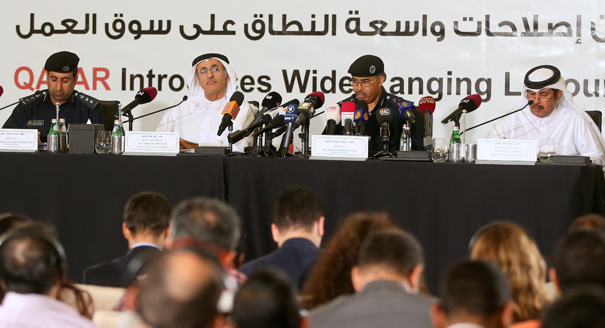
The richest country in the world in terms of GDP per capita, Qatar has been performing well in global anti-corruption indices. However, one should consider how the indices define corruption.
Source: ANTICORRP
Qatar is judged by international anti-corruption indices to be among the highest performing countries in the Middle East and North Africa. The Qatari government has streamlined its regulations regarding business practices and engaged in reforms from above that have liberalized the Qatari economy and increased its strength and viability. However, Qatar is a neo-patrimonial absolute monarchy in which the state is not immune from private interests, and where the ruling family can bypass the rule of law. The complete control by the monarch of state institutions and policies leaves no space for bottom-up calls for reform, or for independent assessment of the performance of the state and the actions of the ruling family by civil society and the media. The permeation of informal networks (mainly in the form of tribal relations) within state institutions and civil society, the lack of interest in and avenues for political participation among Qatari citizens, and the clientelistic relationship between citizens and the state support the continuation of this status quo. This paper analyzes the structures and mechanisms of Qatar’s governance regime that reveal the contradictions inherent within the categories covered by anti-corruption indices. In doing so, it suggests a number of shortcomings in the methodologies and scope of those indices as they specifically apply to Qatar, and poses a number of questions regarding the kind of information that is difficult to find but which is crucial to address in order to form a clearer picture of corruption and anti-corruption practices in Qatar. The paper concludes that the absence of this information in the first place casts a shadow of doubt over the performance of Qatar in anti-corruption indices. Also, the indices’ focus on measuring the scope of state functions while not measuring the strength of state institutions is a key reason behind the discrepancy between Qatar’s anti-corruption ranking and the mechanisms and structure of its governance regime. Instead, the paper proposes specific indicators related to the governance regime that allow for a more comprehensive look at corruption and anti-corruption practices in Qatar.This paper was originally published by ANTICORRP.
Former Director, Middle East Center
Khatib was director of the Carnegie Middle East Center in Beirut. Previously, she was the co-founding head of the Program on Arab Reform and Democracy at Stanford University’s Center on Democracy, Development, and the Rule of Law.
Recent Work
Lina Khatib
Lina Khatib
Carnegie does not take institutional positions on public policy issues; the views represented herein are those of the author(s) and do not necessarily reflect the views of Carnegie, its staff, or its trustees.

If the Russian-speaking community in Latvia cannot articulate their interests without being seen as disloyal, they could end up embracing a pro-Kremlin agenda.

Sergejs Potapkins

Russia’s ruling party would have benefited from Putin appearing as its distant patron, but as an active frontman imposing his views on the public, he has done nothing but harm both the party’s election campaign and the ruling system overall.

Andrey Pertsev

The Bureau of Industry and Security needs to adjust its focus and practices to maintain its position as the U.S. government’s primary champion of international technological competition.

Geoffrey Irving
Despite myriad challenges and occasional stumbles, the new Hungarian government is moving ahead with energy and conviction to uproot years of illiberalism and corruption and rebuild Hungarian democracy.

Thomas Carothers

Depleted financial reserves and a shrinking tax base mean it is no longer possible to simultaneously deliver high defense spending, price stability, and economic growth.

Alexandra Prokopenko