

Q&A
- +1
Amr Hamzawy, Andrew Leber, Eric Lob, …
{
  "authors": [
    "Marwan Muasher"
  ],
  "type": "legacyinthemedia",
  "centerAffiliationAll": "dc",
  "centers": [
    "Carnegie Endowment for International Peace",
    "Malcolm H. Kerr Carnegie Middle East Center"
  ],
  "collections": [
    "Arab Awakening"
  ],
  "englishNewsletterAll": "menaTransitions",
  "nonEnglishNewsletterAll": "",
  "primaryCenter": "Carnegie Endowment for International Peace",
  "programAffiliation": "MEP",
  "programs": [
    "Middle East"
  ],
  "projects": [],
  "regions": [
    "Middle East",
    "North Africa",
    "Egypt",
    "Gulf",
    "Levant",
    "Maghreb"
  ],
  "topics": [
    "Political Reform",
    "Security",
    "Religion"
  ]
}
Source: Getty
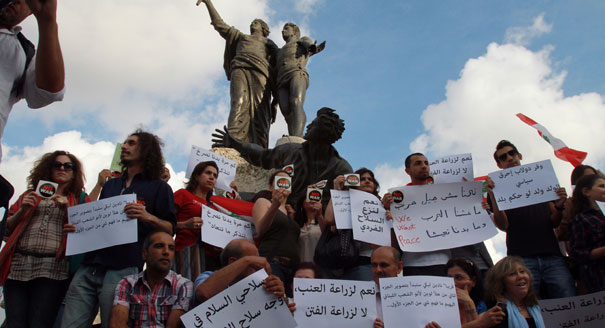
The rising Sunni-Shiite divide in the Arab world is a prime example of how the demons of sectarianism can be roused by opportunistic leaders. But a stronger sense of national identity can eventually lay them to rest.
Source: International New York Times
Sectarian tensions are ripping Arab countries apart. From Syria to Lebanon to Iraq, states are increasingly being defined by what divides them. The Sunni-Shiite divide in particular is emerging as the single most threatening factor to national cohesion in all of these countries and beyond. Left unaddressed, hope for a stable and prosperous future for the Arab world is fleeting.
This sectarian divide is most glaring in countries that were shaped by colonial powers and stem from the famous Sykes-Picot Agreement of 1916. Iraq, which just went through an election campaign that was deeply polarized along sectarian lines, is a case in point.
Throughout the region, different communities, sharing the same Arab heritage but different religious or ethnic backgrounds, were lumped together in artificial countries. Even though almost 100 years have passed since that agreement, governments in these countries chose to maintain stability through force rather than investing in building a true sense of citizenship where national identities would trump any other allegiances.For the last century, leaders have used religious and ethnic differences to create rifts and exploit them to extend their reign. The result has been that people today identify principally as Shiite or Sunni or something else; a Kurd in Iraq thinks of himself first as a Kurd, not an Iraqi.
It is most horrifically on display in Syria, where the civil war has become increasingly sectarian. And in Jordan, where we still cannot decide on the definition of who is Jordanian — more than 60 years after Palestinians who fled to the country after the 1948 Arab-Israeli war were given full citizenship.
Although the problem exists in North Africa, too, it is less severe. People tend to think of themselves as Egyptians, Tunisians or Moroccans first. As a result, their transitions to democracy, even if troubled, have a much better chance of success. A shared sense of citizenship could prove critical in the end.
Arab countries need to focus on creating strong national identities that would trump all other allegiances; otherwise democracy may never take hold.
It is not always easy. There are many examples of national identity run amok. Hitler endorsed a narrow sense of nationalism that depicted a particular race as superior to others. Yugoslavia was made of diverse communities, but they were held together by force rather than a collective sense of citizenship. Even Turkey — seen by many as a model for Arab countries — has a national identity that is one-dimensional in many ways.
The United States today is extremely stable, prosperous and diverse, but it had to go through a civil war that killed almost a million people before it could forge a modern national identity. British India endured the bloody partition of India and Pakistan, and modern India still suffers from communal violence between Hindus and Muslims. National identities take a long time to develop and have their own unique contexts, but the longer it takes for Arab states to get started, the harder it will be to avoid future violence and fragmentation.
The post-independence era in the Arab world witnessed many false starts. Baathism, which emerged as a doctrine in the 1940s and ended up as the governing ideology of Iraq and Syria for decades, preached a secular, socialist model that attracted many elites but ultimately failed to win over the masses as it increasingly adopted an exclusionary, brutal discourse and failed to improve the common man’s quality of life.
Nasserism in Egypt succeeded in rallying people around a common cause of pan-Arabism and the fight for Palestine, but the 1967 war shattered all such dreams and paved the way for the rise of political Islam as an alternative. Baathism and Nasserism failed to advance an effective, pluralistic program that improved people’s lives; both were eventually discredited across the Arab world.
The Arab world’s cultural, ethnic and religious diversity should be regarded as a strength rather than a weakness. And that means governments must foster a sense of citizenship that values diversity, rather than a narrow form of nationalism that emphasizes the pre-eminence of certain groups over others.
First, national education systems need to be reinvented. Teaching subservience and devotion to an all-powerful leader or group should be supplanted by an allegiance to the nation. Humans have a well-developed sense of “us” and “them.” But respect for ethnic and religious diversity is glaringly lacking. Without the intellectual building blocks of pluralistic, democratic societies, it will be difficult to overcome destructive sectarian reflexes.
Second, the rule of law must apply to all; the majority group and minorities must be treated equally. A common theme among all the uprisings in different Arab countries has been social justice. For years, a rentier system in which favors are given to some in exchange for loyalty, at the expense of all, has governed most of the Arab world. As a result, most people don’t feel that their citizenship is enough to allow them to advance in life based on their own merit. Most have resorted to several sub-identities — religious, tribal or geographic — as a more effective way for their grievances to be addressed. So long as there is no equality before the law for all citizens — Christians or Muslims, Sunni or Shiite, Arab or Kurd, men or women — people will resort to narrow forms of tribalism.
Third, the freedom to be different must be legally protected. While it was understandable that most Arab publics wanted to expedite elections and the constitution-writing process, it’s vital that the basic rules of the game are agreed on first before developing a constitution (unless these rights are already embedded in it). Enshrining these freedoms early on will both ensure a smoother transition process and reassure all citizens that their basic rights will be protected by the government, and as a result promote a stronger identification with the state.
Strengthening national identities over all other sub-allegiances will not be a quick process. The rising Sunni-Shiite divide in the Arab world is a prime example of how the demons of sectarianism can be roused by opportunistic leaders. But a stronger sense of national identity can eventually lay them to rest.
This article was originally published in the International New York Times.

Vice President for Studies
Marwan Muasher is vice president for studies at Carnegie, where he oversees research in Washington and Beirut on the Middle East. Muasher served as foreign minister (2002–2004) and deputy prime minister (2004–2005) of Jordan, and his career has spanned the areas of diplomacy, development, civil society, and communications.
Recent Work



Amr Hamzawy, Andrew Leber, Eric Lob, …
Marwan Muasher
Carnegie does not take institutional positions on public policy issues; the views represented herein are those of the author(s) and do not necessarily reflect the views of Carnegie, its staff, or its trustees.

A summer of escalation in the Black Sea has hurt Ukraine economically and is exacerbating world food security. A truce is needed—as is a broader reframing of Europe’s Ukraine strategy.

Thomas de Waal

As the U.S. stumbles in its war with Iran, we are likely to see an acceleration of its disengagement from the region.

Michael Young

In Egypt’s dense cities, the disappearance of foliage has health implications and punishes daily commuters.

Angie Omar

If the Russian-speaking community in Latvia cannot articulate their interests without being seen as disloyal, they could end up embracing a pro-Kremlin agenda.

Sergejs Potapkins
The Zaidi government’s objective to collect weapons is constrained by regional conflict, but it can take certain measures at home.
Ali Al-Mawlawi