

Article
Frederic Grare
{
  "authors": [
    "Frederic Grare"
  ],
  "type": "legacyinthemedia",
  "centerAffiliationAll": "dc",
  "centers": [
    "Carnegie Endowment for International Peace"
  ],
  "collections": [],
  "englishNewsletterAll": "ctw",
  "nonEnglishNewsletterAll": "",
  "primaryCenter": "Carnegie Endowment for International Peace",
  "programAffiliation": "SAP",
  "programs": [
    "South Asia"
  ],
  "projects": [],
  "regions": [
    "South Asia",
    "Afghanistan",
    "Pakistan"
  ],
  "topics": [
    "Security",
    "Foreign Policy"
  ]
}
Source: Getty
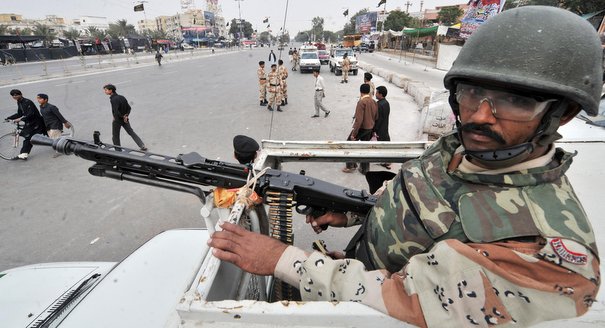
Over the past few years Pakistan has been trying to signal that its foreign policy has changed, yet Pakistan’s strategic objectives in Afghanistan remain largely the same.
Source: Tony Blair Faith Foundation
While Pakistan is signalling a change in its policy on Afghanistan, its strategic objective of undermining Indian influence remains. This entails strengthening its central control over the Taliban, but also reaching out beyond its traditional allies.
Over the past few years, Pakistan has been trying to signal that its foreign policy has changed and that interference in the political affairs of Afghanistan was a thing of the past. As evidence of this new brand of responsible behavior, Islamabad has reached out to its enemies in the former Northern Alliance (now largely working with the government or in the non-violent opposition), promoted a reconciliation process between the Taliban and the Afghan government, and called for regional discussion of a policy of non-interference in Afghanistan. Pakistan has moreover cooperated in the Afghan elections, allowing Afghan refugees to cross the border to vote and restraining its Afghan proxies from disrupting the poll.Yet Pakistan's strategic objectives in Afghanistan remain largely unchanged, and there are few reasons to believe that the shift is anything more than a tactical adjustment to meet new regional and international realities. Islamabad's overarching goal is still to promote a relatively friendly government in Afghanistan, while preventing Indian influence from becoming too great. Islamabad is likewise attempting to re-enter the good graces of the United States by assisting in the American withdrawal from Afghanistan, though simultaneously exploiting the situation to weaken the strategic partnership between Washington and New Delhi. Pakistan also wants Afghan refugees to be able to return to their country and so prevent their potential involvement in Pakistani politics.
But on-the-ground realities in Afghanistan have demanded new policies to achieve these unchanged objectives. Islamabad now acknowledges that the prospect of a Taliban military victory is neither realistic nor desirable in the short term, so it has moved away from using the Taliban as a primary or sole proxy in denying India influence in Afghanistan.
At the same time, Pakistan has strengthened its control over the Taliban by removing key commanders whenever they showed independence from Islamabad, and promoted a bilateral reconciliation process aimed at forging a power-sharing agreement between the Taliban and the government. This tactic has the additional benefit of helping to grow a perception of the Taliban as a legitimate interlocutor in the international community.
Pakistan's reaching out to the former Northern Alliance – an expansion from its traditional Pashtun focus – is primarily a response to India's successful use of development programmes to enhance its influence with every Afghan ethnic group since 2002. Pakistan, systematically blamed in Afghanistan for whatever goes wrong in the country, cannot expect to generate the same level of sympathy. However, by brokering a power sharing agreement in which its proxies would dominate the provinces adjacent to the Afghan-Pakistani border and forego interference in areas controlled by the members of the Northern Alliance, Islamabad is trying to fragment the anti-Taliban camp.
The biggest difference between these new policies and Pakistan's previous approach is the integration of the covert anti-India operation that Pakistan has been conducting in Afghanistan into a much larger and subtler picture. Officials in Islamabad understand that the US withdrawal from Afghanistan will make the US dependent on Pakistan. While President Barack Obama's recent decision to withdraw all troops by the end of 2016 surprised Islamabad, Washington's concern about a potential power vacuum in Afghanistan may lead the US to draw Pakistan closer as a regional partner.
By contrast, India's position remains unchanged and is unlikely to be affected in the short term, including by the result of the recent Afghan elections. It has managed to isolate Pakistan regionally (a situation Islamabad is trying to reverse through the proposal of a non-interference agreement) and will continue to support the Afghan government, but is adamantly opposed to Taliban participation in government, whether in Kabul or in the provinces. However, with the US departure from Afghanistan there will be no international force capable of restraining Pakistani activism in the country. Moreover, as India's legitimacy in Afghanistan depends upon being perceived as a reasonable partner it is compelled to tolerate US–Pakistani cooperation.
However, New Delhi's policy in Afghanistan is validated by the evolution of the Afghan and regional situation it helped to shape. The challenge for the new Indian government will be adjusting to the shifting regional reality.
This piece was originally published by the Tony Blair Faith Foundation.

Former Nonresident Senior Fellow, South Asia Program
Frédéric Grare was a nonresident senior fellow at the Carnegie Endowment for International Peace, where his research focuses on Indo-Pacific dynamics, the search for a security architecture, and South Asia Security issues.
Recent Work
Frederic Grare
Frederic Grare
Carnegie does not take institutional positions on public policy issues; the views represented herein are those of the author(s) and do not necessarily reflect the views of Carnegie, its staff, or its trustees.

European states control several Overseas Countries and Territories around the world that carry strategic, economic, and environmental weight. As great powers challenge the rules-based order, defending them is a geopolitical imperative for Europe.

Marc Pierini
By focusing only on hard security, the Shield ignores the conditions that fuel cartel power.


Alejandro Martin Rodriguez, Kayly Ober

In any defense establishment, change is an ongoing process. However, despite the best of intentions, existing bureaucracies, bound by habit and years of socialization, have their limits in implementing transformative change.

Anit Mukherjee

The conflict has sent economic and political shock waves through a country with no representation at the negotiating table—and Kenya is not alone.

Georgia Schaefer-Brown, Jane Munga
Japan’s revision of its three strategic documents reflects an intention to keep the United States engaged in the region while Japan fills any vacuums of U.S. power to preserve the Indo-Pacific order.

Ryo Sahashi