

Commentary
Dmitri Trenin
{
  "authors": [
    "Dmitri Trenin"
  ],
  "type": "legacyinthemedia",
  "centerAffiliationAll": "",
  "centers": [
    "Carnegie Endowment for International Peace",
    "Carnegie Russia Eurasia Center",
    "Carnegie China"
  ],
  "collections": [],
  "englishNewsletterAll": "",
  "nonEnglishNewsletterAll": "",
  "primaryCenter": "Carnegie Endowment for International Peace",
  "programAffiliation": "",
  "programs": [],
  "projects": [],
  "regions": [
    "North America",
    "United States",
    "East Asia",
    "China",
    "Russia",
    "Eastern Europe",
    "Ukraine",
    "Western Europe",
    "Caucasus"
  ],
  "topics": [
    "Economy",
    "Climate Change",
    "Foreign Policy"
  ]
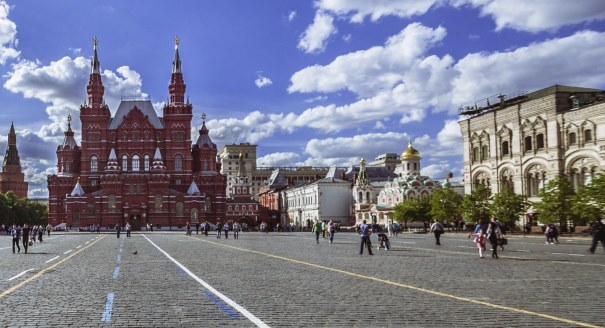
}
Source: Getty
Russia could use the U.S.-led sanctions to begin its long-delayed re-industrialization and to start building a modern economy.
Source: Global Times
An IMF report on July 1 spoke about the substantial effects that US-orchestrated sanctions can have on Russia's economy, even driving it toward recession. At the same time, many observers, not all of them Russian, claim that the effects of the sanctions on Russia have been slight, even negligible. So far, the sanctions have been more of a warning shot. The next few months will demonstrate whether Washington will be able to mobilize much-needed support from its European and Asian allies, or whether Moscow will succeed in exploiting divisions among Western countries.
Russia's economy had been slowing down well before the Ukraine crisis. The model which assured Russia's elevated growth rates in the 2000s and its ever-rising oil prices was destroyed in the global crisis of 2008-09. Oil prices have recovered after its spectacular fall, and remained remarkably stable, keeping Russia's budget in more or less decent shape, but this is not nearly enough to assure growth. The situation is serious: President Vladimir Putin's 2012 package of social expenditure and his military modernization program were based on a projection of 5 percent growth.
The Ukraine crisis immediately led to a worsening of capital flight from Russia, a collapse of the stock market, and a weakening of the ruble. Western sanctions sent a powerful message to foreign investors: stay away from Russia. Personal sanctions against some of Putin's closest friends and associates impacted prominent businessmen, such as Gennady Timchenko, an oil trader, and Igor Sechin, head of the state-owned Rosneft company. There were fears in spring that symbolic and targeted measures would be followed up by sector-by-sector sanctions, aimed at crippling entire and specific parts of the Russian economy, such as energy and banking.Yet, this has not happened so far. For one, the Kremlin, in its Ukraine policy, has been careful to fly beneath the radar screen. It certainly gave support to the eastern Ukrainian resistance against the Kiev government and its Western sponsors, yet it abstained from overt interference, in particular military invasion. Putin also engaged diplomatically with European leaders, as during his visit to France in June. Moscow could not hope to change views in Washington. What Putin could and did do, however, was to provide just enough arguments to those in Europe who were interested in continuing business relations.
The German business community, with over 6,000 companies active in Russia, made it clear to Chancellor Angela Merkel that it considered the Russian connection a vital one. France decided to go ahead with the delivery of two warships commissioned by the Russian Navy, one appropriately named Sevastopol after the Black Sea Fleet's main base in Crimea. During a visit to Austria in late June, Putin concluded deals related to the South Stream, a gas pipeline to Southern Europe. Throughout the crisis, Britain made it absolutely clear that it had no intention to move against Russian interests in London. And Italy, despite the change of governments, clearly opposed any sanctions against Russia. In a nutshell, most Europeans wanted to contain the Ukraine crisis, rather than Russia itself.
The threat of sanctions, however, was not wholly dismissed by Moscow. Faced with a brief interruption in the service of banking cards of some of its financial institutions, the Russians revived their plans to develop a national payment system on the model of China's and Japan's. This should be ready within 18 months or so. The State Duma has just passed legislation requiring the storage by Internet companies of personal data on Russian citizens in Russian territory. The Russian defense industry, conscious of the coming more stringent export controls on high-technology products, is seeking to better use domestic resources. Most spectacularly, Gazprom sealed a 30-year-long, $400 billion contract in May with China's CNPC to provide its neighbor with Siberian natural gas.
It is not clear how the sanctions saga will develop. The US has never imposed sanctions against an economy as big as Russia's - the world's fifth in terms of purchasing power parity. US own trade with Russia is relatively small, and it critically depends on the cooperation of its allies, many of which have productive relations with Russia, which they are reluctant to break off. Europe still heavily depends on Russia's energy exports. Some US energy giants, like ExxonMobil, remain committed to continuing cooperation with Russia. China, the world's second largest economy, does not take guidance from Washington, making Russia's complete economic isolation technically impossible.
US-led sanctions can also jolt the Russian economy out of its complacent reliance on oil and gas. Russia could use the new regime to begin its long-delayed re-industrialization. As they say in Russia, misfortune can give something which fortune has failed to give - a powerful impetus - in this case, to wean off the image of being "Saudi Arabia with snow" and start building a modern economy. If this really happens, the Russians should be thankful to the Obama administration.
Former Director, Carnegie Moscow Center
Trenin was director of the Carnegie Moscow Center from 2008 to early 2022.
Recent Work
Dmitri Trenin
Dmitri Trenin
Carnegie does not take institutional positions on public policy issues; the views represented herein are those of the author(s) and do not necessarily reflect the views of Carnegie, its staff, or its trustees.

Ahead of a tough winter for Ukraine, Donald Trump’s swing back toward Russia bodes ill. But instead of panicking, Kyiv’s European allies are focusing on action.

Rym Momtaz

Without a ceasefire with Ukraine on attacking each other’s energy infrastructure—to which the Kremlin is unlikely to agree—the diesel agreement between Putin and Trump is largely for show, rather than representing a genuine increase in the volumes of Russian diesel on the global market.

Sergey Vakulenko

Despite its flop at the box office, the film raises important questions for the climate community to answer.

Leonardo Martinez-Diaz

Funding Ukraine remains a priority for European leaders. As Russia’s war of aggression heads into another winter, two feasible options to mobilize support for Kyiv should be fast-tracked.


Vladyslav Rashkovan, Gregory P. Wilson

Russian strikes are weakening the economy sustaining Ukraine’s war effort. Closing the growing funding gap will require more European support and politically contentious reforms in Kyiv.

Balázs Jarábik