

Commentary
The acknowledgment has sparked fears of a new arms race with China and Russia.
Chris O’Meara
{
  "authors": [
    "Lina Khatib",
    "Aymenn Jawad Al-Tamimi",
    "Lawrence Korb"
  ],
  "type": "legacyinthemedia",
  "centerAffiliationAll": "dc",
  "centers": [
    "Carnegie Endowment for International Peace",
    "Malcolm H. Kerr Carnegie Middle East Center"
  ],
  "collections": [],
  "englishNewsletterAll": "menaTransitions",
  "nonEnglishNewsletterAll": "",
  "primaryCenter": "Malcolm H. Kerr Carnegie Middle East Center",
  "programAffiliation": "MEP",
  "programs": [
    "Middle East"
  ],
  "projects": [],
  "regions": [
    "Gulf",
    "Levant",
    "Syria",
    "Middle East"
  ],
  "topics": [
    "Political Reform",
    "Security",
    "Foreign Policy"
  ]
}
Source: Getty
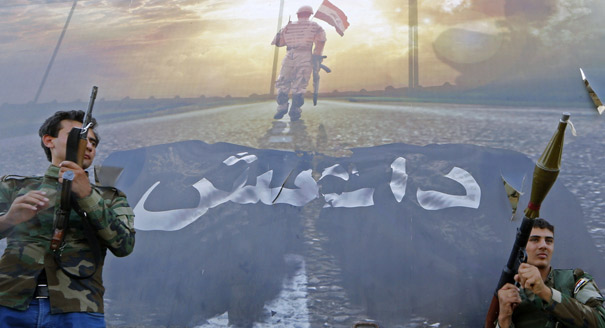
The U.S.-led air strikes threaten to alienate more moderate groups in Syria.
Source: Al Jazeera Inside Story
In the early days of Syria’s civil war, opposition activists and fighters pleaded with the United States to strike the Syrian government. It has now been a week since a U.S..-led coalition began bombing Syria. But they are targeting the Islamic State, not Bashar al-Assad’s forces.
Many opposition groups now fear U.S. President Barack Obama is no longer committed to seeing President Bashar al-Assad leave power. And increasingly, armed groups in Syria view the air strikes as against their interests, with some Syrian rebels even vowing to fight Western nations. Will the continuing campaign against ISIL alienate fighters who were previously seeking U.S. backing?
This interview was originally broadcasted on Al Jazeera Inside Story.
Former Director, Middle East Center
Khatib was director of the Carnegie Middle East Center in Beirut. Previously, she was the co-founding head of the Program on Arab Reform and Democracy at Stanford University’s Center on Democracy, Development, and the Rule of Law.
Aymenn Jawad Al-Tamimi
Lawrence Korb
Carnegie does not take institutional positions on public policy issues; the views represented herein are those of the author(s) and do not necessarily reflect the views of Carnegie, its staff, or its trustees.
The acknowledgment has sparked fears of a new arms race with China and Russia.

Chris O’Meara
Smaller powers cannot go it alone, but Canadian history shows that integration with the United States will not always be benign.
Paul Samson

The European Commissioner for Trade is headed to China. But after President Xi’s bridge-building visit to Washington, can a more isolated EU overcome Beijing’s stranglehold on critical raw materials? Who will blink first?

Rym Momtaz, ed.
The summit may be remembered as a fatal blunder, when Washington, Beijing, and the AI industry collectively chose ceremony over action.
Jeffrey Prescott

European NATO countries are wrestling with the possibility of U.S. disengagement from the alliance. With the continent’s security increasingly uncertain, governments must restore the credibility of their collective defense.



Hans-Dieter Lucas, Adam Thomson, Pierre Vimont