

Article
C. Raja Mohan, Darshana M. Baruah
{
  "authors": [
    "C. Raja Mohan"
  ],
  "type": "legacyinthemedia",
  "centerAffiliationAll": "dc",
  "centers": [
    "Carnegie Endowment for International Peace",
    "Carnegie India"
  ],
  "collections": [],
  "englishNewsletterAll": "ctw",
  "nonEnglishNewsletterAll": "",
  "primaryCenter": "Carnegie India",
  "programAffiliation": "SAP",
  "programs": [
    "South Asia"
  ],
  "projects": [],
  "regions": [
    "South Asia",
    "India"
  ],
  "topics": [
    "Foreign Policy"
  ]
}
Source: Getty
The persistent use of new phrases by leaders of major powers shapes international discourse.
Source: Indian Express
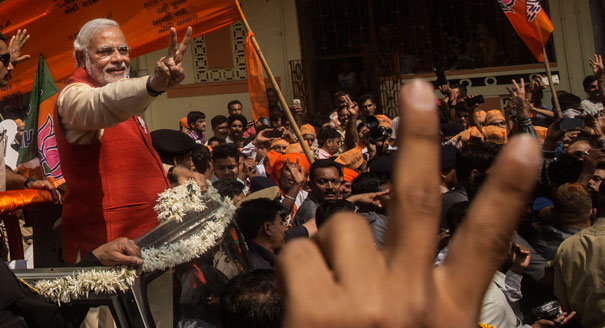
Prime Minister Narendra Modi’s fluent Hindi, through which he engages foreign interlocutors and the rhetorical instinct for catchy phrases, is helping expand India’s diplomatic lexicon. In Kathmandu last month, his play on “Buddha” and “yuddha” captured the essence of the contemporary political dynamic in Nepal. In Tokyo this week, Modi framed an interesting antinomy in Asia: the tension between what he called “vistar vaad” or “expansionism” and “vikas vaad” or peaceful development.
We will get in a minute to the political significance of Modi’s indirect criticism of China’s assertive approach to territorial disputes. Staying with Modi’s vocabulary, the persistent use of new phrases by leaders of major powers shapes international discourse. For example, Chinese leaders over the decades have popularised such terms as “three worlds”, “social imperialism”, “peaceful rise”, “maritime rights” and “active defence”. More recently, Chinese President Xi Jinping has popularised the phrase “a new type of major power relationship”, which even the American strategic community has adopted.
In India, the debate has unfortunately been framed in terms of English versus Hindi. If the PM feels comfortable in Hindi, is confident to speak extempore and is making a big impact, then so be it. The fact, however, is not everyone in India or the world understands Hindi. The PMO and the foreign office, then, must quickly deliver translations of his speeches into English and other Indian languages and ensure their widespread distribution.Some in the East say the rising Asian powers must develop their own concepts for international relations and discard the ones borrowed from the West. That too is a false proposition. Over the last three decades, Chinese scholars have mastered the Western discourse on international relations. Chinese universities and think-tanks today are littered with political science PhDs from the US.
As it engages the Western world on its own terms, Chinese scholarship has also invested a lot of energy in reviving classical Chinese studies on statecraft and diplomacy. There is excitement in Beijing and Shanghai about building a “Chinese school” of international relations. Some of them have sought to inject old Chinese concepts like “Tian Xia” — all under heaven — with contemporary relevance. In New Delhi, Modi and his predecessor, Manmohan Singh, have often recalled the idea of “vasudhaiva kutumbakam” — the entire world is a family — to underline India’s enduring commitment to universalism.
The Institute for Defence Studies and Analyses in Delhi had initiated a focused effort a couple of years ago to renew the study of Kautilya’s writings and assess their relevance to India’s contemporary foreign policy and national security. Much more, though, remains to be done. Kautilya’s strategic realism is indeed as hard-nosed as any from the West. “The strong do what they can, and the weak endure what they must” is an old Greek proposition. India’s classics have similarly talked about “matsya nyaya” — that big fish eat the small. It is not, therefore, a question of East versus West. India must internalise the dominant Western discourse as well as reclaim strategic thought from the ancient, medieval and pre-Independence periods of our history.
Modi’s use of the term “vistar vaad” in Tokyo has got much attention. This indirect criticism of China is unlikely to limit Modi’s warm welcome to Xi, who arrives in India later this month. Nor should it dampen Beijing’s enthusiasm for building a strong partnership with the NDA government.
Before he headed out to Tokyo, Modi was asked about China’s expansionism by a group of Japanese journalists. Modi said in response that China is at the top of India’s foreign policy priorities. “It is my government’s resolve to utilise the full potential of our strategic and cooperative partnership with China.” Modi also hinted that he is eager to settle the boundary dispute with China. “I am keen to work closely with the Chinese leadership to push the relationship forward and deal with all issues in our bilateral relations by proceeding from the strategic perspective of our developmental goals.”
The prime minister is signalling to Xi that the logic of mutually beneficial development provides a sound basis for the resolution of the boundary dispute that continues to hobble bilateral relations. Modi added that “India, Japan and China have many common interests and we need to build on them to convert ours into an Asian century by working together”. Modi’s message, then, is straightforward: only “vikas vaad” will make the Asian century a peaceful and prosperous one.
This article was originally published in the Indian Express.
Former Nonresident Senior Fellow, Carnegie India
A leading analyst of India’s foreign policy, Mohan is also an expert on South Asian security, great-power relations in Asia, and arms control.
Recent Work

C. Raja Mohan, Darshana M. Baruah


Alexander Gabuev, Paul Haenle, C. Raja Mohan, …
Carnegie does not take institutional positions on public policy issues; the views represented herein are those of the author(s) and do not necessarily reflect the views of Carnegie, its staff, or its trustees.

The EU can impose sanctions but struggles to enforce them without the United States. With Washington increasingly disinterested in backing European interests, the bloc must now fend for itself.


Nicu Popescu, Tiago Antunes
Global and rising powers will need to engage with Africa’s priorities and agency in order to secure the continent’s increasingly attractive partnerships.
Fonteh Akum

Rubio’s recent visit brought welcome attention, but more capital requires governance changes that may be a hard sell for regional governments.

Jennifer B. Murtazashvili

America’s foreign-policy objectives have grown more demanding while Americans have demanded greater focus on their own affairs.

Stephen Wertheim

Japan’s long-term security policy is driven by concerns about China, and there is little appetite for (or interest in) pursuing a confrontation with Moscow.

James D.J. Brown