

Commentary
Dmitri Trenin
{
  "authors": [
    "Dmitri Trenin"
  ],
  "type": "legacyinthemedia",
  "centerAffiliationAll": "",
  "centers": [
    "Carnegie Endowment for International Peace",
    "Carnegie Russia Eurasia Center"
  ],
  "collections": [],
  "englishNewsletterAll": "",
  "nonEnglishNewsletterAll": "",
  "primaryCenter": "Carnegie Russia Eurasia Center",
  "programAffiliation": "",
  "programs": [],
  "projects": [
    "Eurasia in Transition"
  ],
  "regions": [
    "East Asia",
    "China",
    "Central Asia",
    "Russia"
  ],
  "topics": [
    "Economy",
    "Trade",
    "Climate Change",
    "Security",
    "Military",
    "Foreign Policy"
  ]
}
Source: Getty
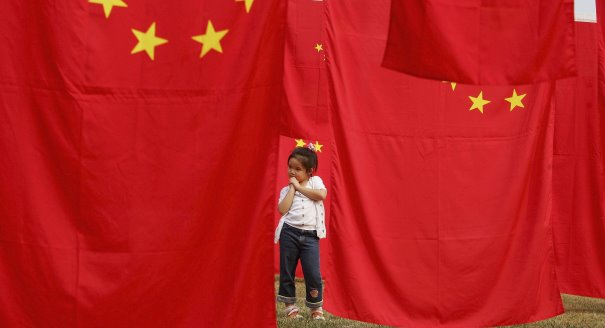
A Greater Asia, stretching from Shanghai to St. Petersburg, could transform the entire continent of Eurasia and have a significant impact on the global balance of power.
Source: Global Times
A year ago, Russia's foreign policy universe changed dramatically. After the overthrow in February 2014 of then Ukraine president Viktor Yanukovych and the arrival of nationalist and pro-Western forces in power in Kiev, the Ukrainian crisis led to Russia's confrontation with the US and its estrangement from Europe. By contrast, Moscow's relations with Beijing have grown visibly closer since then, going way beyond the "marriage of convenience" model that some scholars once devised to describe them. If the current situation persists, the Sino-Russian entente may become a more salient feature of international relations.
China and Russia, of course, will not establish a military alliance. There is no need for that now in the form of a common military threat, and a peacetime alliance between Moscow and Beijing on a NATO model would be unworkable in the absence of a clear hegemon commanding unquestionable loyalty and committed to protecting its junior partner. At this point, neither government is considering an alliance-type relationship, and only small minorities in each country's elites are even willing to discuss it. The broader publics are totally unmoved by such a prospect.The two countries, however, are cooperating more closely than before. In May, Chinese President Xi Jinping will review the military parade in Red Square to mark the 70th anniversary of victory over Nazi Germany. In September, Russian President Vladimir Putin will return the compliment by visiting Beijing to celebrate the anniversary of the end of the WWII, to which the former Soviet Union substantially contributed.
10 years after the Russian forces and the PLA began exercising together, this year they are taking the show of Sino-Russian defense cooperation to a new theater: the Mediterranean. This step can presage more intimate coordination of Russia's and China's policies in the Middle East. There are also some indications that Moscow may agree to transfer more sophisticated military technology to Beijing.
There has been a lot of skepticism, not only in the West, but in China and Russia as well, about the recent gas deals between Gazprom and CNPC. Some key details are still unknown to the wider public, and all sorts of doubts about the future persist. However, with Russian gas reaching China for the first time in a few years, and Chinese companies finally getting access to Russian hydrocarbon resources, the energy relationship between the two countries is on the way to becoming an energy partnership. Russia will not dominate the Chinese natural gas market the way it has dominated Europe's, but the geoeconomic importance of opening the Chinese market to Russia can be compared to the arrival of Russian gas in Western Europe in the 1970s.
Similarly, there is much speculation about Sino-Russian competition in Central Asia. The inauguration of the Eurasian Economic Union this year has coincided with the announcement of the Chinese plans for the Silk Road economic belt area. Since the end of the Soviet Union, Moscow's influence in Central Asia has waned, while Beijing's has soared. Yet, it is more likely that the future will bring some kind of an economic interaction between the Russian efforts and the Chinese plans in Central Asia than some kind of geopolitical rivalry along the lines of what is happening in Ukraine. Russia itself may buy into China-proposed infrastructure projects, connecting East Asia to Europe across Eurasia.
The rupture in EU-Russian ties makes the failure of Putin's pet project of a Greater Europe from Lisbon to Vladivostok very probable. The alternative is clear to see: a Greater Asia, from Shanghai to St. Petersburg. This may not be what many Russians have expected, or would prefer. Yet, this may be the reality that will transform the entire continent of Eurasia, elevate China still more, and give Russia a very different role from the one it traditionally imagined. If that happens, and a continental Asia will emerge as a loose unit, with the Shanghai Cooperation Organization as its political, economic and security forum, this will also impact the global balance of power. The process of change has already started.
Former Director, Carnegie Moscow Center
Trenin was director of the Carnegie Moscow Center from 2008 to early 2022.
Recent Work
Dmitri Trenin
Dmitri Trenin
Carnegie does not take institutional positions on public policy issues; the views represented herein are those of the author(s) and do not necessarily reflect the views of Carnegie, its staff, or its trustees.
Only collective security can protect fragile economic models.

Andrew Leber
In a volatile Middle East, the Omani port of Duqm offers stability, neutrality, and opportunity. Could this hidden port become the ultimate safe harbor for global trade?
Giorgio Cafiero, Samuel Ramani
Europe’s reaction to the war in Iran has been disunited and meek, a far cry from its previously leading role in diplomacy with Tehran. To avoid being condemned to the sidelines while escalation continues, Brussels needs to stand up for international law.

Pierre Vimont

South Korea’s rapid demographic transition previews governance challenges many advanced and middle-income economies will face. This paper argues that aging is not only a care issue but a structural governance challenge—reshaping welfare, productivity, and fiscal sustainability, and reorganizing responsibilities across the state, private sector, and society.

Darcie Draudt-Véjares
In 2021, the U.S. government began to consider how to address climate migration. The outcomes of that process offer useful takeaways for other governments.

Jennifer DeCesaro